LLMOps Blueprint: Taking GenAI from Demo to Production
Learn how to design LLMOps architectures that scale GenAI from demos to secure, cost-efficient production systems for chatbots, copilots, and AI agents.
Learn how to design LLMOps architectures that scale GenAI from demos to secure, cost-efficient production systems for chatbots, copilots, and AI agents.
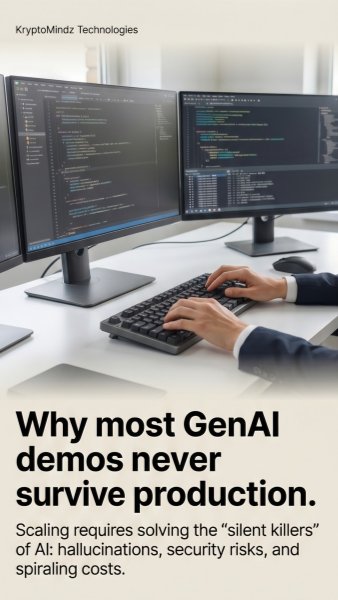
Many GenAI demos look impressive because they run in controlled environments with clean prompts, narrow datasets, and low user volume. Production LLM applications are different: users ask messy questions, business data changes daily, and accuracy has to hold up under real operational pressure. This is where the RAG vs. fine-tuning decision becomes a foundational LLMOps architecture choice, not a model preference. Retrieval-augmented generation is often better for dynamic knowledge, such as support policies, product catalogs, or compliance documents, while fine-tuning can help when you need consistent behavior, tone, or domain-specific reasoning patterns. Choosing the right approach early helps teams reduce hallucinations, control costs, and build AI systems that can adapt without constant rework.

As GenAI systems scale, small weaknesses become expensive and visible. A chatbot that occasionally invents an answer in testing can create customer trust issues when thousands of users rely on it for billing, healthcare, legal, or technical support. Security risks also grow when prompts, retrieved documents, and tool calls expose sensitive data or allow prompt injection attacks. At the same time, token usage can spiral if every request sends long conversation histories, oversized context windows, or unnecessary model calls. Effective LLMOps planning means measuring hallucination rates, enforcing access controls, and tracking token spend before these risks become production incidents.

Layered LLM rails give teams a practical way to make GenAI applications safer, more predictable, and easier to troubleshoot. Instead of trusting one prompt to handle everything, each stage has a specific job: validate user input, shape the prompt, retrieve relevant context, control tool access, and moderate the final response. For example, an enterprise assistant might block a malicious prompt, retrieve only documents the user is authorized to see, call a CRM tool safely, and then check the answer for policy violations before responding. This modular design helps prevent one failure from spreading across the entire AI stack. It also gives engineering, security, and compliance teams clearer control points for auditing and improving production LLM systems.

Token economics determine whether a GenAI product delivers sustainable ROI or becomes too costly to operate. Caching can reduce repeated model calls for common questions, such as shipping policies, onboarding steps, or standard troubleshooting flows. Batching helps process similar tasks more efficiently, while intelligent routing sends simple requests to smaller, cheaper models and reserves premium models for complex reasoning. Teams can also reduce cost by trimming unnecessary context, summarizing long histories, and monitoring which prompts consume the most tokens. When caching, batching, and routing work together, organizations can improve response speed, lower infrastructure costs, and scale AI features with more predictable margins.
Follow the hub for production AI infrastructure, deployment, observability, cost and reliability resources.
Related Service AI Agents & LLMOps DeliveryMove copilots and agents from demos to governed production workflows with monitoring and cost controls.
Implementation Use Case Secure AI Knowledge Operations AgentSee how AI agents can answer, route and govern operational knowledge for teams with traceable controls.
Recommended Course EU AI Act Strategy & LeadershipBuild leadership fluency in AI governance, risk, operating models and practical readiness planning.
YouTube Playlist Production LLMOps ArchitectureWatch the playlist on cutting GenAI costs, latency, failures and production reliability risks.
Book a Discovery Call Map This to Your RoadmapDiscuss how this topic applies to your product, compliance posture, architecture or delivery plan.
Editorial trust
Each KryptoMindz article is reviewed against current enterprise AI, blockchain, digital identity and compliance practices before publication or major updates.
Founder-led perspective from KryptoMindz Technologies, focused on secure AI adoption, Web3 risk, digital identity and enterprise trust architecture.
LinkedIn profileResearch, engineering and advisory work across AI Agents, Enterprise Blockchain, Digital Identity and Digital Trust Engineering.
YouTube channelDiscover more insights and resources on our platform.
Visit Kryptomindz