Bhutan’s Digital Identity Revolution
Digital identity is shifting from siloed government databases to more open, interoperable systems. In this video, we’ll explore why traditional models struggle

Digital identity is shifting from siloed government databases to more open, interoperable systems. In this video, we’ll explore why traditional models struggle
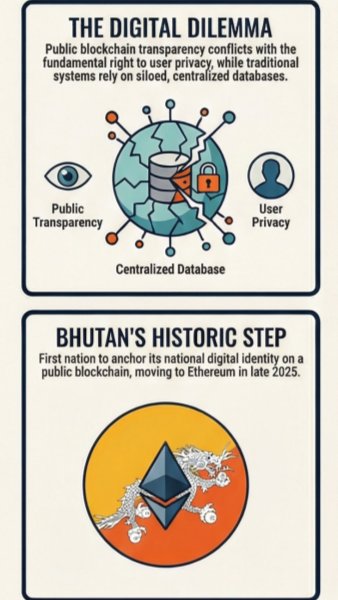
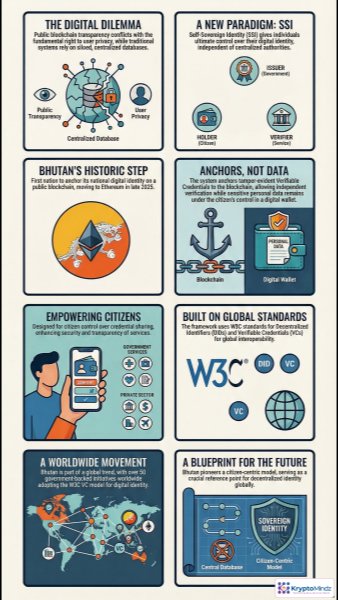
Digital identity is moving beyond isolated government databases toward open, interoperable systems that can work across borders, agencies, and digital services. Instead of creating a separate login or record for every interaction, people could use trusted digital credentials to prove who they are when applying for benefits, opening a bank account, or accessing healthcare. This shift matters because traditional identity systems often collect too much personal data and make it difficult for citizens to control how that data is used. Self-sovereign identity offers a new model where individuals hold and share verified information on their own terms. Bhutan’s national digital identity strategy is emerging as a practical example of how governments can modernize identity infrastructure while improving privacy, trust, and usability.
The digital dilemma is simple but difficult to solve: societies need trusted data flows, while individuals need strong privacy and protection from misuse. Public blockchains can create transparency, but if used incorrectly, they may reveal more information than citizens should ever have to expose. Centralized databases solve some coordination problems, yet they also concentrate power and create attractive targets for hackers, surveillance, or administrative abuse. For example, a single breached identity database can affect millions of people at once, while an overly transparent system can make sensitive life events permanently visible. This tension is why governments are exploring privacy-preserving digital identity architectures that combine openness, user rights, and cybersecurity.
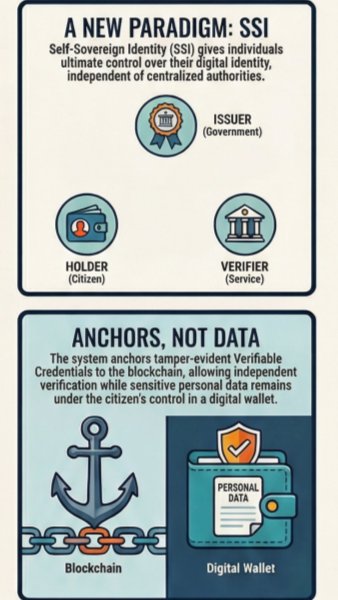
Self-sovereign identity, often called SSI, gives individuals direct control over their digital credentials instead of leaving every organization to store separate copies of their personal data. A government, university, bank, or employer can issue a verified credential, and the citizen can keep it in a secure digital wallet. When proof is needed, such as confirming age, residency, qualifications, or eligibility, the person can share only the required information rather than handing over an entire document. Cryptographic verification allows the service provider to confirm that the credential is genuine without contacting a central database every time. This model reduces unnecessary data collection, improves digital privacy, and makes online identity verification faster and more secure.
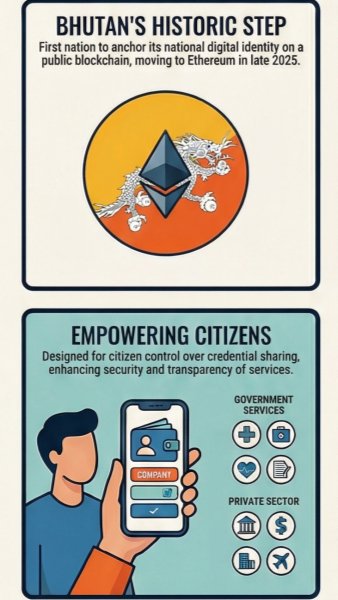
Bhutan’s move to anchor its national digital identity on a public blockchain shows how a government can use open infrastructure without putting citizens’ private information on-chain. The planned Ethereum deployment in late 2025 is designed to record proofs and identifiers, not names, addresses, health data, or other sensitive personal details. This approach takes advantage of blockchain’s transparency, resilience, and global verifiability while keeping personal data protected through local governance and wallet-based control. In practice, it could make identity checks more reliable for public services, financial inclusion, travel, education, and cross-border verification. Bhutan’s strategy is important because it demonstrates that public blockchain and privacy-preserving identity can work together when the system is designed carefully.
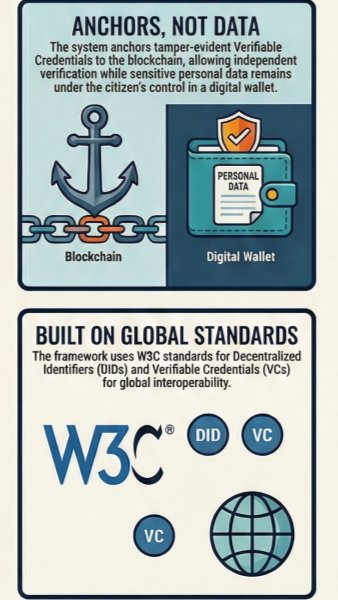
The key design principle is that the blockchain stores anchors, not personal data. These anchors act like cryptographic fingerprints, allowing a verifier to confirm that a credential is valid and unchanged without seeing the full contents of that credential. For example, a citizen could prove they hold a valid driver’s license or education certificate while the actual document remains encrypted in their digital wallet. This reduces the risk of mass surveillance, identity theft, and large centralized data honeypots. By separating verification from data storage, verifiable credentials can deliver trust without requiring citizens to surrender control over their most sensitive information.
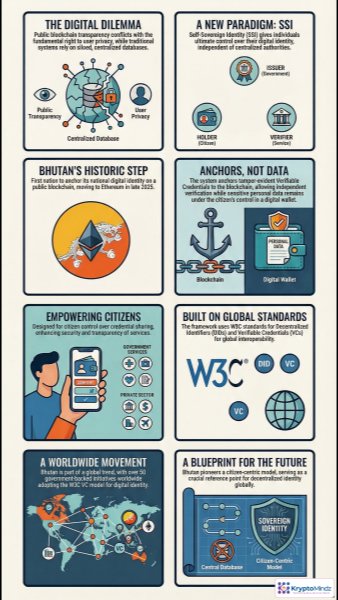
Digital identity is entering a new phase where citizens can use standards-based credentials instead of relying only on opaque, centralized records. Bhutan’s approach brings together self-sovereign identity, verifiable credentials, public blockchain anchoring, and privacy-focused governance into one practical national model. The result is a framework where people can prove important facts about themselves while limiting unnecessary exposure of personal data. For policymakers, this creates a path toward more trusted digital public infrastructure; for technologists, it highlights the importance of secure wallet design and interoperability; for citizens, it points to more control over everyday digital interactions. As more countries modernize identity systems, the challenge will be building solutions that are inclusive, secure, transparent, and respectful of individual rights.
Follow the hub for EUDI wallets, verifiable credentials, digital signatures and trust architecture.
Related Service Digital Identity & eIDAS StrategyDesign trusted identity, wallet and credential systems with compliance and interoperability in mind.
Implementation Use Case Government Citizen ServicesExplore how trusted digital services can streamline identity-driven workflows and citizen support.
Recommended Course The Future of Digital IdentityLearn how wallets, verifiable credentials and digital trust frameworks change onboarding and compliance.
YouTube Playlist eIDAS 2.0 EUDI Wallet KYC BootcampWatch the learning path for EUDI wallet onboarding, KYC architecture and trusted digital identity.
Book a Discovery Call Map This to Your RoadmapDiscuss how this topic applies to your product, compliance posture, architecture or delivery plan.
Editorial trust
Each KryptoMindz article is reviewed against current enterprise AI, blockchain, digital identity and compliance practices before publication or major updates.
Founder-led perspective from KryptoMindz Technologies, focused on secure AI adoption, Web3 risk, digital identity and enterprise trust architecture.
LinkedIn profileResearch, engineering and advisory work across AI Agents, Enterprise Blockchain, Digital Identity and Digital Trust Engineering.
YouTube channelDiscover more insights and resources on our platform.
Visit Kryptomindz