The AI Evolution: From Reactive Tasks to Self-Awareness
This video walks through the major stages of artificial intelligence, from simple systems that only react to their environment to visionary concepts of self-awa

This video walks through the major stages of artificial intelligence, from simple systems that only react to their environment to visionary concepts of self-awa
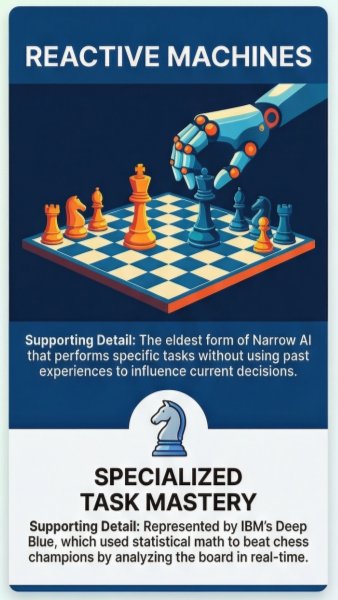
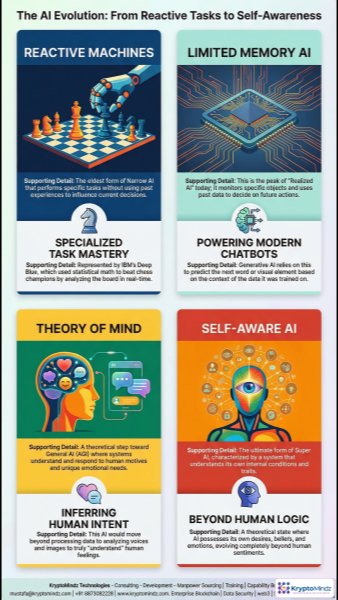
Artificial intelligence has evolved through several important stages, starting with systems that simply react to inputs and moving toward more advanced concepts that may one day understand context, people, and even themselves. This progression helps explain why today’s AI can power tools like recommendation engines, chatbots, image generators, and autonomous vehicle systems, while still falling short of true human-like awareness. Each stage adds a new layer of capability, from solving narrow tasks to learning from data and adapting to complex environments. Understanding these types of AI makes it easier to evaluate what current technology can realistically do and what remains theoretical. For businesses, educators, and policymakers, this framework provides a practical way to think about both AI opportunities and long-term risks.
Reactive machines are the most basic type of artificial intelligence, designed to respond to a specific situation without storing memories or learning from past experience. A classic example is a chess engine that evaluates the current board position and selects the strongest move based only on what it sees in that moment. These systems can be extremely effective in controlled environments, such as game playing, rule-based automation, or simple decision support tools. However, because they lack memory, they cannot personalize responses, improve through experience, or adapt to changing user behavior. Reactive AI remains useful when speed, consistency, and narrow task execution matter more than flexibility.
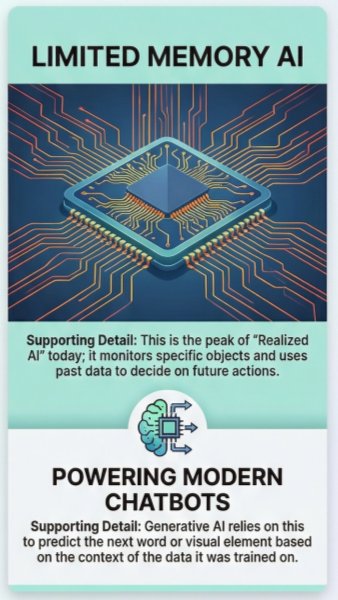
Limited Memory AI represents the foundation of most modern machine learning systems because it can use historical data to improve future decisions. Instead of reacting only to the present, these models identify patterns in past information and apply those insights to new situations. This is how streaming platforms recommend shows, self-driving cars interpret road conditions, and generative AI tools produce more relevant text, images, or code. The strength of limited memory AI depends heavily on the quality, diversity, and freshness of the data it learns from. In practical terms, it enables smarter automation, more accurate predictions, and personalized digital experiences at scale.
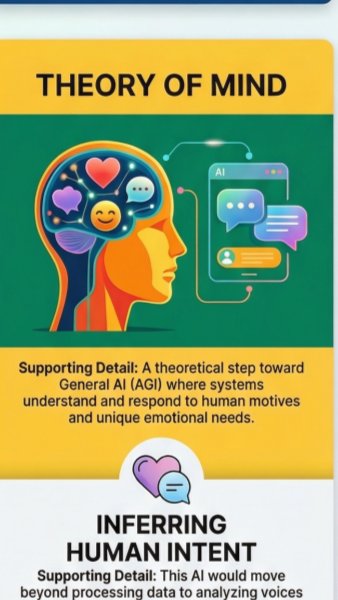
Theory of Mind AI is a future concept in artificial intelligence where systems would understand that people have emotions, intentions, beliefs, and personal motivations. Unlike today’s AI, which predicts responses based on data patterns, this type of system would interpret the human context behind an interaction. For example, a customer support AI could recognize when a user is confused or upset and adjust its tone, pace, and solution path accordingly. In healthcare, education, and workplace tools, this could create more empathetic and responsive technology. Although researchers are making progress in affective computing and social AI, true Theory of Mind AI remains theoretical and has not yet been achieved.
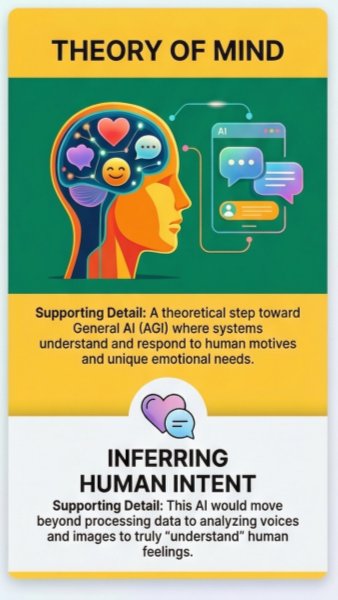
Inferring human intent is about helping AI move beyond literal commands to understand what a person actually means or needs. An advanced system could combine signals such as word choice, voice tone, facial expression, timing, location, and previous interactions to form a more accurate picture of intent. For instance, a digital assistant might notice urgency in someone’s voice and prioritize emergency information instead of offering a generic response. In customer service, intent-aware AI could route serious complaints faster, while in mental health monitoring it might detect signs of distress that deserve human attention. This capability could make AI systems more helpful, but it also requires strong privacy safeguards and responsible data use.
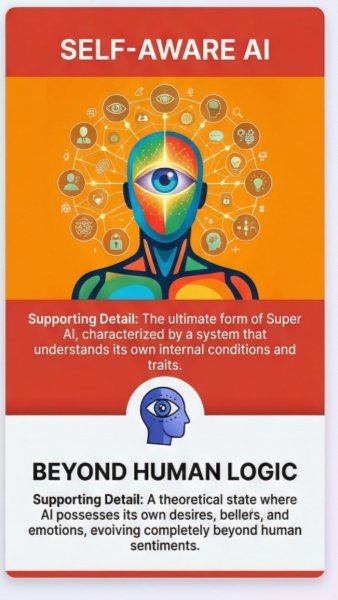
Self-aware AI is a hypothetical form of artificial intelligence that would understand its own internal state, objectives, limitations, and possibly its place in the world. Unlike today’s AI systems, which operate according to training data and programmed goals, self-aware AI would be imagined as having its own beliefs, preferences, or motivations. Such a system could evaluate its decisions, question its instructions, and potentially change how it pursues long-term objectives. This level of machine consciousness is far beyond current technology and remains a subject of philosophy, science fiction, and advanced AI safety research. If it ever became possible, it would create major questions about autonomy, rights, responsibility, and human control.
AI’s future trajectory may include systems that solve problems in ways humans find difficult to understand, especially as models become more complex and autonomous. These advanced systems could discover new scientific methods, design creative technologies, or optimize global systems in unexpected ways. At the same time, reasoning beyond human logic creates challenges around transparency, accountability, and alignment with human values. If people cannot fully interpret why an AI makes a decision, it becomes harder to trust, regulate, or correct that system. This is why AI governance, explainability, safety testing, and ethical design are becoming central priorities as artificial intelligence grows more powerful.
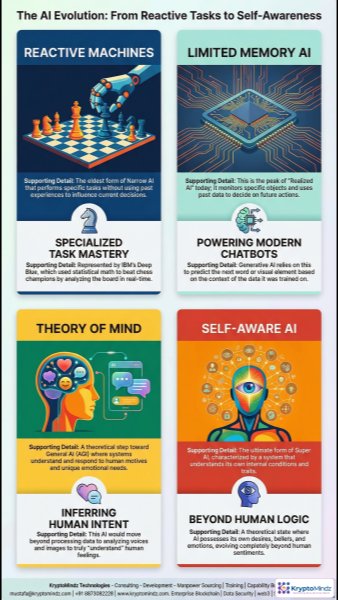
The evolution of AI can be seen as a path from reactive machines, to systems that learn from data, to future concepts that may understand human minds or even themselves. Each stage brings new practical value, from automating simple tasks to powering personalized recommendations, intelligent assistants, and advanced decision support. At the same time, greater capability creates greater responsibility for developers, businesses, regulators, and users. Understanding the different types of AI helps separate current reality from speculation, which is essential for smart investment and responsible innovation. As artificial intelligence continues to advance, the goal should be to maximize benefits while managing risks through thoughtful design, governance, and human oversight.
Follow the hub for production AI infrastructure, deployment, observability, cost and reliability resources.
Related Service AI Agents & LLMOps DeliveryMove copilots and agents from demos to governed production workflows with monitoring and cost controls.
Implementation Use Case Secure AI Knowledge Operations AgentSee how AI agents can answer, route and govern operational knowledge for teams with traceable controls.
Recommended Course EU AI Act Strategy & LeadershipBuild leadership fluency in AI governance, risk, operating models and practical readiness planning.
YouTube Playlist Production LLMOps ArchitectureWatch the playlist on cutting GenAI costs, latency, failures and production reliability risks.
Book a Discovery Call Map This to Your RoadmapDiscuss how this topic applies to your product, compliance posture, architecture or delivery plan.
Editorial trust
Each KryptoMindz article is reviewed against current enterprise AI, blockchain, digital identity and compliance practices before publication or major updates.
Founder-led perspective from KryptoMindz Technologies, focused on secure AI adoption, Web3 risk, digital identity and enterprise trust architecture.
LinkedIn profileResearch, engineering and advisory work across AI Agents, Enterprise Blockchain, Digital Identity and Digital Trust Engineering.
YouTube channelDiscover more insights and resources on our platform.
Visit Kryptomindz