Uncontrolled AI Portfolio
Teams use models, copilots and agents without a complete inventory, ownership model or common review path.
Accountable Enterprise AI
Turn AI principles, risk expectations and regulatory pressure into an operating model with named owners, proportionate controls, human oversight and evidence that survives scrutiny.
KryptoMindz connects AI inventory, classification, policy, lifecycle gates, security, monitoring and accountability so governance supports delivery instead of becoming a document-only exercise.
Many organizations have responsible AI principles but cannot answer operational questions: which models and agents are in use, who accepted each risk, which changes require review, where human intervention is mandatory and what evidence proves that controls operated.
An effective governance model connects business ownership, product delivery, security, privacy, legal, compliance and operations. It applies stronger review to consequential systems without forcing every low-impact experiment through the same process.
Governance work is valuable when AI adoption is moving faster than accountability, evidence or lifecycle controls.
Teams use models, copilots and agents without a complete inventory, ownership model or common review path.
AI can call tools or act on records, increasing the need for identity, approval, monitoring and escalation controls.
EU AI Act, sector expectations or customer assurance require traceable classification, decisions and evidence.
Employees use public AI tools without consistent data-handling, vendor or acceptable-use controls.
Security, legal, data and product teams review AI independently without clear decision rights.
Leadership needs evidence that policies are implemented in workflows, not merely published.
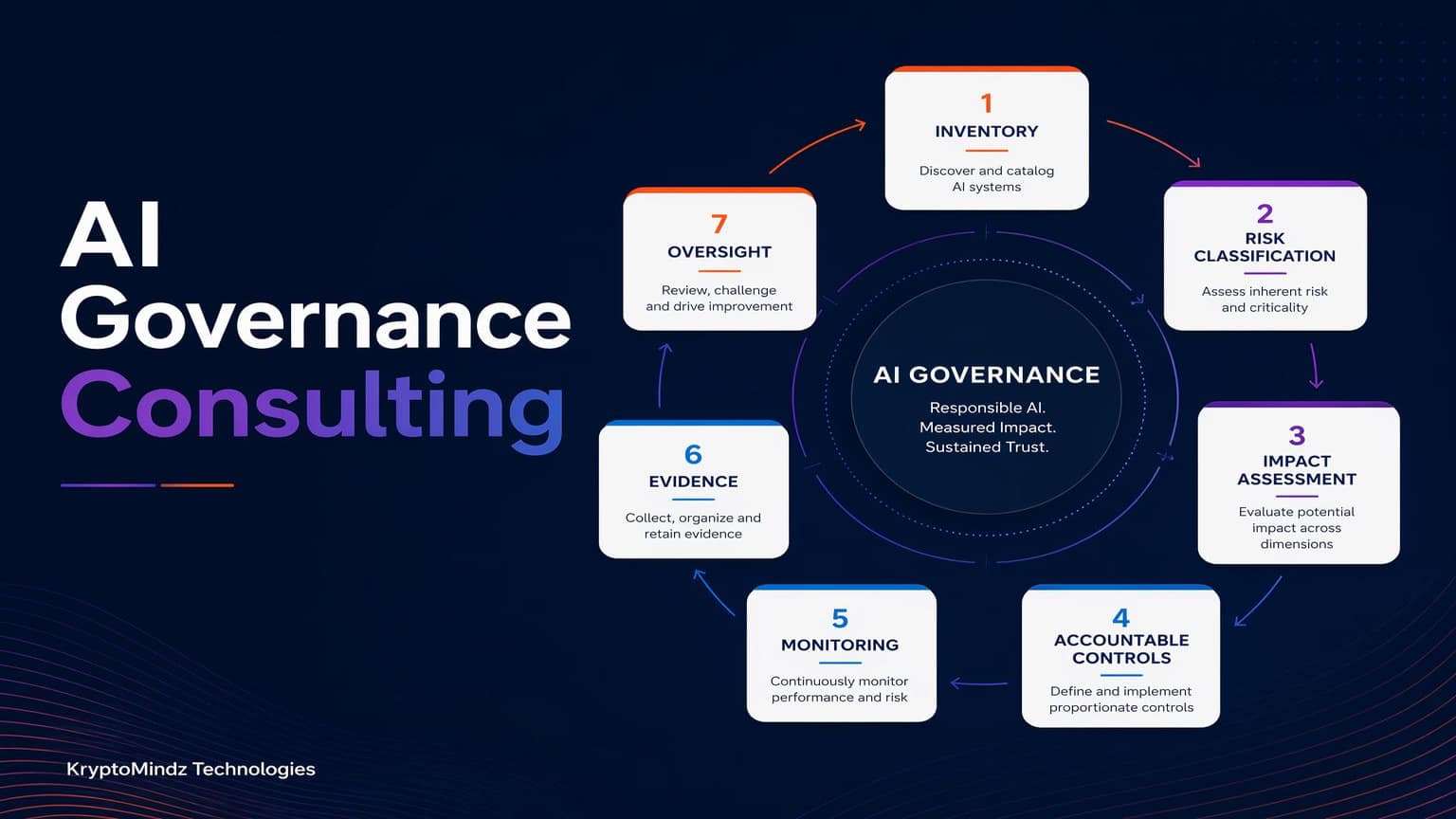
Identify AI systems, agents, vendors, use cases, data, users, decisions and accountable owners.
Define proportionate tiers using autonomy, affected people, data sensitivity, decision impact and reversibility.
Connect each tier to required approvals, testing, documentation, security, oversight and release evidence.
Place governance decisions inside procurement, design, development, deployment, change and retirement workflows.
Define incidents, exceptions, drift signals, review cadence, audit trails and management reporting.
A practical system of record for use cases, owners, components, vendors, risks and lifecycle status.
Proportionate requirements mapped to risk tiers, delivery stages and accountable control owners.
Clear roles for business, product, security, privacy, legal, operations and governance forums.
Required records, signals, exception handling, incident triggers, dashboards and review cadence.
| AI context | Governance emphasis | Typical evidence |
|---|---|---|
| Low-impact productivity assistance | Approved tools, data boundaries and user accountability | Tool register, acceptable-use controls and training |
| Customer or employee recommendations | Quality, transparency, bias, review and challenge paths | Impact assessment, testing, disclosures and monitoring |
| Autonomous tool-using agents | Identity, permissions, approvals, observability and emergency control | Tool policy, action logs, approval records and incidents |
| High-consequence decisions | Strong human oversight, validation, traceability and independent assurance | Decision records, model evidence, controls and audit reports |
Do not create a separate committee and control catalogue when existing product risk, security, privacy and change-management processes can be extended with clear AI-specific criteria. Governance should reuse accountable enterprise mechanisms where they work and add new forums only for unresolved cross-functional decisions.
Scope depends on the size and maturity of the AI portfolio, number of business units and jurisdictions, autonomy and decision impact, existing risk processes, evidence requirements, policy gaps, tooling integration and change-management needs. A focused operating-model assessment is smaller than a global rollout with inventory tooling, lifecycle workflow integration and assurance preparation.
Bring your AI portfolio, policies and current approval process. We will help define a proportional operating model with controls teams can execute and evidence leadership can inspect.
Discuss Your ProjectAI governance consulting translates principles, risk expectations and regulatory obligations into an owned operating model with policies, decision rights, controls, monitoring and evidence.
No. The depth of governance should be proportional to impact, but every organization benefits from knowing which AI systems it uses, who owns them and how incidents or material changes are handled.
No. Governance defines accountability, policies and evidence. AI security implements technical protections for models, data, agents, tools and infrastructure. Strong programs connect both disciplines.
Typical deliverables include an AI inventory model, risk taxonomy, policy and control framework, RACI, lifecycle gates, oversight design, monitoring requirements, evidence model and implementation roadmap.
No. KryptoMindz provides technical and strategic governance support. Legal interpretation and formal conformity decisions should remain with qualified legal and assurance professionals.