Cross-Organization Workflows
Shared approvals, handoffs and status changes where each organization retains responsibility for its own actions.
Enterprise Blockchain
Decide whether blockchain belongs in your architecture, choose the right platform and move from a shared-trust problem to an implementation-ready consortium, integration and operating model.
KryptoMindz provides technology-neutral guidance across Hyperledger Fabric, Hyperledger Besu, Enterprise Ethereum, public anchoring and conventional alternatives—without forcing blockchain into problems a database can solve better.
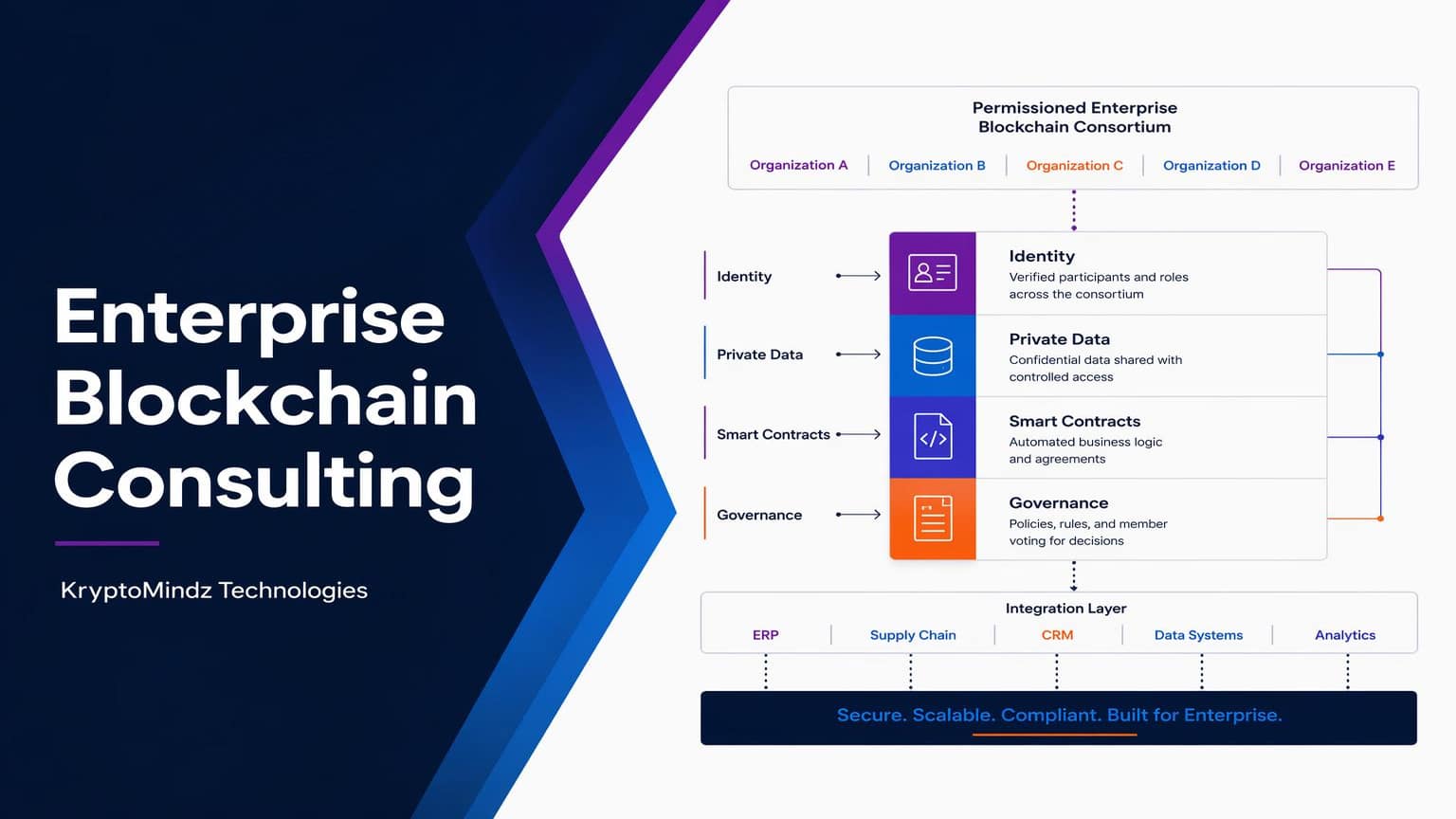
Enterprise blockchain is a distributed system in which several participants maintain or verify a shared record under agreed governance. The useful part is not that records are “on blockchain.” The value comes from reducing reconciliation, making cross-organization events verifiable, automating jointly governed rules and avoiding one participant becoming the unquestioned owner of everyone else's evidence.
A production program therefore needs more than smart contracts. It needs participant identity, data ownership, privacy rules, node and key operations, transaction endorsement, legal agreements, integration with systems of record, monitoring, change governance and a way to handle disputes or network exits.
KryptoMindz begins with the business relationship and evidence problem. Platform selection follows only after the team can explain why participants cannot rely on an existing database, API or immutable storage service.
A credible candidate usually has multiple accountable parties, a shared state transition and a reason each participant must verify evidence independently.
Shared approvals, handoffs and status changes where each organization retains responsibility for its own actions.
Events, certifications, custody changes and exceptions that require verification across suppliers, operators and customers.
Multi-party records where signatures, timestamps, participant identity and tamper-evident history strengthen auditability.
Jointly governed asset lifecycle, tokenization, transfer, reconciliation or settlement among regulated participants.
Selective sharing in which participants need a common source of verification without exposing all private data.
Publishing compact proofs to a public network while operational data remains in controlled enterprise systems.
Saying no to blockchain is part of responsible consulting. These conditions often favor a conventional architecture.
If one organization creates, validates and consumes all records, a secured database and good audit controls are usually simpler and cheaper.
If partners are comfortable using one operator's API and do not need independent evidence, distributed consensus adds little value.
Telemetry, analytics streams and large documents belong in purpose-built data platforms; only selected evidence may need anchoring.
A ledger cannot decide who joins, who pays, who can change rules or how disputes are resolved. Those agreements must exist first.
If participants cannot agree what metadata is visible and how private information is removed, blockchain can create durable exposure.
Object Lock, WORM storage, signed logs or immutable cloud storage may meet the requirement without consortium infrastructure.
Platform selection depends on governance, privacy, interoperability, developer skills and who must verify the network state.
| Option | Strong Fit | Key Strengths | Important Trade-Offs |
|---|---|---|---|
| Hyperledger Fabric | Permissioned consortium workflows with known organizations and selective privacy | MSP identity, endorsement policies, channels, private data collections, modular architecture | Distinct programming and operating model; privacy and channel design need discipline |
| Hyperledger Besu | Enterprise Ethereum networks, EVM compatibility and public/private interoperability | Solidity ecosystem, Ethereum tooling, permissioning, familiar account model | Privacy and consortium operations require careful platform and transaction design |
| Public Ethereum | Open verification, public assets, ecosystem composability and durable neutral settlement | Large ecosystem, transparent state, broad tooling and liquidity | Public data, variable fees, throughput constraints and irreversible deployment risk |
| Layer 2 / Public Anchoring | Lower-cost public verification or compact evidence anchoring | Public trust signals with reduced transaction cost and selective on-chain data | Bridge, sequencing, finality and ecosystem dependencies must be understood |
| Traditional Database + Signatures | Single-owner workflows or high-throughput systems with controlled trust | Simplicity, mature operations, flexible queries and lower cost | Does not create distributed governance or independent shared consensus |
ERP, CRM, portals, mobile applications, partner systems and workflow services remain the primary business experience.
API management, event streaming, orchestration and adapters connect systems of record without copying all data to the ledger.
Participant onboarding, organization identity, user and service certificates, credential status and role governance.
Only jointly governed state transitions and verification rules belong in chaincode or EVM contracts.
Consensus, endorsement, private data, transaction visibility and public anchoring selected according to the trust model.
Node health, key custody, transaction monitoring, audit export, incident response, backup and governance change processes.
Define participants, shared decisions, current reconciliation, trust assumptions, evidence requirements and the non-blockchain alternative.
Set participant roles, onboarding, visibility, ownership, dispute, upgrade, cost and exit policies before platform decisions harden.
Compare Fabric, Besu, Ethereum, anchoring and conventional designs using explicit privacy, interoperability, performance and operating criteria.
Design identity, key management, smart contract boundaries, APIs, events, off-chain storage, monitoring and deployment topology.
Implement one measurable workflow with representative participants, test data, governance assumptions and production-quality evidence.
Plan security review, performance testing, resilience, onboarding automation, operating ownership and phased participant rollout.
Keep detailed operational data in existing applications while the ledger records selected state, approvals, hashes or settlement events.
Use integration events to propose blockchain transactions, then return confirmed state to downstream enterprise workflows.
Store documents in controlled repositories and commit cryptographic fingerprints, signatures and timestamps for later verification.
Begin with a small governance group, automate membership and certificate lifecycle, then add participants after operational criteria pass.
Run blockchain and existing reconciliation in parallel until transaction integrity, exception handling and business ownership are proven.
Anchor batches or proofs to a public network when external verification matters, without exposing confidential transaction content.
Issue, rotate, suspend and revoke participant, service and administrator credentials with accountable approval.
Protect validator, ordering, signing and administrative keys using HSMs or managed key controls appropriate to the threat model.
Define authorization, validation, upgrade, emergency, dependency and testing practices before production release.
Minimize personal and confidential data, evaluate transaction metadata and use private-data patterns or off-chain storage deliberately.
Monitor node, consensus, transaction, identity and smart contract signals with clear incident and escalation ownership.
Retain proposals, approvals, version changes, onboarding decisions and policy evidence alongside technical transaction records.
Enterprise blockchain cost is shaped less by the number of smart contracts than by participant governance, privacy, integration and operational responsibility. A single-organization pilot is not representative of a consortium that must onboard partners, separate data, protect keys and operate nodes across environments.
Commercial scope is defined after qualification. KryptoMindz does not claim that every blockchain program reduces cost or removes intermediaries; the architecture must demonstrate measurable benefit against the conventional alternative.
Bring the participants, workflow, evidence requirement and current reconciliation pain. We will help determine whether blockchain is justified and what a defensible pilot should prove.
Discuss Your ProjectEnterprise blockchain consulting helps organizations decide whether distributed ledger technology fits a business problem, select a platform and design the governance, identity, privacy, integration and operating model required for production.
Blockchain is usually unnecessary when one trusted organization owns the workflow, participants do not need shared verification, a conventional database meets audit requirements or the workload needs extreme throughput without decentralized governance.
Fabric provides a permissioned modular architecture with MSP identities, channels and private data collections. Besu provides Ethereum compatibility, familiar EVM smart contracts and enterprise permissioning. The right choice depends on governance, privacy, interoperability and developer ecosystem needs.
Yes. The architecture can connect ERP, CRM, portals, identity providers, event platforms, document stores, APIs and analytics without placing every business record on-chain.
Typical deliverables include use-case qualification, platform decision records, reference architecture, governance and identity models, smart contract boundaries, integration design, security controls, pilot plan and production roadmap.