Pilot Proliferation
Many proofs of concept exist, but ownership, architecture and value criteria differ across teams.
Trusted AI Systems
Move from scattered copilots and pilots to an enterprise AI portfolio with clear business value, reusable architecture, governed agents and an operating model built for production.
KryptoMindz connects workflows, data, models, AI agents, MCP-ready tools, identity, security, observability and governance in a roadmap your product and platform teams can execute.
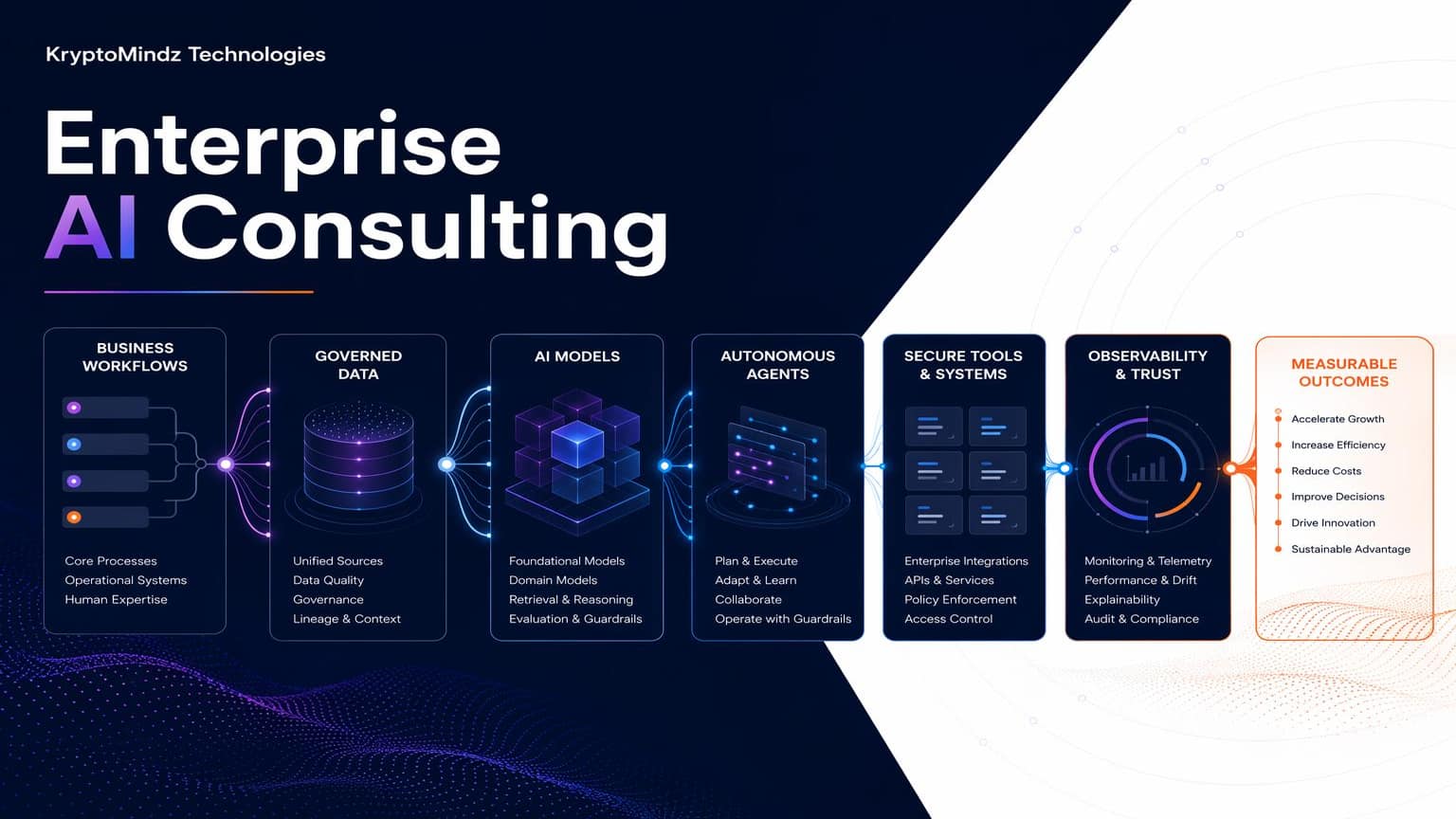
AI programs stall when each team chooses its own model, data pattern, integration approach and control process. The result is a collection of demonstrations that cannot share context, evidence, security controls or operating responsibility.
Enterprise AI consulting creates a coherent path from business workflow to production architecture. It identifies where prediction, retrieval, generation or bounded agent autonomy belongs, then defines the reusable platform and governance capabilities those use cases need.
Many proofs of concept exist, but ownership, architecture and value criteria differ across teams.
Leaders want autonomous workflows but need to identify safe boundaries, tools, approvals and operating controls.
Teams need a defensible approach to cloud, models, retrieval, data, integration, MCP and observability.
ERP, CRM, portals and custom applications need phased AI augmentation rather than risky wholesale replacement.
Leadership needs measurable outcomes, realistic cost drivers and stop/go criteria before scaling.
Production AI must connect governance, security, data boundaries, evidence and human accountability.
Identify decisions, handoffs, delays, data, systems, exceptions and measurable outcomes.
Choose between analytics, retrieval, generation, copilots and bounded agents based on value and risk.
Define data and context, model access, agents, MCP tools, integration, identity, security and observability.
Connect evaluation, approvals, governance, release evidence, monitoring and incident response.
Create a sequenced backlog with dependencies, owners, value hypotheses, stage gates and production criteria.
| Decision | Key question | Typical output |
|---|---|---|
| AI pattern | Does the workflow need prediction, retrieval, generation, assistance or autonomy? | Pattern and autonomy decision record |
| Data and context | Which sources are authoritative, permitted, current and observable? | Context architecture and data controls |
| Models and platforms | Which quality, latency, sovereignty, cost and portability constraints matter? | Platform options and evaluation plan |
| Tools and integration | Which operations may AI invoke and under whose identity and approval? | API/MCP tool boundaries and permission model |
| Operations | How will quality, cost, drift, incidents and business outcomes be monitored? | Observability and service operating model |
Scored opportunities, assumptions, risks, value measures and pilot recommendations.
Reusable layers for data, context, models, agents, tools, identity, security and operations.
Transparent choices for cloud, model, retrieval, integration, deployment and observability options.
Pilots, dependencies, owners, controls, production gates and scale criteria.
Enterprise AI effort depends on workflow complexity, data readiness, integration depth, autonomy, model evaluation, security, regulatory impact, operating maturity and the number of reusable platform capabilities already available.
A focused workflow assessment can be short. A multi-business portfolio and target platform requires broader discovery and stakeholder alignment. Commercial scope is defined after qualification, and every roadmap should include stop criteria for use cases that cannot demonstrate value or acceptable risk.
Bring your workflows, pilots, architecture constraints and business priorities. We will help identify what to build, what not to automate and which shared capabilities make the portfolio sustainable.
Discuss Your ProjectEnterprise AI consulting helps organizations select valuable use cases and design the architecture, data, operating model, governance and roadmap needed to move from experiments to dependable production systems.
Enterprise AI consulting addresses the portfolio and target operating model across multiple use cases. AI agent development implements a specific autonomous workflow within that broader strategy.
No. Some problems are better served by analytics, retrieval, prediction or assisted workflows. Agents are appropriate when bounded autonomy and tool use create measurable value with acceptable risk.
Typical deliverables include use-case prioritization, current-state assessment, target architecture, platform decisions, data and integration requirements, governance controls, pilot backlog and phased roadmap.
Yes. The architecture can work with existing cloud, ERP, CRM, data, identity, integration and observability platforms instead of assuming a wholesale replacement.