Qualify the Use Case
Define the claim, participants, relying decision, privacy need and measurable outcome before selecting standards or platforms.

Digital identity consulting helps teams design verifiable credentials, SSI, EUDI wallet strategy, digital signatures and HSM-backed trust architecture for digital services that need privacy, interoperability and governance.
KryptoMindz helps turn identity ideas into buildable trust layers: issuer and verifier roles, credential schemas, wallet flows, revocation, consent, digital signature evidence and integration controls.
Discuss Your Project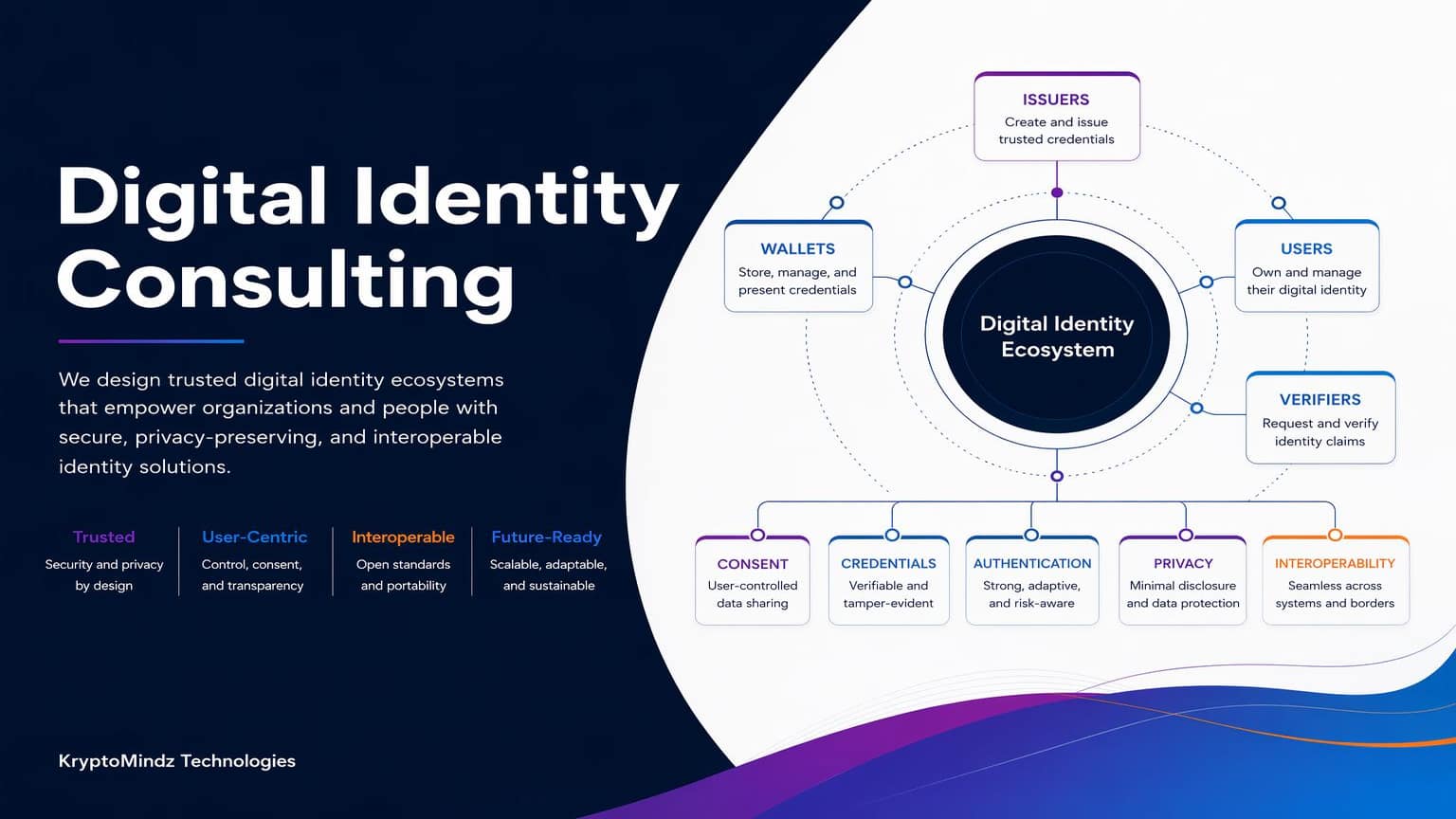
Digital identity is no longer only login. Regulated ecosystems need claims that can be issued, verified, revoked and trusted across organizations without copying excessive personal data into every workflow.
The challenge is designing the whole trust system. Teams need credential governance, data minimization, wallet-ready UX, security controls and a path from pilot to production.
Define schemas, issuer governance, verifier checks, lifecycle rules and evidence needs.
Plan wallet interactions, DID methods, trust roles, consent and user experience constraints.
Map ecosystem rules, roles, registries, onboarding, revocation and control ownership.
Connect identity flows with applications, APIs, access control and compliance evidence.
Credential flows should prove the necessary claim without spreading sensitive records across systems.
Issuers, verifiers, registries and operators need clear accountability before production rollout.
Identity architecture must account for standards, wallet behavior and ecosystem constraints.
Define the claim, participants, relying decision, privacy need and measurable outcome before selecting standards or platforms.
Identify issuers, holders, verifiers, registries, wallet operators, authorities and accountable service owners.
Specify schemas, issuance, consent, selective disclosure, verification, status, revocation and retained evidence.
Evaluate W3C Verifiable Credentials, OpenID4VCI/OpenID4VP, DID or PKI patterns, wallets, signatures and HSM-backed keys.
Define integration, testing, onboarding, support, governance, monitoring and production acceptance criteria.
| Need | Likely pattern | Decision caution |
|---|---|---|
| Enterprise authentication and access | OIDC, SAML and centralized identity | Do not add credentials when federation already solves the workflow. |
| Portable claims across organizations | Verifiable credentials and wallet presentation | Requires issuer/verifier governance and lifecycle operations. |
| Legally significant document approval | PKI-backed digital or qualified signatures | Signature level and assurance depend on jurisdiction and use case. |
| Privacy-preserving attribute proof | Selective disclosure or derived proofs | Interoperability and verifier support must be tested. |
Do not introduce wallets, decentralized identifiers or verifiable credentials merely to modernize login. Conventional identity federation is usually simpler when one organization controls the users and applications, portable claims add no business value, or ecosystem participants cannot support shared governance.
Typical deliverables include a trust-role map, credential and data model, flow diagrams, standards decisions, key and signature architecture, threat model, governance model, pilot backlog and phased roadmap. Cost and timeline depend on participant count, wallet scope, assurance level, privacy requirements, legacy integrations, HSM/signature needs, interoperability testing and operational governance.
Digital Trust Engineering gives identity programs a path from pilot credential to durable ecosystem.
It is technical and strategic support for identity, credential, wallet and trust architecture.
Yes. KryptoMindz can help design credential flows, governance, verification rules and implementation roadmaps.
No. This is technical and strategic readiness support, not legal advice.
Start with one credential use case, clear trust roles and measurable verification outcomes.