Enterprise AI and Agents
Define agent identity, tool permissions, human approvals, model and prompt evidence, observability, incident response and accountability for autonomous actions.

Digital Trust Engineering
Design the Trust Layer that lets enterprise AI, applications, identities and cross-organization workflows operate with verifiable evidence, accountable decisions and compliance controls built in.
KryptoMindz connects identity, cryptography, digital signatures, HSM-backed keys, blockchain where justified, policy enforcement and operational monitoring into one implementation-ready architecture.
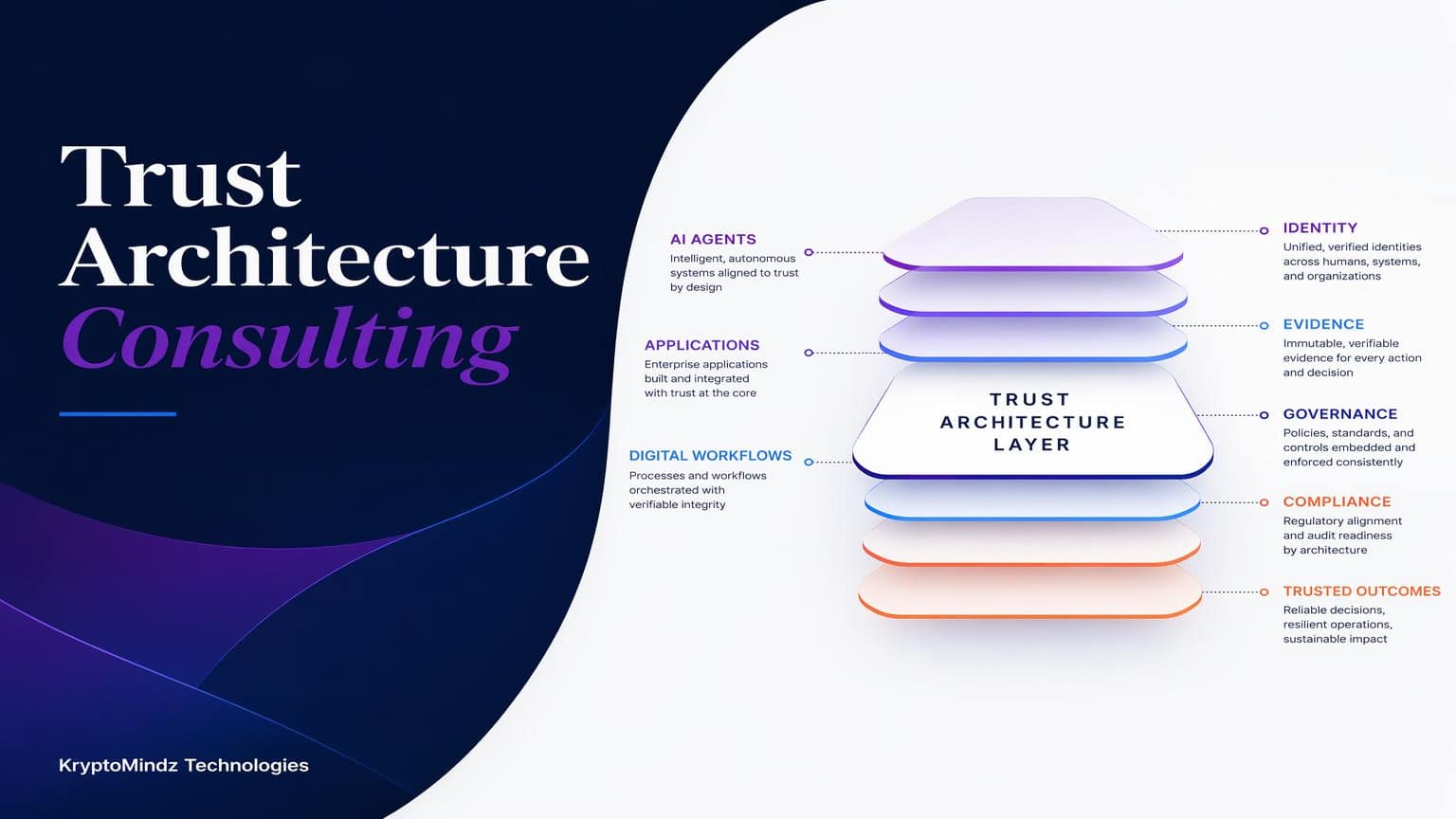
Enterprises rarely suffer from a complete absence of controls. They usually have identity providers, API gateways, logs, encryption, approval workflows, databases and security policies. The difficulty is that these controls operate in separate products and teams. An AI agent may know which tool it can call but not why the action was approved. A signed document may prove integrity but not the business policy under which it was issued. An audit log may record an event while remaining editable by the same administrators who operate the platform.
Trust architecture defines how those parts create dependable business evidence together. It asks who or what is acting, what authority was granted, which policy applied, what data and model informed a decision, what cryptographic proof exists, who can challenge the result and how the organization can investigate or reverse an unsafe outcome.
The result is not a new layer that replaces enterprise applications. It is a target architecture and operating model that makes existing and new systems more secure, verifiable and governable.
The engagement is most valuable when a program crosses technology, organizational or regulatory boundaries that cannot be solved by one product team.
Define agent identity, tool permissions, human approvals, model and prompt evidence, observability, incident response and accountability for autonomous actions.
Coordinate issuers, holders, verifiers, wallets, trust registries, revocation, consent and HSM-backed signing across organizational boundaries.
Establish shared governance, participant onboarding, evidence, dispute handling and selective blockchain or immutable-storage patterns.
Translate governance and compliance expectations into architecture decisions, control ownership and inspectable evidence flows.
Connect digital signatures, timestamps, certificate validation, approvals, policy context and retention for defensible business evidence.
Review fragmented identity, key, logging, integration and governance controls before scaling a new digital platform.
A Trust Layer is a set of architecture capabilities and operating responsibilities. The implementation can use existing enterprise platforms where they fit and introduce new components only where there is a proven gap.
Human, organization, service and AI-agent identities; authentication; delegation; scoped permissions; credential status; and separation of duties.
PKI, digital signatures, certificate validation, timestamps, secure key lifecycle, HSM integration and evidence verification.
Machine-enforceable rules, approval gates, exception paths, control ownership, participant governance and change authorization.
Decision context, source lineage, prompts, models, policies, approvals, signatures, timestamps and tamper-evident retention.
Observability, trust signals, anomaly detection, incident criteria, rollback paths, audit investigation and evidence export.
Databases, immutable object storage or enterprise blockchain selected according to ownership, governance, privacy and verification needs.
Balanced architecture means avoiding platform work that does not improve risk, evidence or operations.
If one organization controls every actor, datastore and approval, a well-designed application with standard identity, logging and database controls may be sufficient.
An IAM modernization or Zero Trust access program may solve the actual problem without a broader trust transformation.
Low-risk internal workflows may not justify cryptographic signing, immutable retention or a complex cross-system evidence model.
Technology cannot compensate for undefined ownership, absent policies or partners who have not agreed how decisions and disputes will work.
The work moves from evidence and constraints to a target state that delivery teams can implement in phases.
Clarify business outcomes, participants, systems, high-consequence decisions, regulated data, current incidents and the evidence stakeholders need.
Map identities, permissions, keys, signatures, policies, data flows, logs, storage, integrations and operational ownership. Identify where trust is assumed but cannot be independently verified.
Document actors, delegated authority, administrative power, external dependencies, failure modes, disputes and misuse paths across the workflow.
Define trust services, evidence flows, reference patterns, integration contracts and technology choices. Record where standard databases, HSMs, signatures, immutable storage or blockchain fit—and where they do not.
Map policies, approvals, audit evidence, monitoring, retention and incident duties to accountable owners and implementation components.
Prioritize the smallest defensible pilot, dependencies, proof criteria, phased rollout, architecture governance and measures for production readiness.
Actors, systems, assertions, approvals, evidence, policies and ownership around critical business decisions.
Logical components, trust services, integration paths, boundaries, data classes and deployment considerations.
Defensible choices and rejected alternatives for identity, signatures, keys, evidence stores, blockchain and governance patterns.
Required controls, evidence produced, responsible owner, verification method and retention expectations.
Architecture, operational, supplier, governance and compliance risks with proposed treatments and decision owners.
Pilot scope, milestones, prerequisites, delivery sequence, validation criteria and architecture review checkpoints.
| Need | Likely Foundation | What It Does Not Solve Alone |
|---|---|---|
| Secure service or agent credentials | Enterprise identity, workload identity, credential lifecycle | Business authorization, evidence context and governance |
| Protect signing and encryption keys | HSM or managed key service with lifecycle controls | Whether a business action should be approved |
| Prove document integrity and origin | Digital signatures, PKI, timestamping and validation | Complete workflow provenance or cross-party consensus |
| Retain tamper-resistant records under one owner | Immutable object storage or WORM controls | Distributed governance among independent parties |
| Share verification among organizations | Permissioned blockchain or shared verification service | Identity governance, key custody and legal agreements |
| Explain an AI-assisted decision | Trust context, model/prompt provenance, policy and approval evidence | Model quality, fairness or compliance certification by itself |
Trust architecture is scoped according to the number of critical workflows, systems, identity domains and participating organizations—not by word count or diagram count. A bounded assessment for one AI-agent workflow is materially different from a consortium platform spanning wallets, HSMs, signatures and multiple jurisdictions.
KryptoMindz defines scope and commercial terms after discovery. The page does not promise a fixed result, certification or compliance outcome.
Bring one critical workflow, the systems it touches and the trust questions your team cannot answer confidently. We will identify the right architecture review or pilot scope.
Discuss Your ProjectTrust architecture consulting defines how identity, permissions, cryptographic evidence, governance, monitoring and compliance controls work together across enterprise systems.
No. Zero Trust focuses strongly on access and continuous verification. Enterprise trust architecture also covers evidence, signatures, AI accountability, shared ledgers, governance and business decision integrity.
An engagement is useful when several systems, parties or regulations must share reliable identity, permissions, evidence and accountability, especially before a high-consequence platform moves into production.
No. Blockchain is appropriate only when shared verification, multi-party governance or tamper-evident consensus adds value. Many trust architectures use databases, PKI, HSMs and immutable storage without a blockchain.
Typical deliverables include a current-state assessment, trust-boundary map, target architecture, control and evidence model, technology decisions, risk register and phased implementation roadmap.