
1. Introduction
Enterprise blockchain is a coordination architecture for organizations that need to share facts, execute jointly governed rules, and retain evidence without granting one participant unilateral control over the complete record. That definition is deliberately narrower than the popular idea that blockchain is a universal database. A blockchain adds replicated state, consensus, cryptographic identity and governance overhead. It should earn that overhead by solving a real multi-party trust problem.
The durable enterprise use cases are rarely about placing an existing application “on chain.” They are about reducing repeated reconciliation, proving provenance, coordinating asset or document lifecycles, automating shared obligations and making cross-organization decisions inspectable. The ledger is one component in a larger system that still needs applications, APIs, identity, private storage, key management, monitoring, incident response and legal agreements.
2. What Is Enterprise Blockchain?
A blockchain is an append-oriented ledger whose participants agree on ordered state changes under a consensus mechanism. Blocks cryptographically reference prior blocks, making retrospective change detectable. Enterprise blockchain adds explicit operating concerns: known or governed participants, service availability, privacy, integration, policy, auditability and organizational accountability.
Business value
Value appears when several organizations maintain conflicting copies of the same process, depend on one party's reconciliation service, cannot prove event order, or need a jointly governed automation layer. The gain is not “immutability” in isolation. It is a shared control model that can lower reconciliation effort, shorten exception handling, improve provenance or create a common settlement surface.
Common misconceptions
- A ledger cannot determine whether data was true before submission.
- Replication is not confidentiality; sensitive data requires deliberate placement.
- A smart contract is deterministic shared logic, not a substitute for every enterprise service.
- Permissioned does not mean one administrator can be trusted implicitly.
- Blockchain does not remove governance; it turns governance decisions into architecture and operating procedures.
3. Public vs Private Blockchain
The public/private choice is a trust-model decision, not a maturity ladder. Public networks optimize for open verification and broad participation. Permissioned networks optimize for identified members, controlled access and consortium governance. Hybrid designs use a private execution domain while anchoring selected hashes or proofs to a public network.
| Criterion | Public network | Permissioned network | Hybrid pattern |
|---|---|---|---|
| Governance | Open protocol and ecosystem governance | Named organizations and agreements | Consortium execution plus public verification |
| Participation | Broad or permissionless | Approved nodes/accounts | Controlled writers; public proof readers |
| Privacy | Assume transaction data is publicly observable | Channels, private transactions or controlled distribution | Private detail with public commitments |
| Cost | Variable fees and public-network economics | Infrastructure, support and consortium operations | Both private operations and anchoring fees |
| Best fit | Open assets, settlement and public composability | Known-party workflows and selective privacy | Enterprise privacy with external timestamp/proof |
Security assumptions differ. Public networks rely on economic and protocol incentives across broad validator sets. Permissioned networks rely on member identity, validator or ordering topology, operational separation and enforceable governance. Neither model is automatically safer.
4. When Blockchain Should Not Be Used
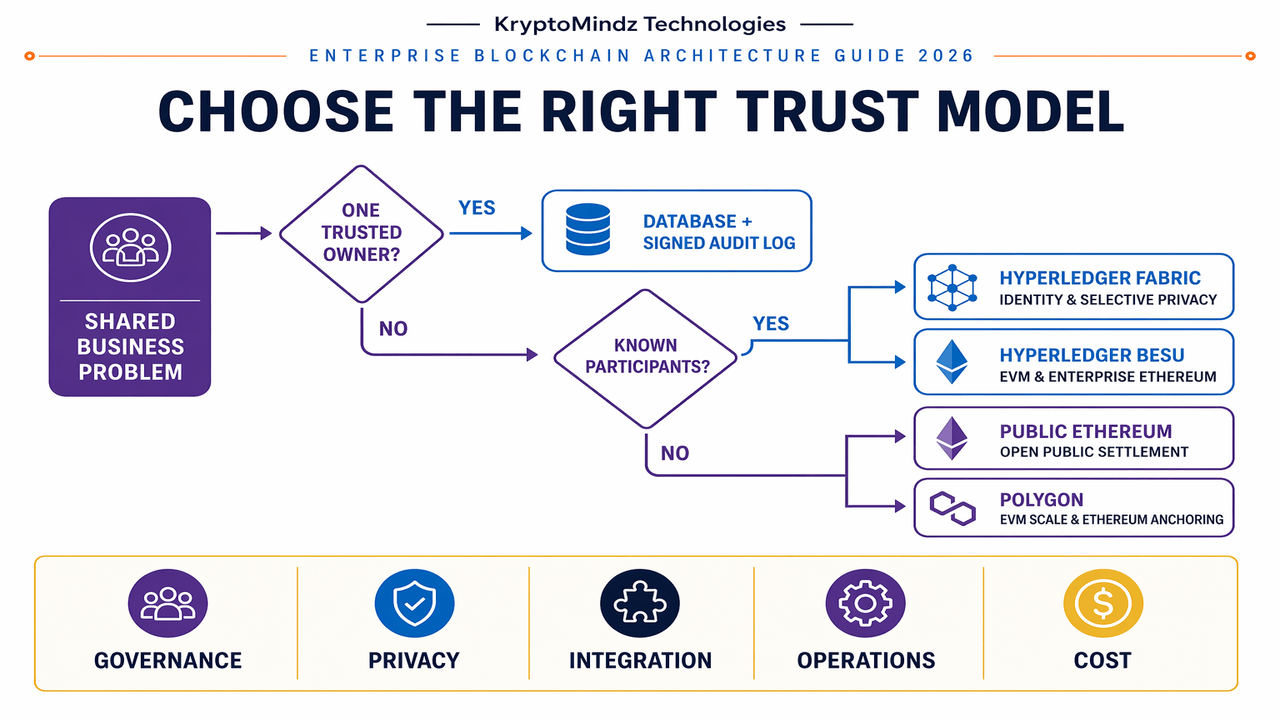
Do not use blockchain when one trusted owner controls every write and dispute, when a database plus access control and signed logs satisfies evidence needs, or when participants have no willingness to operate shared governance. A ledger also cannot rescue a poorly defined process: if parties disagree about semantics, ownership or exceptions, replicated ambiguity is still ambiguity.
- Single-owner workflow: use a conventional transactional system.
- No shared verification need: use APIs and signed event records.
- High-volume private computation: keep computation and data off-chain.
- Unstable requirements: simplify the business process before encoding contracts.
- No consortium commitment: do not build infrastructure for hypothetical members.
- Irreversible-data conflict: redesign storage and retention before adopting an append-only ledger.
5. Enterprise Blockchain Reference Architecture
A production architecture separates business channels, integration, shared execution, trust controls and operations. Applications submit commands through authenticated APIs. Integration services validate and enrich requests from systems of record. Smart contracts update only the shared state that participants must verify together. Private records remain in appropriate enterprise stores, referenced by identifiers, hashes or proofs.
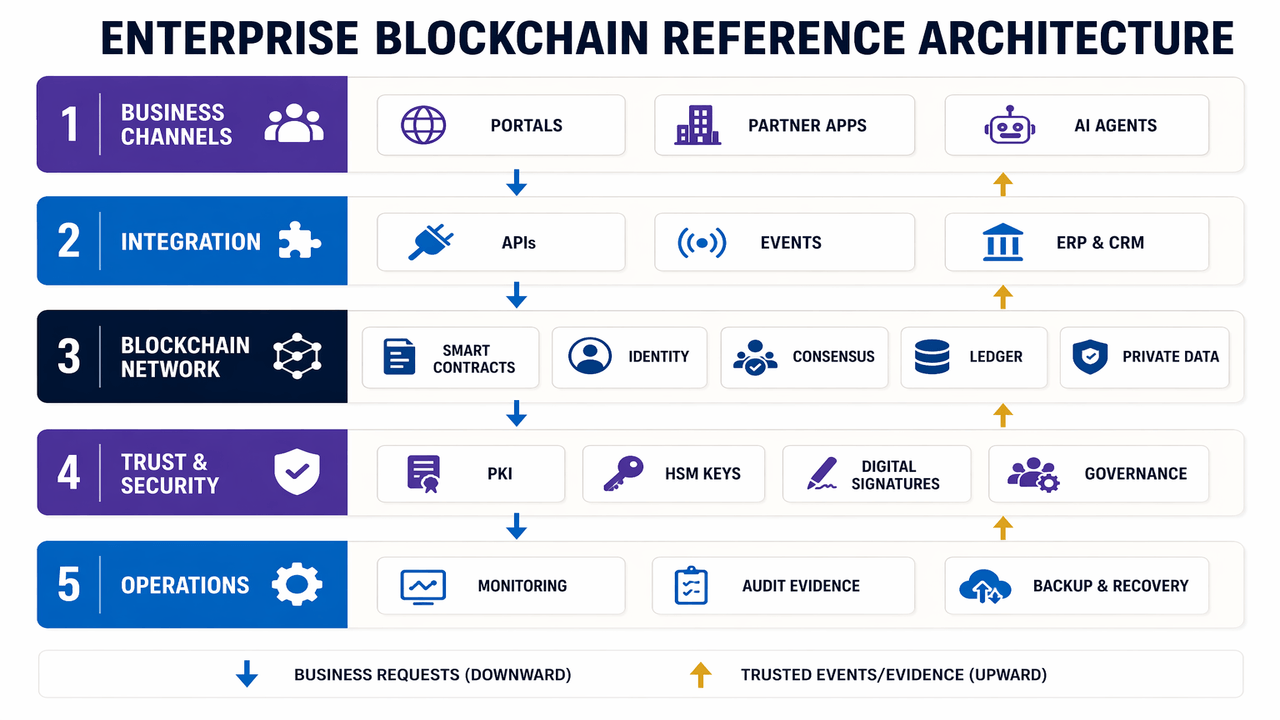
Architecture layers
Business channels include portals, partner applications and bounded AI agents. Integration provides APIs, events, transformation and system-of-record connectivity. The network provides contracts, identity, consensus, ledger and privacy mechanisms. Trust and security provides PKI, protected keys, signatures and governance. Operations provides telemetry, evidence, continuity and incident handling.
Transaction lifecycle
A production design follows a transaction from business intent to final business outcome. A user or workload authenticates to an application. The application validates authorization and submits an idempotent command. Integration services resolve reference data and assemble the minimum shared payload. Network participants endorse or validate the proposed transition according to platform rules. Consensus establishes order or finality. Committed events update systems of record, trigger downstream work and create operational evidence.
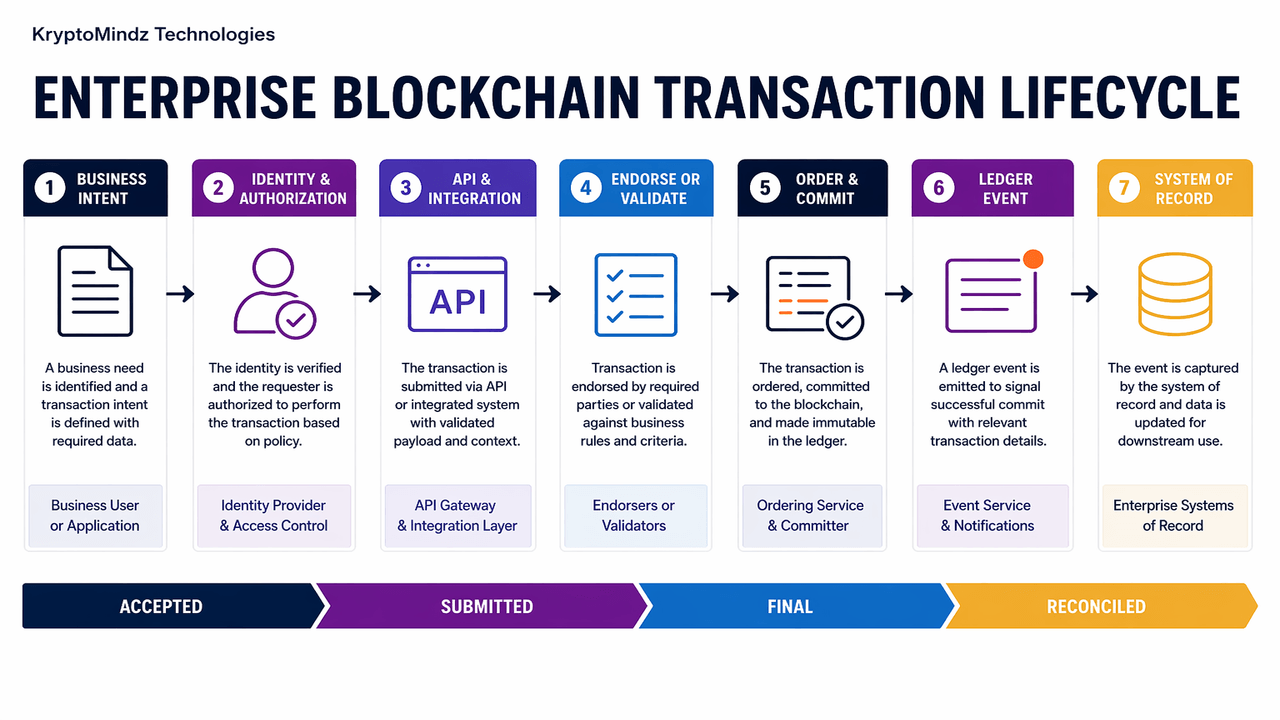
Each transition needs an explicit failure state. A request can be rejected before submission, fail endorsement, time out during ordering, commit as invalid, or succeed on-ledger while a downstream ERP update fails. Architecture diagrams that show only a happy path hide the reconciliation work that production teams must own. Define correlation identifiers, retry rules, compensating actions, finality thresholds and operator dashboards before implementation.
Data placement model
Classify every field as public shared state, consortium-visible state, restricted participant data, enterprise-private data or derived evidence. Place identifiers and jointly governed state on-ledger only when all intended readers may retain them for the ledger lifetime. Keep large documents, personal data, commercial terms, mutable reference data and analytics in controlled stores. Hashes can demonstrate later equality to a prior value, but they do not anonymize predictable data and do not remove retention obligations.
Governance as architecture
Consortium governance determines who may join, run nodes, deploy contracts, vote on configuration, rotate keys, approve emergency actions and leave. Those decisions become MSP policies, validator sets, permissioning contracts, multisignature controls, deployment pipelines and runbooks. A governance document that is not reflected in technical enforcement is aspirational; technical control without an agreed dispute and authority model is brittle.
6. Hyperledger Fabric
Hyperledger Fabric is a permissioned distributed-ledger platform with modular identity, ordering, endorsement and ledger components. Membership Service Providers translate certificate trust into recognized organizations and roles. Applications propose transactions to peers; required endorsers simulate chaincode, the ordering service establishes order, and peers validate endorsements and state versions before commitment.
Channels isolate complete ledgers among selected members. Private data collections allow a subset of organizations on a channel to exchange private values peer-to-peer while committing hashes to the shared ledger. This is useful when participants need common transaction evidence but not common access to every field.
Strengths and limitations
Fabric is strong for known organizations, policy-based endorsement, selective privacy and workflows that benefit from general-purpose chaincode languages. Its flexibility creates design responsibility: MSP lifecycle, channel topology, private-data dissemination, ordering, endorsement and chaincode upgrades require disciplined operations. Excess channels and contracts can turn privacy design into operational debt.
Fabric production decisions
Begin with organization boundaries rather than server counts. An MSP represents a trust domain and maps certificate chains to roles; it should correspond to accountable organizational control. Decide which organizations operate peers, certificate authorities and ordering nodes, and whether these duties are separated. Endorsement policies should represent real business approval, not simply require every peer because that seems safer. Overly broad endorsement increases latency and availability coupling.
Channel design deserves restraint. A channel creates a distinct ledger and configuration domain. Use it when an entire transaction history must be isolated among a stable group. Prefer private data collections when the wider channel should see transaction evidence while only selected organizations receive private values. Model collection dissemination, retention, purge behavior and dispute disclosure. Test a peer that misses private data at endorsement time and must retrieve it later.
Chaincode should contain deterministic shared rules. Keep external service calls outside execution, because endorsers must produce matching results. Emit events for integration but design consumers for duplicates and replay. Treat chaincode definitions, endorsement policies and upgrade approval as governed production changes. A contract release can alter business rights as materially as an application release.
7. Hyperledger Besu
Hyperledger Besu is an Ethereum client that supports public Ethereum and private networks. Enterprise teams choose it when EVM compatibility, Solidity contracts, Ethereum tooling and account-based state are strategic requirements. Private networks commonly combine node and account permissioning with proof-of-authority consensus.
Besu documentation recommends QBFT for enterprise-grade private-network consensus. Approved validators take turns proposing blocks, and a supermajority signs before commitment. This creates immediate finality under the configured validator set, but availability depends on validator participation: losing more than one third can stop block production. Validator distribution, membership changes, RPC exposure and key custody are therefore architectural concerns, not deployment afterthoughts.
Permissioning controls nodes and accounts, but peer-to-peer enforcement still depends on participating operators following network rules. Governance and monitoring are needed alongside technical allowlists.
Besu production decisions
Define the chain ID, validator governance and genesis configuration as controlled network artifacts. Decide whether validator changes occur through block-header voting or a management contract, who can propose changes and how emergency recovery works. QBFT tolerates Byzantine behavior only within its validator assumptions; geographic distribution and organizational diversity matter more than simply running multiple processes in one cloud account.
Separate node permissioning from account authorization. Node permissioning controls peer connections, while account permissioning and application contracts control who may submit or perform actions. Local permissioning protects a node an organization controls but cannot force another operator to enforce identical rules. Consortium agreements, configuration verification and monitoring remain necessary.
Protect JSON-RPC endpoints as privileged application surfaces. Divide read, submit, administration and consensus APIs; apply network segmentation, authentication, rate limits and monitoring. Keep validator and high-authority account keys outside ordinary application files. Plan how contracts are deployed, upgraded or paused, and define which governance evidence accompanies each change.
8. Public Ethereum for Enterprise Use
Ethereum provides a public EVM state machine, smart contracts, proof-of-stake consensus and a broad ecosystem of standards, tools and assets. Enterprises use it when open settlement, public verifiability, token interoperability or access to public liquidity matters more than private-network control.
The trade-offs are public data visibility, variable gas costs, probabilistic ecosystem conditions and limited control over protocol governance. Sensitive business data should not be placed on a public ledger simply because it can be encrypted; metadata, permanence and future cryptographic risk still matter. Public-chain applications also require contract security, key custody, monitoring and incident plans.
9. Polygon and Ethereum Scaling
Ethereum scaling solutions use different security and data-availability models. Rollups execute outside layer 1 and post data or proofs back to Ethereum. Sidechains and other EVM-compatible networks use separate consensus and communicate with Ethereum through bridges or checkpoints.
Polygon PoS uses a dual-layer design: Bor provides EVM execution while Heimdall coordinates consensus and checkpoints to Ethereum. For enterprise architects, “Ethereum compatible” does not mean “identical Ethereum security.” Evaluate validator set, finality, bridge contracts, checkpoint behavior, data availability, operational dependencies and exit paths for the exact Polygon technology selected.
10. Corda
Corda approaches distributed business workflows through shared facts and flows between relevant parties rather than global broadcast of every transaction. It has historically been associated with regulated financial and multi-party process use cases where transaction privacy and legal-state transitions are central.
Evaluate Corda as a distinct application and workflow model, not as an interchangeable Ethereum or Fabric variant. Platform selection should consider current product support, participant skills, contract model, identity, interoperability and long-term operating ownership.
11. Blockchain Integration Patterns
A ledger should coordinate enterprise systems, not duplicate them. ERP and CRM remain authoritative for internal records; document systems retain files; identity providers authenticate users; data platforms support analytics. The blockchain holds shared state transitions and evidence that multiple parties must verify.
| Pattern | Purpose | Control point |
|---|---|---|
| Command API | Submit validated business intent | Identity, authorization, idempotency |
| Ledger events | Update ERP/CRM and workflows | Finality, replay and reconciliation |
| Off-chain document store | Keep files and sensitive records private | Hash, access, retention and evidence |
| Oracle or trusted data service | Introduce external facts | Source authority, freshness and disputes |
| Public anchoring | Provide external timestamp/proof | Batching, fees and disclosure |
Integration services should handle retries, duplicate submissions, finality, failure compensation and observability. A transaction acknowledged by an API is not necessarily final on the ledger; the business workflow must distinguish accepted, ordered, committed, invalid and compensated states.
Event-driven integration
Ledger events are useful integration facts, but they are not a complete message bus contract. Consumers need durable checkpoints, replay from a known block, ordering assumptions and schema-version handling. If a consumer updates an ERP and fails before recording its checkpoint, the event may be delivered again. Business updates must therefore be idempotent or protected by a processed-event record.
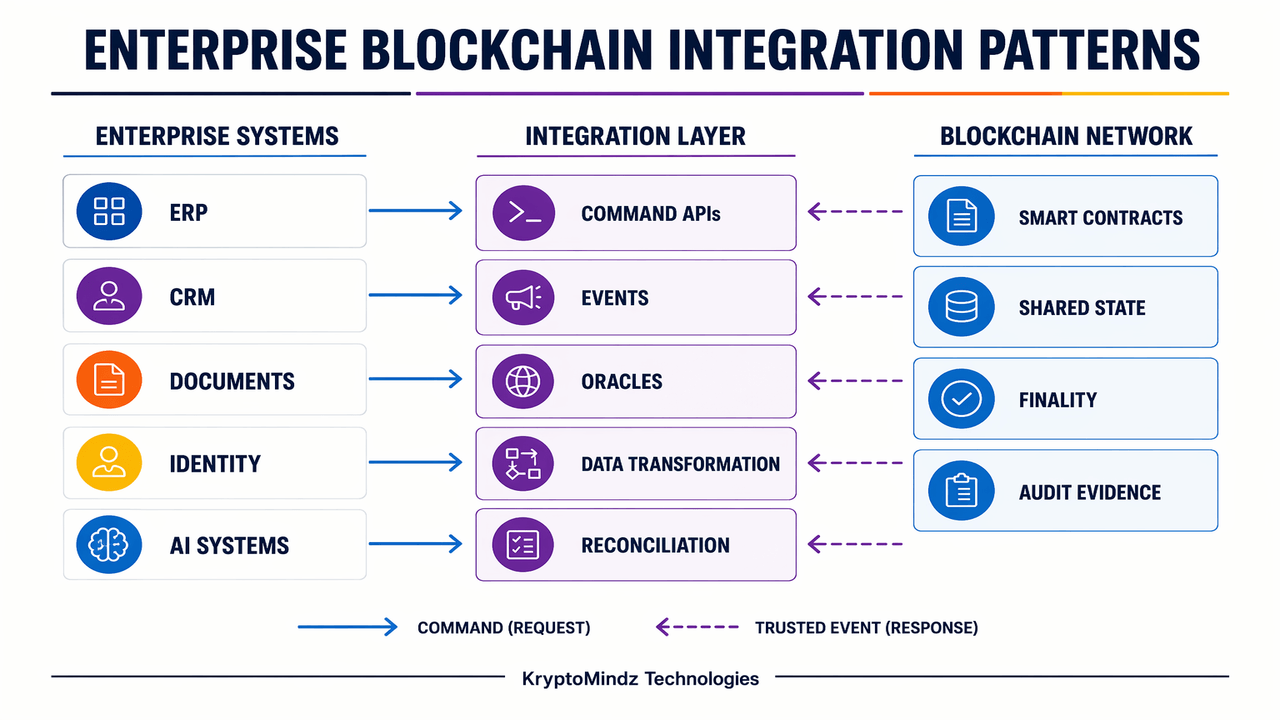
Do not let every application connect directly to peers or nodes. A governed integration layer centralizes identity mapping, transaction construction, telemetry, error semantics and platform upgrades. It can also prevent internal identifiers, secrets or full documents from leaking into a shared transaction. This layer should not become a new unilateral source of truth; participants must understand which validations happen before consensus and which rules are enforced by the shared network.
Oracle and external-data controls
Smart contracts cannot independently observe shipment arrival, exchange rates, inspection results or court decisions. An oracle introduces those facts under an explicit trust model. Define source authority, signing identity, freshness, quorum, correction and dispute handling. Multiple feeds improve resilience only if they are genuinely independent and aggregation rules account for stale or conflicting values.
12. Digital Identity and Blockchain
Enterprise networks need identities for organizations, nodes, workloads, administrators and transaction actors. Fabric uses PKI and MSP configuration to recognize organizations and roles. Besu uses node and account identities with permissioning. Public networks use accounts, but enterprise applications still need an off-chain relationship between accounts and accountable entities.
Verifiable credentials can carry portable claims among issuers, holders and verifiers. The W3C model explicitly allows different registry technologies, including trusted databases and distributed ledgers; blockchain is optional. A verifier must still decide whether an issuer is trusted and whether a claim is fit for purpose. Cryptographic verification does not prove claim truth.
Verifiable Credentials Consulting and Identity Wallet Consulting cover schema, lifecycle, protocol, privacy and wallet decisions in detail.
13. Digital Signatures, PKI and HSM Integration
Every enterprise blockchain relies on keys, but not all keys serve the same purpose. Node transport, member identity, transaction signing, certificate authorities, validator keys, document signatures and encryption keys require separate policy and lifecycle decisions.
PKI establishes certificate trust and revocation. Digital-signature workflows add signer intent, document format, timestamps and validation evidence. HSMs can protect high-value non-exportable keys and enforce controlled signing, but they also add availability, backup, ceremony, integration and migration requirements. NIST key-management guidance emphasizes key purpose, cryptoperiod, protection and compromise response.
Read the specialist architecture paths for Digital Signature and PKI Consulting and HSM Integration Consulting.
14. Enterprise AI and Blockchain
Blockchain can complement enterprise AI when several parties need shared evidence about model versions, approvals, data lineage, policy references, agent actions or decision outcomes. It can make submitted evidence tamper-evident and provide a common chronology across organizations.
It cannot establish that a model is accurate, fair or secure. It cannot prevent prompt injection, validate training data automatically or replace human oversight. Keep large prompts, model artifacts and sensitive traces off-chain; record identifiers, hashes, approvals and bounded state changes where shared verification adds value.
15. Enterprise Use Cases
Banking: shared KYC evidence, trade workflows or asset settlement can reduce repeated reconciliation, but privacy, legal finality and participant governance dominate design. Healthcare: consent or credential verification may benefit from shared evidence; patient records should remain in protected clinical systems. Manufacturing: provenance and maintenance events can coordinate OEMs, suppliers and operators when source data is authenticated.
Government: licenses and attestations can become machine-verifiable across agencies without centralizing every record. Supply chain: milestone and custody evidence can reduce disputes if scanners, organizations and source systems are trustworthy. Insurance: shared event evidence can accelerate claims while preserving private underwriting data. Energy: certificates, meter events and multi-party settlement require strong device identity and oracle controls.
Each case should define the business problem, participants, shared state, source authority, dispute path and measurable outcome before platform selection.
Banking and capital markets
Possible workflows include shared KYC evidence, collateral lifecycle, trade documentation and tokenized settlement. The architecture must distinguish legal ownership from technical token state, define settlement finality, protect confidential terms and integrate sanctions, identity and books of record. A network that speeds one step but creates manual legal or accounting reconciliation downstream has not solved the end-to-end problem.
Manufacturing and supply chain
Provenance networks can coordinate purchase orders, component identity, custody events, certifications and recalls. The difficult boundary is source integrity: a sensor signature proves which device reported a value, not that the device measured the physical world correctly. Device identity, calibration, operator accountability and exception workflows belong in the architecture.
Healthcare and public services
Healthcare needs selective evidence, consent and regulated access, not replication of clinical records across a consortium. Government credential use cases can improve cross-agency verification while leaving authoritative personal records with issuers. In both domains, data minimization, revocation, accessibility and avenues to correct errors are more important than maximal ledger permanence.
Insurance and energy
Insurance claims can coordinate incident evidence, assessors, repair networks and settlement approvals, but underwriting models and personal records stay private. Energy networks may coordinate certificates, meter events and settlement across producers and consumers; they require device identity, time synchronization, oracle controls and clear treatment of corrected readings.
16. Blockchain Platform Selection Matrix
| Platform | Governance/privacy | Contract model | Best-fit signal | Main caution |
|---|---|---|---|---|
| Fabric | Known orgs; MSP, channels, private data | Chaincode; endorsement policies | Selective privacy and participant-specific approval | Topology and certificate operations |
| Besu | Permissioned nodes/accounts; optional public use | EVM/Solidity | Enterprise Ethereum skills and interoperability | Validator, RPC and privacy governance |
| Ethereum | Open public network | EVM/Solidity | Public settlement and composability | Fees, privacy and irreversible public exposure |
| Polygon PoS | Separate PoS network with Ethereum checkpoints | EVM/Solidity | Lower-cost EVM execution and ecosystem access | Bridge and network-specific trust assumptions |
| Corda | Relevant-party workflow and privacy model | Contract/flow model | Regulated bilateral or multiparty workflows | Distinct skills, ecosystem and product path |
17. Enterprise Deployment Models
Permissioned consortium
Members operate nodes under shared governance. Identity, privacy and contract upgrades are explicit. This pattern fits stable organizations with jointly owned workflows.
Public trust anchoring
Enterprise systems batch hashes or commitments to a public network while keeping business data private. The anchor proves that a commitment existed by a public-chain point in time; it does not prove source truth.
Hybrid execution
A permissioned network executes private shared workflows and publishes selected proofs or settlement transactions publicly. Integration must manage finality and failure across both domains.
Multi-cloud and AI-integrated
Nodes distributed across member environments can reduce infrastructure concentration, but operational consistency becomes harder. AI-agent integrations must use bounded APIs, workload identity, approvals and evidence minimization.
Consortium governance blueprint
A consortium needs a constitution that can be implemented technically and operated during conflict. Define eligibility, onboarding evidence, membership classes and who may run validating or ordering infrastructure. Specify voting thresholds separately for routine configuration, contract upgrades, emergency actions, admission, suspension and removal. Requiring unanimity for every change can make the network impossible to operate; allowing one operator to make every change recreates unilateral control.
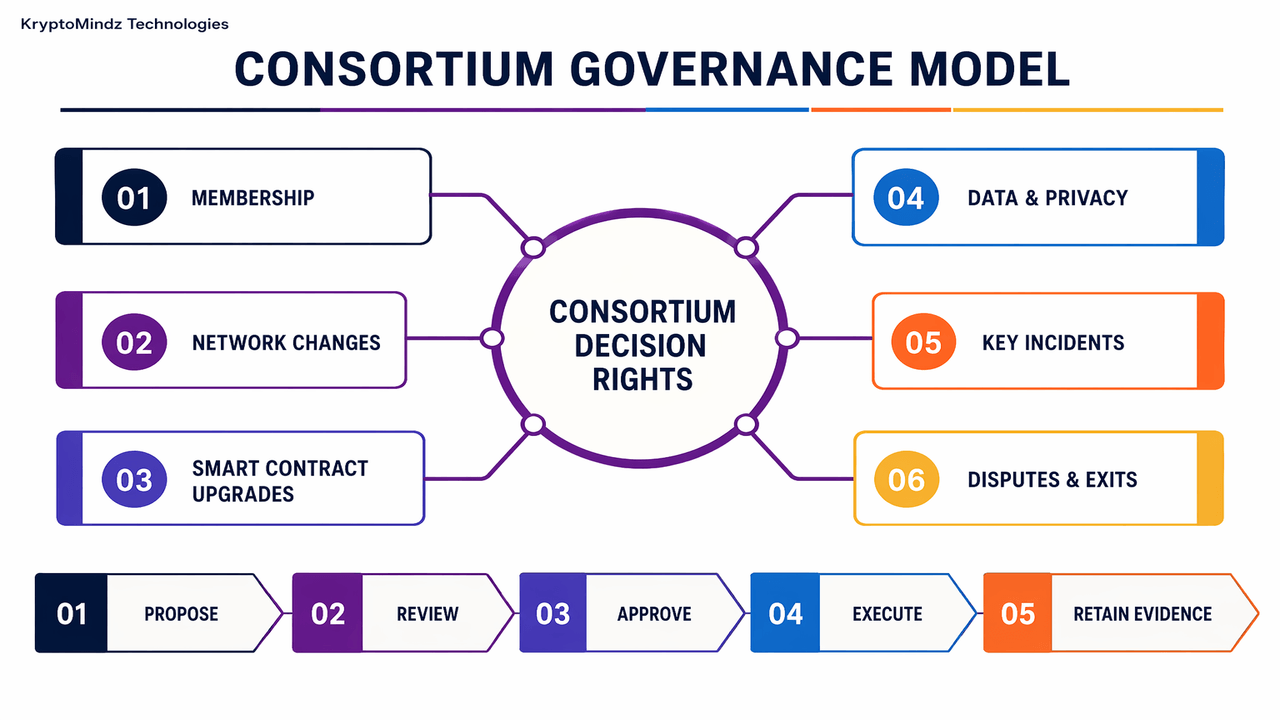
Allocate costs and service obligations explicitly. Members should know who funds shared environments, certificate services, monitoring, security review and support. Define minimum node availability, patch timelines, incident notification, key-rotation duties and evidence retention. A participant that repeatedly misses operational obligations may weaken consensus or private-data availability even if it never submits a malicious transaction.
Plan disputes and exits before the first production transaction. Determine which records remain visible after exit, how keys and certificates are revoked, whether nodes must delete private data, how in-flight obligations settle and how a departing member can verify retained evidence. Contract and configuration changes need proposal, review, approval, deployment and rollback records. Emergency controls should be narrow, time-bound and reviewable after use.
Governance also covers intellectual property and liability. Participants need agreement on contract ownership, software licensing, data responsibilities, oracle errors, invalid transactions and recovery costs. Technical architecture cannot settle these legal questions, but it must expose where decisions and evidence are needed. Engage qualified legal and regulatory professionals for jurisdiction-specific interpretation.
Architecture decision record checklist
For every platform and deployment choice, record the business driver, considered alternatives, participant assumptions, data classification, consensus or endorsement model, identity and key design, failure behavior, operating owner, exit strategy and conditions that would invalidate the decision. Attach performance and security evidence rather than relying on vendor defaults. Revisit the record when participants, regulation, transaction volume or platform support changes.
18. Cost and Implementation Considerations
Do not estimate enterprise blockchain from node count alone. Discovery and governance can outweigh ledger development. Cost drivers include participant count, contracts, privacy, identity and HSMs, systems integration, environments, performance testing, security review, cloud/network infrastructure, observability, support, disaster recovery and member onboarding.
- Build: architecture, contracts, APIs, applications and migration.
- Operate: nodes, certificates, keys, telemetry, backup and incidents.
- Govern: membership, voting, upgrades, disputes and exits.
- Assure: threat modeling, code/security review, evidence and compliance.
Commercial scope should follow qualification. A proof of concept that ignores governance and integration is cheap because it omits the difficult parts; it is not a reliable production estimate.
Team and operating model
A production program needs business process ownership, enterprise and security architecture, platform engineering, smart-contract development, integration, identity/key management, site reliability, testing and consortium governance. These do not need to be separate full-time teams, but every responsibility needs a named owner. Participant organizations also need local operators and decision-makers; a central delivery team cannot permanently operate every member's obligations.
Capacity and performance engineering
Performance testing must represent endorsement or validator topology, geographic latency, transaction payloads, privacy workloads, contract complexity, database choice, event consumers and failure conditions. Average throughput from an empty laboratory network is not a capacity plan. Measure confirmation distribution, invalid transactions, queue depth, storage growth, catch-up time, private-data retrieval and downstream processing.
Define service objectives around business completion rather than block time alone. A block may finalize quickly while an approval waits, an event consumer lags or an ERP rejects the update. Test loss of a peer, orderer, validator, region, certificate authority, HSM partition and integration service. Recovery objectives should include the time to restore cryptographic and consortium control, not only virtual machines.
Security threat model
Threats include stolen member or administrator keys, malicious contract upgrades, exposed RPC APIs, compromised CI/CD, colluding validators, denial of service, privacy metadata leakage, vulnerable bridges, oracle manipulation and insider misuse. Smart-contract review covers only one part of this surface. Use separated roles, protected keys, reviewed configuration, signed releases, network controls, runtime monitoring and rehearsed incident procedures.
Preserve evidence needed to investigate who proposed, endorsed, approved, deployed and operated each change. Avoid logging private payloads merely for convenience. Security telemetry should combine ledger events with identity, infrastructure and application context under controlled retention.
19. Migration Strategy
- Assess: map reconciliation, ownership, disputes, existing controls and alternatives.
- Prototype the trust assumption: test identity, shared state, privacy and integration—not a generic ledger demo.
- Pilot with real participants: include representative data, exceptions, operations and measurable outcomes.
- Production design: complete governance, security, resilience, support and migration plans.
- Roll out progressively: dual-run critical records, reconcile results and define rollback.
- Adopt and improve: onboard members, monitor business/service measures and control upgrades.
Legacy systems rarely disappear immediately. Treat blockchain as a new coordination layer, migrate shared state deliberately, and preserve authoritative history and rollback during transition.
Production readiness gates
- Named participants have approved governance, data rights and operating responsibilities.
- Every on-chain field has a retention and disclosure rationale.
- Identity issuance, renewal, revocation and emergency access are tested.
- Contracts have threat models, tests, upgrade authority and rollback or compensation paths.
- Integrations handle duplicate events, replays, finality and partial failure.
- Capacity tests represent production topology and degraded conditions.
- Monitoring covers business, ledger, node, integration, key and security signals.
- Backup, recovery, member exit and disaster procedures have been exercised.
- The pilot demonstrates a measurable outcome against the conventional alternative.
20. Future Trends
Tokenization is expanding the need for identity, lifecycle and legal-state integration. Digital credentials can make participant authority portable without placing personal data on a ledger. Confidential computing can protect computation beyond ledger privacy. AI agents increase demand for accountable identities and action evidence.
Post-quantum migration requires cryptographic inventory and algorithm agility across certificates, signatures, nodes, wallets and stored evidence. Regulatory evolution will continue to shape data placement, custody, operational resilience and asset treatment. Architecture should prefer replaceable cryptographic and integration layers over permanent dependence on one algorithm or platform feature.
Enterprise Architecture Workbooks
The following workbooks turn the guide into a repeatable architecture process. They are not vendor questionnaires. Each one produces an artifact that a business owner, architect, security reviewer and network participant can inspect before funding the next stage.
Workbook 1: qualify the shared-trust problem
List every organization that writes, verifies, disputes or depends on the proposed shared state. For each participant, record its current source of truth, incentive, liability, authority and ability to operate infrastructure. Then identify the facts that are repeatedly reconciled: asset ownership, document status, custody, approvals, settlement, certification, identity or provenance. Quantify the current delay, exceptions, losses, manual checks and dispute effort.
Ask what happens if one existing party runs a shared database and exposes signed APIs. If participants accept that owner, conventional architecture is simpler. If they reject unilateral control, document why: competitive neutrality, regulatory separation, cross-border jurisdiction, continuity, audit independence or inability to appoint a common intermediary. “Decentralization” is not a sufficient answer; name the decision or record that no one party should control.
Define success in operational terms. Examples include reducing reconciliation from days to hours, eliminating duplicate document validation, shortening partner onboarding, improving recall traceability or creating atomic delivery-versus-payment. Record the baseline and how it will be measured. If the pilot cannot test the claimed outcome, it is a technology demonstration rather than a business experiment.
Workbook 2: shared-state and data-placement inventory
For each business object, list the authoritative identifier, owner, lifecycle states, permitted writers, required approvers, readers, retention, correction method and evidence need. Separate shared facts from source records. A purchase order may remain in ERP while the ledger coordinates accepted obligations and milestone status. A clinical record remains in a healthcare system while a credential or hash supports verification. A certificate file remains off-chain while issuer, status and evidence references are shared.
Classify fields by visibility. Public data can appear on an open network. Consortium-visible data can be distributed to all approved members. Restricted data may use Fabric private data collections, appropriate Besu privacy architecture or encrypted participant stores. Enterprise-private data remains behind one organization's controls. Derived evidence includes hashes, signatures, timestamps and status references. A hash belongs in a privacy assessment because low-entropy or predictable values may be guessed and compared.
Define correction rather than assuming immutability forbids it. Append a correcting transaction, supersede a state, revoke a credential or preserve an original record under legal hold. Decide how applications present current state while retaining history. If regulations or contracts require erasure, assess whether on-chain personal data, identifiers, metadata or hashes create a conflict. Default to data minimization and off-chain protected storage.
Workbook 3: consortium governance and decision rights
Create a table of governed decisions: member admission, suspension, removal, node authorization, certificate authorities, validator or ordering membership, contract deployment, configuration changes, emergency pause, key compromise, software upgrades, data policy, service levels and dispute resolution. Assign proposal rights, review parties, voting thresholds, execution authority and retained evidence for each decision.
Distinguish constitutional change from operations. Adding a new member may require a higher threshold than approving a routine patch. Emergency action may allow a small group to pause a dangerous workflow, but restoration and retrospective approval should require broader review. Avoid a universal multisignature rule that either blocks routine work or grants emergency power too widely.
Model exit and failure. A member can leave voluntarily, lose its license, merge, become insolvent or operate a compromised node. Specify certificate and account revocation, validator removal, data access after exit, settlement of open obligations, software and evidence retention, private-data deletion, cost allocation and communication. Test whether the remaining network can make governance decisions and maintain consensus after losing a major member.
Workbook 4: smart-contract boundary and upgrade safety
Write each proposed contract rule in plain language and identify which participants must independently verify it. Place deterministic shared state transitions in the contract. Keep user interfaces, private pricing, document rendering, machine-learning inference, complex analytics and external calls outside. A contract may verify a signed oracle statement; it should not pretend to observe the physical event itself.
For every function, document caller identity, preconditions, consulted state, authorized changes, endorsements or approvals, emitted events, error states and invariants. Include negative cases: duplicate commands, stale versions, expired authority, conflicting approvals, unavailable oracle and attempted replay. In Fabric, align endorsement with accountable organizations. In EVM systems, separate business roles, deployment authority, upgrade authority and emergency control.
Choose an upgrade model deliberately. Immutable contracts reduce administrator power but preserve defects. Proxies or governed deployment processes permit change but introduce privileged control. Define proposal, independent review, testing, approval, activation, compatibility, migration and rollback. Preserve the exact source, compiler, dependencies, configuration, approvals and deployed artifact for every release.
Workbook 5: integration, finality and reconciliation
Draw a sequence diagram from initiating application to final business record. Mark authentication, authorization, transformation, proposal, endorsement or validation, ordering, commitment, event delivery and system-of-record update. Name the identifier used to correlate every step. Define which response the user sees at accepted, submitted, final and failed states.
Finality differs by platform. Fabric peers validate and commit ordered transactions; applications must inspect transaction validity. A QBFT network reaches finality under its validator assumptions. Public Ethereum applications choose a confirmation policy based on risk. Checkpointed or bridged networks add another finality domain. The business process should not label an action complete before its required finality and downstream updates.
Plan reconciliation despite using a shared ledger. Consumers can fail, external systems can reject updates, private data can arrive late and nodes can lag. Maintain durable event checkpoints, idempotent operations and reports comparing ledger state to systems of record. Define who investigates mismatches and whether the remedy is replay, compensation, source correction or governance action.
Workbook 6: identity, key and cryptographic lifecycle
Inventory organization, node, workload, user, administrator, oracle, deployer and validator identities. Record who proves each identity, which credential or account represents it, how authorization is derived, where private keys live, and how renewal, suspension, revocation and recovery work. Technical accounts should map to accountable owners and approved purposes.
Separate keys by use. TLS, transaction signing, validator identity, certificate authority, document signing, encryption and backup-wrapping keys have different exposure and recovery needs. Define algorithms, cryptoperiods, creation, activation, rotation, escrow or backup, compromise response and destruction. Use HSMs or managed protection when non-exportability, controlled signing and assurance justify the operational burden.
Practice compromise scenarios. Can the network revoke a member certificate without stopping unrelated transactions? Can validators replace a key while retaining quorum? Can an issuing authority restore after region loss without weakening root custody? Which historical signatures remain verifiable after algorithm or certificate changes? Record ceremony evidence and test recovery, not only backup creation.
Workbook 7: security and privacy threat model
Identify assets: shared state, private data, contract authority, signing keys, validator availability, identities, integration credentials and governance evidence. Enumerate trust boundaries among member clouds, nodes, applications, administrators, CI/CD, HSMs, oracles and public networks. Threats include stolen keys, compromised administrators, malicious members, collusion, vulnerable contracts, RPC abuse, denial of service, bridge failure, privacy leakage and software supply-chain compromise.
Map preventive, detective and recovery controls. Preventive controls include least privilege, role separation, protected keys, reviewed contracts, signed builds, network segmentation and data minimization. Detective controls include invalid-transaction alerts, configuration drift, validator participation, certificate expiry, unusual signing, RPC anomalies and business invariant violations. Recovery includes revocation, pause, contract replacement, node rebuild, evidence preservation and participant communication.
Privacy analysis includes metadata. Even when values are encrypted or private, transaction timing, participant patterns, identifiers, payload size and repeated hashes may reveal relationships. Determine who can observe node traffic, public commitments, channel membership and event subscriptions. Test privacy using representative data and adversary assumptions, not only access-control configuration.
Workbook 8: performance, resilience and production evidence
Build a workload model from business demand: command types, peak rate, payload size, contract reads/writes, endorsers or validators, privacy distribution, event consumers and geographic topology. Set objectives for end-to-end completion, not a marketing transactions-per-second number. Measure latency percentiles, invalid rate, queue depth, resource saturation, storage growth, event lag and catch-up time.
Test degraded conditions one at a time and in combination. Stop a peer, orderer, validator, certificate authority, HSM partition, database, event consumer and region. Introduce network delay, expired certificates, full disks and slow external systems. Confirm what remains available, how operators detect the condition, whether the system fails safely and how long recovery takes.
The production-readiness package should include architecture and data decisions, governance approvals, threat model, contract review, performance evidence, recovery results, key ceremonies, monitoring coverage, support rota, participant runbooks, known limitations and go/no-go criteria. Approval should state which evidence was reviewed and which residual risks were accepted.
Workbook 9: platform due-diligence questions
For Fabric, ask how MSPs map to organizations, how certificate authorities are operated, whether channels or private collections are justified, which endorsement policies represent business approval, how ordering is distributed, and how private data is recovered. For Besu, ask how validators are selected, how QBFT quorum survives member loss, which permissioning controls are locally versus collectively enforced, how RPC is protected, and how contracts and validator keys are governed.
For public Ethereum, ask whether data and metadata may be public permanently, how gas and congestion affect the workflow, which confirmation policy is required, how contracts are upgraded, and what happens if public infrastructure providers are unavailable. For Polygon or another scaling network, document consensus, validator and sequencer assumptions, bridge and checkpoint contracts, data availability, exit paths and dependency on Ethereum.
For Corda, evaluate the current platform version and support model, participant identity, notary or uniqueness service, contract and flow architecture, privacy, interoperability and operational skills. Across every platform, verify release lifecycle, security response, observability, backup, tooling, licensing, community health and the organization's ability to operate or migrate without one unavailable specialist.
Workbook 10: pilot scorecard
A pilot should have a written hypothesis and stopping rule. Score business outcome, participant engagement, integration effort, privacy, security, performance, operability, governance and cost. Use production-like identities and representative systems, not fabricated members and isolated scripts. Include at least one exception and one recovery scenario.
At the pilot review, compare the blockchain result with the best conventional alternative. Identify which costs move rather than disappear: reconciliation may decrease while consortium governance and platform operations increase. Proceed only when measurable benefit, participant commitment and operating capability justify those new obligations.
Enterprise Blockchain Anti-Patterns and Remedies
Anti-pattern: blockchain as a shared database brand
The architecture replaces a database with a replicated ledger but keeps one organization as the only writer, administrator, node operator and dispute authority. This adds consensus and operational complexity without changing the trust model. Remedy: use a database with signed, append-only audit evidence, or redistribute genuine verification and governance responsibility among participants.
Anti-pattern: every record and document on-chain
Teams store full documents, personal data, commercial terms and mutable reference records in ledger transactions for “transparency.” Replication expands exposure, retention becomes difficult and node storage grows unnecessarily. Encryption does not erase metadata or guarantee future confidentiality. Remedy: classify data, retain protected records in appropriate systems, and commit only shared state, identifiers and proportionate evidence.
Anti-pattern: governance deferred until after the prototype
A technical team launches nodes before participants agree on membership, voting, contract upgrades, cost allocation, service obligations and exits. The prototype works because one team controls everything; the consortium stalls when real authority must be distributed. Remedy: prototype at least one governance decision, member onboarding and emergency scenario alongside the transaction flow.
Anti-pattern: smart contract as the whole application
Contracts accumulate private business logic, huge state objects, presentation rules and assumptions about external systems. Upgrades become dangerous and every participant pays the cost of shared execution or replication. Remedy: place deterministic jointly governed transitions in contracts; keep workflow orchestration, private calculations, documents and analytics in controlled services.
Anti-pattern: one key equals one organization
A single administrator or deployer key can modify contracts, validators or member policy. The network appears distributed while privileged control remains concentrated and difficult to audit. Remedy: separate operational and constitutional roles, use quorum or governed approval where proportionate, protect high-value keys, and monitor every privileged action.
Anti-pattern: benchmark-led platform selection
A platform is selected from transactions-per-second claims measured under unrelated topology, payload and failure assumptions. The production workload later includes privacy, signatures, remote participants, integration and complex contracts. Remedy: create an application workload model and compare end-to-end business completion under representative normal and degraded conditions.
Anti-pattern: immutable means infallible
Teams assume a committed transaction cannot be wrong. In reality, compromised credentials, faulty oracles, software errors and fraudulent source data can create durable incorrect records. Remedy: design correction, revocation, compensation, dispute and evidence procedures. Protect source identity and validate business facts before submission.
Anti-pattern: bridge trust left undocumented
A private network, Ethereum deployment or Polygon workflow depends on bridges, relayers or checkpoint contracts, but architecture diagrams label the connection simply “interoperability.” Failures can freeze assets or create inconsistent state. Remedy: document custody, validator, contract, finality and recovery assumptions for every cross-network path and minimize bridged value.
Anti-pattern: pilot success without operating evidence
The pilot demonstrates transactions but excludes certificate expiry, key rotation, node loss, event replay, contract upgrade, private-data recovery and member exit. Production approval extrapolates from a happy-path demo. Remedy: require operational and security evidence, named owners, tested recovery and a costed support model before scale.
Anti-pattern: blockchain as automatic compliance
Teams treat immutability as proof of regulatory compliance. Regulations concern lawful purpose, privacy, rights, control effectiveness, resilience and accountable governance, not one database property. Remedy: map obligations to architecture and evidence with qualified legal, compliance and assurance professionals; use blockchain only where it strengthens a specific control.
Delivery Accountability and Evidence Model
A successful program assigns decisions to accountable roles and defines evidence before work begins. Titles vary by organization, but responsibilities cannot remain implicit. The business owner is accountable for workflow value and participant adoption. The consortium or governance lead is accountable for cross-organization rules. Enterprise architecture owns system boundaries and platform decisions. Security owns threat and control review. Platform engineering owns network reliability. Application teams own integration and user outcomes.
| Decision or artifact | Accountable role | Required contributors | Approval evidence |
|---|---|---|---|
| Use-case qualification and measures | Business owner | Participant owners, finance, architecture | Baseline, alternatives and measurable hypothesis |
| Trust and governance model | Consortium governance lead | Members, legal, risk, operations | Membership, voting, dispute and exit agreement |
| Platform and deployment architecture | Enterprise architect | Security, platform, integration, data | Decision records and reviewed diagrams |
| Data placement and privacy | Data owner | Privacy, security, legal, participant owners | Field inventory, retention and access rationale |
| Identity and key lifecycle | Security owner | IAM, PKI/HSM, platform, members | Key model, ceremonies and recovery tests |
| Smart-contract release | Product/process owner | Developers, reviewers, security, members | Source, tests, review, approvals and deployment hash |
| Production readiness | Service owner | All control owners and participants | Gate checklist, residual risks and go/no-go record |
Discovery evidence
Retain current-state process maps, participant interviews, reconciliation data, system inventories, legal and policy constraints, candidate alternatives and the reason a shared control model is needed. Record assumptions that have not been validated. If a critical participant has not agreed to the problem or operating role, mark that as a dependency rather than silently treating participation as certain.
Architecture evidence
Maintain context, container, component, deployment, data-flow and sequence views at the level needed to explain trust boundaries. Link each architecture decision to alternatives, consequences and owners. Keep a data-placement register and privileged-action matrix. Record platform and version assumptions, because a statement true for one release or deployment model may not apply to another.
Security and quality evidence
Preserve threat models, contract and application review findings, dependency scans, configuration checks, test results and remediation decisions. Include negative and abuse cases. For key operations, retain approved ceremony procedures and signed records without exposing sensitive key material. For performance, preserve workload, topology, configuration and raw results so tests can be reproduced.
Operational evidence
Define service indicators for transaction acceptance, finality, invalidity, node health, event lag, certificate expiry, key operations, private-data delivery and business completion. Run backup restoration, node rebuild, member revocation, validator or ordering failure, contract change and incident communication exercises. Record observed recovery times and unresolved manual steps.
Governance evidence
Every membership, configuration, contract and emergency decision should connect proposal, review, approval and execution. Preserve meeting or vote records, exact configuration artifacts and deployment receipts. Make it possible for a participant or auditor to answer who changed what, under which authority, with which evidence and when the change became effective.
Procurement and vendor evaluation
Ask vendors to describe trust assumptions, data handling, key custody, administrative access, portability, observability, incident response, support lifecycle, subcontractors and exit. A managed blockchain service can reduce infrastructure work but does not remove consortium governance or application responsibility. Confirm what the service automates and what remains with participants.
Go-live decision
The go-live record should identify approved scope, members, known limitations, residual risks, service objectives, support contacts, recovery status and conditions requiring rollback or pause. Confirm that operating teams have access, training and authority. A sign-off that merely states “testing passed” is too weak for a system coordinating obligations across organizations.
Enterprise Blockchain Terminology
Consensus is the mechanism by which network participants agree on transaction order or state. Finality describes when an application treats a transaction as irreversible under its network assumptions. Endorsement in Fabric is policy-based approval of simulated transaction results before ordering. Validation checks whether a committed transaction satisfies platform and application rules.
Permissioning restricts which nodes or accounts may participate. MSP is Fabric's mechanism for recognizing trusted certificate authorities, organizations and roles. Validator is a node authorized to participate in proof-of-authority consensus such as QBFT. Smart contract or chaincode is deterministic logic executed under network rules.
Private data collection is a Fabric mechanism that distributes private values only to authorized organizations while putting hashes on the channel ledger. Public anchoring commits a hash or proof to a public network. Oracle is a trusted mechanism that introduces external facts. Bridge transfers or represents state across networks under additional contract, validator and custody assumptions.
System of record remains the authoritative enterprise source for a class of data. Shared state is the subset participants must verify together. Consortium is the governed group operating or relying on a permissioned network. Cryptographic agility is the ability to replace algorithms, keys and certificates without rebuilding the complete business system.
21. Frequently Asked Questions
Should every enterprise use blockchain?
No. Blockchain is justified when multiple parties need shared verification, no single party should unilaterally control the record, and governance can support a distributed system.
What is enterprise blockchain architecture?
It is the complete design connecting applications, integrations, identity, smart contracts, consensus, ledger data, privacy, security, operations and consortium governance.
What is the difference between public and private blockchain?
Public networks accept broad participation under open protocol rules. Private or permissioned networks restrict participation and usually define member identity and governance explicitly.
When should blockchain not be used?
Avoid it when one trusted owner controls the workflow, a database meets audit needs, shared consensus adds no value, or throughput and privacy requirements conflict with the proposed network.
How do Hyperledger Fabric and Besu differ?
Fabric uses MSP identity, endorsement policies, channels and private data. Besu uses the EVM, Solidity tooling, permissioning and proof-of-authority consensus such as QBFT for private networks.
Is Ethereum suitable for enterprises?
It can be when open settlement, public verifiability, token standards and ecosystem reach matter, provided fees, privacy, finality and public-data exposure are acceptable.
Is Polygon an Ethereum layer 2?
Polygon includes multiple technologies. Polygon PoS is an EVM-compatible chain with its own validator and consensus model that periodically checkpoints data to Ethereum; architecture teams must evaluate its specific trust assumptions.
Where does Corda fit?
Corda is relevant to governed multi-party workflows, particularly where parties exchange shared facts without broadcasting all transaction data to every network participant.
Does blockchain guarantee data truth?
No. It can make accepted transactions tamper-evident, but source accuracy, oracle integrity, identity, authorization and business validation remain separate responsibilities.
What belongs in a smart contract?
Only deterministic rules and shared state transitions that participants must verify together. Large files, secrets, mutable analytics and private system-of-record data usually remain off-chain.
How should private data be handled?
Minimize on-chain data. Use Fabric private data collections, appropriate Besu privacy patterns, encrypted off-chain stores, hashes or proofs according to participant and retention requirements.
How does blockchain integrate with ERP and CRM?
Through APIs, events and integration services that translate business transactions into ledger commands and return confirmed events without replacing systems of record unnecessarily.
What identity does an enterprise blockchain need?
It needs identities for organizations, nodes, applications, administrators and transaction actors, with certificate or account lifecycle, roles, revocation and policy enforcement.
Are digital signatures the same as blockchain signatures?
Both use cryptography, but enterprise document signatures include certificate policy, validation, timestamps and legal context beyond transaction signing.
When is an HSM appropriate?
An HSM is appropriate for high-value non-exportable keys, certificate authorities, signing services, validators or regulated custody where strong access control and audit evidence justify the operational cost.
Can blockchain improve AI governance?
It can preserve cross-party evidence, approvals, model or policy references and decision provenance. It does not replace model evaluation, security, human oversight or AI governance.
How fast is enterprise blockchain?
There is no universal rate. Performance depends on consensus, endorsers or validators, transaction size, privacy, contract execution, storage, network latency and infrastructure.
How much does enterprise blockchain cost?
Cost depends on discovery, participant governance, platform, nodes, contracts, integrations, identity and keys, security review, cloud infrastructure, operations and partner onboarding.
How long does implementation take?
A focused qualification or prototype can be short; a production consortium usually requires months of governance, integration, security, testing and participant onboarding.
What should a proof of concept prove?
It should test the disputed trust assumption, critical transaction flow, privacy, identity, integration, performance and measurable benefit—not merely show that blocks can be written.
How should a consortium be governed?
Define membership, voting, cost allocation, data rights, contract upgrades, key incidents, disputes, exits, service levels and change control before production.
Can blockchain meet regulatory requirements?
It can support evidence and control, but compliance depends on jurisdiction, data placement, privacy, identity, retention, governance and legal interpretation. Blockchain is not automatic compliance.
How should enterprises prepare for post-quantum cryptography?
Maintain a cryptographic inventory, algorithm agility, upgradeable identity and signature layers, protected key lifecycle and migration plans aligned with standards evolution.
What does an architecture engagement deliver?
Typical outputs include use-case qualification, platform decision, reference architecture, identity/privacy/governance models, integration and security design, cost drivers, pilot plan and production roadmap.
Sources, Author and Technical Review
This guide prioritizes primary standards and platform documentation. Platform behavior changes over time; confirm current release documentation during implementation.
- NIST IR 8202, Blockchain Technology Overview
- Hyperledger Fabric: Introduction
- Hyperledger Fabric: Membership Service Provider
- Hyperledger Fabric: Private Data
- Hyperledger Besu: Private Networks
- Hyperledger Besu: QBFT Consensus
- Hyperledger Besu: Permissioning
- Ethereum: Technical Introduction
- Ethereum: Scaling
- Polygon PoS Architecture Overview
- W3C Verifiable Credentials Data Model 2.0
- NIST SP 800-57 Part 1, Key Management
Need Help Selecting the Right Enterprise Blockchain Platform?
Platform selection depends on participant trust, governance, privacy, regulation, integration, scale and operating ownership. KryptoMindz can help qualify the use case and turn those constraints into a defensible architecture roadmap.
Discuss Your Blockchain Strategy