Scattered AI Pilots
Teams have demonstrations but no common criteria for value, production readiness or scale.

Enterprise AI Planning
Identify which AI opportunities are worth pursuing, which foundations are missing and which pilot can produce measurable evidence without creating unmanaged risk.
KryptoMindz evaluates business workflows, data readiness, platform architecture, security, governance and operating capability to produce a prioritized, implementation-ready roadmap.
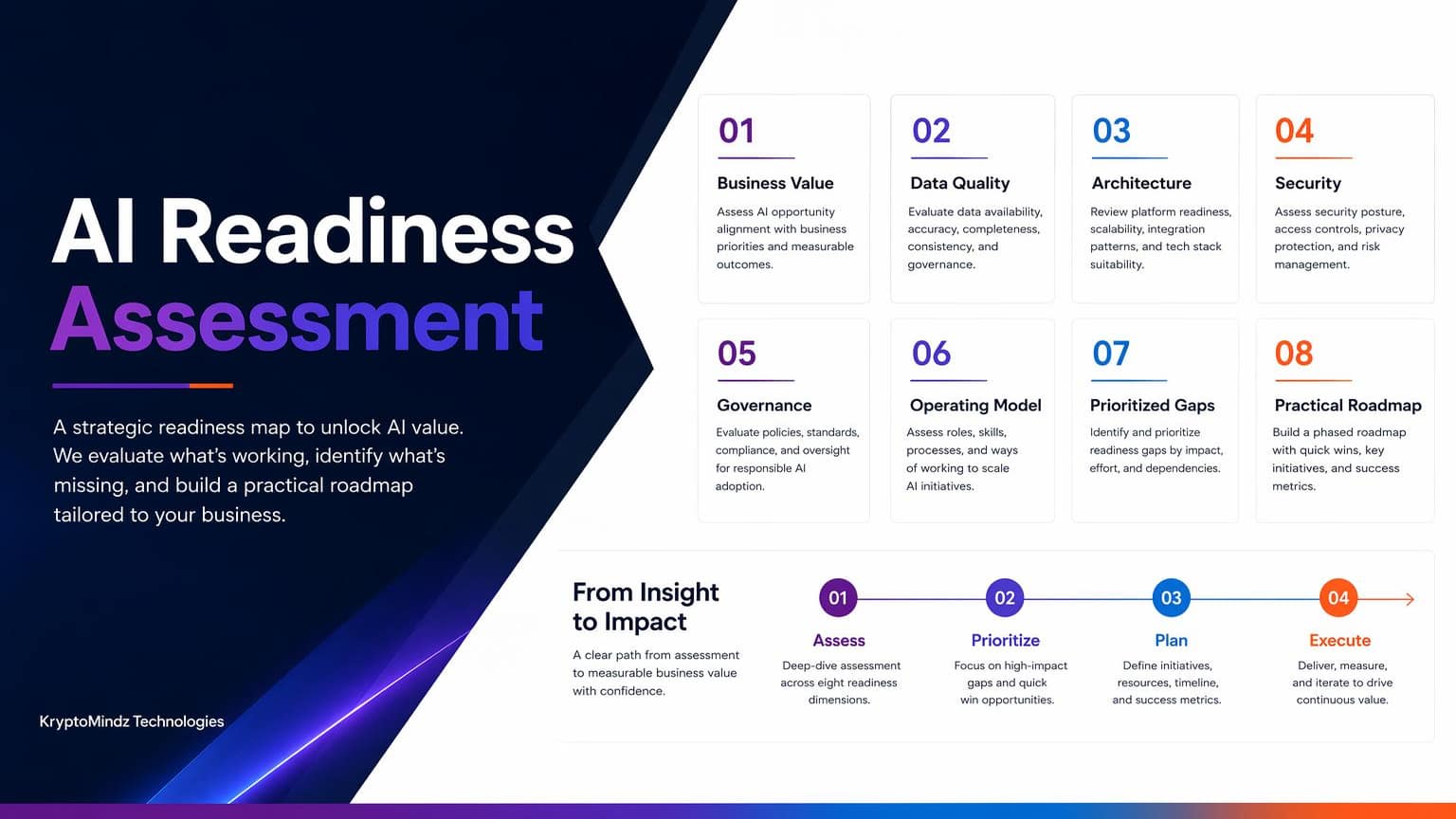
An organization can license powerful models and still be unready to deliver dependable AI. The limiting factor may be workflow clarity, data ownership, integration, evaluation, security, decision rights or operating capacity.
A useful assessment tests the complete delivery system. It distinguishes opportunities that need simple assistance, retrieval or analytics from those that justify agents and controlled autonomy.
Teams have demonstrations but no common criteria for value, production readiness or scale.
Executives need a defensible portfolio, investment sequence and ownership model.
The organization needs to understand tool, identity, approval and observability requirements before autonomy.
Use cases depend on context, integrations or controls that are not production-ready.
Security, privacy, legal and governance teams need a shared assessment method.
Teams need requirements before selecting platforms, models or implementation partners.
Do not commission a broad readiness program when one bounded workflow already has clear value, owned data, architecture and controls. In that case, a focused solution assessment or pilot design may be faster and more useful.
Map decisions, handoffs, delays, systems, users, pain, value measures and constraints.
Score opportunities for value, feasibility, data, risk, autonomy and change impact.
Evaluate data, architecture, integration, security, governance, talent and operations.
Identify foundations required before pilots can produce credible evidence.
Prioritize pilots, owners, controls, success measures, stop criteria and scale gates.
| Decision | Question | Output |
|---|---|---|
| AI pattern | Assistance, retrieval, prediction, generation or bounded autonomy? | Pattern decision and rationale |
| Data readiness | Are sources authoritative, permitted, accessible and current? | Data gap and control map |
| Architecture | Which shared model, context, tool and observability capabilities are needed? | Target capability architecture |
| Governance | Who owns decisions, risks, exceptions and evidence? | RACI and lifecycle gates |
| Value | What measurable outcome justifies continuation or scale? | Pilot scorecard and stop criteria |
Evidence-based findings across six delivery domains.
Value, feasibility, risk and dependency scoring.
Required data, platform, security, governance and operations capabilities.
Sequenced initiatives with owners, gates, measures and dependencies.
Starting with a model or vendor can produce expensive demonstrations without business adoption.
Access, quality, ownership and semantics often dominate delivery effort.
Agent ambition can outrun identity, permissions, approvals and monitoring.
Scope depends on business units, workflows, use-case count, stakeholder availability, data complexity, platform fragmentation, regulatory impact and required roadmap depth. The assessment should remain small enough to drive decisions rather than become a transformation program itself.
Bring the workflow, current architecture, participants, constraints and evidence requirements. KryptoMindz will help qualify the approach and define the smallest defensible next step.
Discuss Your ProjectIt is a structured evaluation of business value, use cases, data, architecture, security, governance, people and operations before scaling AI investment.
No. Requirements and use-case evidence should guide platform decisions rather than the other way around.
No. The assessment should stop weak or premature ideas and prioritize only opportunities with credible value and feasible foundations.
Yes. Production readiness includes ownership, risk tiers, data boundaries, identity, approvals, monitoring, incidents and evidence.
Typical outputs include a scorecard, prioritized portfolio, capability gaps, target architecture, pilot recommendations and phased roadmap.