High-Assurance Signing
Digital signatures or code signing require protected non-exportable keys.

Hardware-Backed Key Security
Protect high-value cryptographic keys with an architecture that covers integration, non-exportable key use, availability, backup, recovery, ceremonies, monitoring and migration.
KryptoMindz helps teams define HSM requirements, deployment topology, interfaces, key hierarchy, signing flows, access control, resilience and operational governance without assuming one vendor or appliance model.
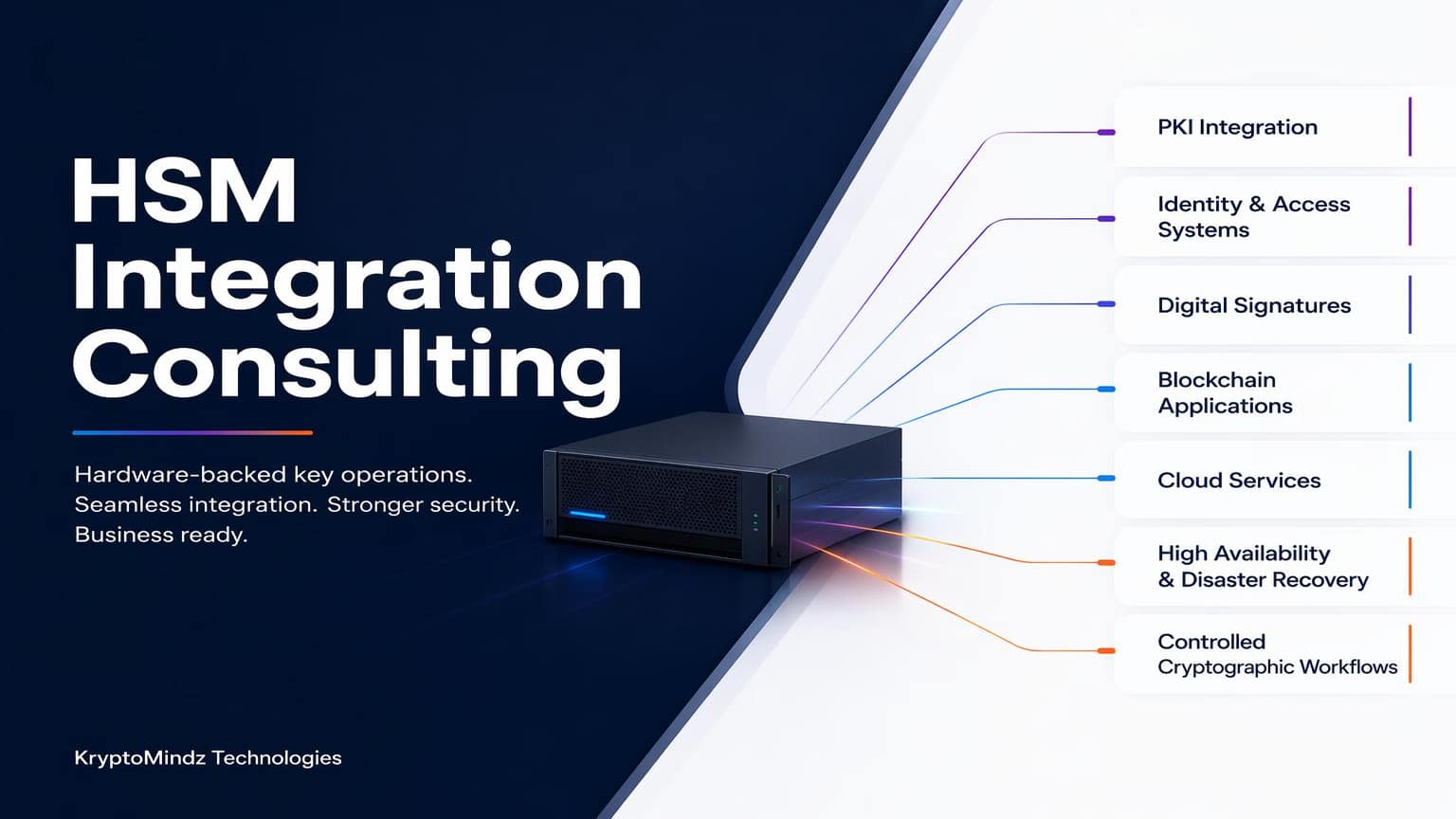
An HSM can generate and use keys inside a protected boundary, but the surrounding architecture determines who may request operations, how applications authenticate, what happens during failure and whether backup, recovery and ceremonies are controlled.
Integration must connect cryptographic policy, application interfaces, network zones, identity, roles, availability, observability and operational evidence.
Digital signatures or code signing require protected non-exportable keys.
Certificate authorities need controlled key generation, backup and ceremony.
Policies or assurance requirements call for hardware-backed controls and evidence.
Validator, issuer or service keys need stronger custody and accountable use.
Applications need consistent cryptographic control across environments.
Legacy appliances, algorithms or deployment models require controlled transition.
Do not deploy an HSM when the key risk, assurance requirement and operating capability do not justify its cost and complexity. Cloud KMS, managed signing or well-controlled software keys may be proportionate for lower-risk workloads.
Map workloads, keys, algorithms, assurance, throughput, latency, regions and dependencies.
Define appliances or services, partitions, clients, network zones, identities and APIs.
Specify generation, ownership, roles, quorum, authorization, rotation and destruction.
Design high availability, backup, restore, disaster recovery and ceremony evidence.
Plan testing, cutover, monitoring, capacity, incidents, firmware and lifecycle governance.
| Decision | Question | Output |
|---|---|---|
| Deployment | On-premises appliance, cloud HSM, managed service or hybrid? | Deployment topology |
| Interfaces | PKCS#11, JCE, CNG, REST or vendor integration? | Application integration design |
| Key hierarchy | Which roots, wrapping keys, signing keys and data keys are required? | Key architecture |
| Authorization | Which workloads and people may request each operation? | Identity, role and quorum model |
| Recovery | How are keys backed up, restored and tested without weakening custody? | Continuity and ceremony plan |
Topology, zones, partitions, clients, interfaces and application paths.
Hierarchy, roles, quorum, generation, rotation, backup and destruction.
Authentication, APIs, throughput, errors, monitoring and application changes.
Testing, cutover, ceremonies, resilience, capacity and support.
Insufficient availability or capacity planning can make key protection a service outage.
Documented ceremonies are not enough unless backup and restore are tested.
Vendor-specific interfaces can make migration and resilience harder.
Scope depends on key and workload count, deployment model, assurance and certification needs, throughput and latency, regions, availability, interfaces, application changes, ceremonies, backup/recovery, migration and operational staffing.
Bring the workflow, current architecture, participants, constraints and evidence requirements. KryptoMindz will help qualify the approach and define the smallest defensible next step.
Discuss Your ProjectIt is architecture and implementation planning for hardware-backed key generation, storage, signing, encryption and lifecycle operations.
No. Protection should be proportional to key value, threat, assurance, performance and operational requirements.
Yes. On-premises, cloud and managed HSM patterns can support cloud and hybrid workloads with appropriate network and identity design.
Backup and recovery mechanisms vary, but they should preserve non-exportability intent, quorum, audit evidence and tested restoration.
Typical outputs include topology, key hierarchy, roles, integration specifications, availability, backup/recovery, migration and operations roadmap.