Known Consortium Members
Organizations need controlled onboarding, certificate identity and shared transaction rules.

Permissioned Blockchain Architecture
Turn a qualified multi-organization workflow into a buildable Fabric network with explicit trust roles, privacy boundaries, endorsement policy and operating ownership.
KryptoMindz designs consortium topology, MSP and certificate architecture, channels, private data collections, chaincode boundaries, integrations and production controls without forcing Fabric into single-owner problems.
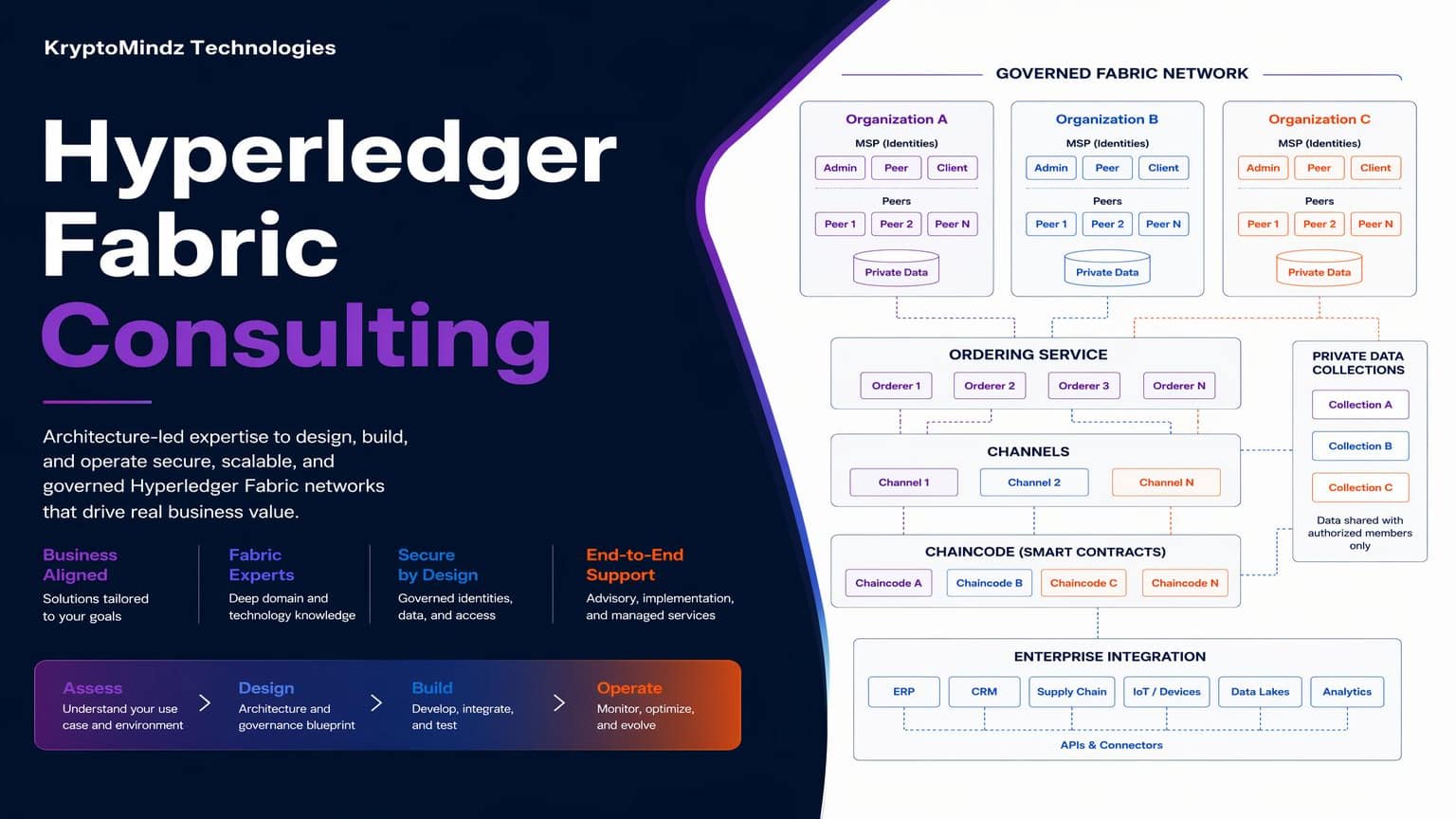
Hyperledger Fabric is not a conventional application database. Its value appears when known organizations need shared verification while retaining explicit identity, endorsement and selective privacy.
Architecture decisions about organizations, peers, channels, private data, ordering, chaincode and key custody encode the consortium operating model. Weak decisions become difficult to change after participants integrate.
Organizations need controlled onboarding, certificate identity and shared transaction rules.
Some participants must validate a workflow without seeing every field or record.
Partners repeatedly reconcile status, approvals, provenance or document evidence.
Business actions require signatures from defined organizations or roles.
Identity, access, audit and evidence must be inspectable.
The ledger must coordinate with ERP, CRM, documents, events and analytics.
Do not use Fabric when one trusted organization owns the workflow, participants do not need shared verification, privacy can be handled through ordinary access control, or a conventional database and signed audit log meet the requirement with less operational burden.
Validate participants, shared state, disputes, privacy, governance and measurable benefit.
Define organizations, certificate authorities, identities, roles, onboarding and removal.
Place shared and restricted data in the simplest defensible topology.
Separate jointly governed state transitions from off-chain systems and records.
Define ordering, peers, environments, keys, observability, resilience, upgrades and support.
| Decision | Question | Output |
|---|---|---|
| Network topology | Which organizations run peers, orderers and certificate authorities? | Topology and responsibility map |
| Privacy | Channels, private data collections or off-chain protected storage? | Data placement decision |
| Endorsement | Which organizations must approve each state transition? | Endorsement policy model |
| Chaincode | Which rules require shared deterministic execution? | Contract boundary and upgrade plan |
| Operations | How are nodes, certificates, keys and incidents managed? | Runbook and service model |
Organizations, MSPs, peers, ordering, channels and network zones.
Certificate lifecycle, roles, policies and restricted-data design.
Shared state, transactions, events and upgrade governance.
Integration backlog, environments, tests, operations and scale gates.
Too many channels increase deployment, integration and operational complexity.
Putting private business logic or large records on-ledger weakens maintainability.
MSP identity depends on disciplined issuance, renewal, revocation and key protection.
Cost and timeline depend on consortium size, organization and node count, privacy topology, chaincode complexity, certificate/HSM requirements, integration depth, performance targets, environments, resilience and partner onboarding maturity.
Bring the workflow, current architecture, participants, constraints and evidence requirements. KryptoMindz will help qualify the approach and define the smallest defensible next step.
Discuss Your ProjectIt is architecture and implementation planning for permissioned Fabric networks, including organizations, MSP identity, channels, private data, chaincode, integration, deployment and governance.
Fabric fits known-organization workflows that need shared verification, policy-based endorsement and selective data privacy.
No. Channels, private data collections and off-chain storage should be compared to avoid unnecessary topology complexity.
Yes. Fabric commonly coordinates with APIs, events, ERP, CRM, document stores, identity systems and analytics.
Typical outputs include topology, MSP and privacy models, chaincode boundaries, integration architecture, security controls, pilot plan and production roadmap.