RWA Tokenization Programs
Design token structures, smart-contract governance and operating rules for funds, bonds, private credit, invoices, commodities and real estate.
Architect tokenization programs for real-world assets that regulators, custodians, auditors and investors can actually trust — from token design and custody to MiCA compliance, issuance, redemption and settlement.
KryptoMindz brings enterprise blockchain, HSM-backed custody, digital identity, cryptographic evidence and compliance engineering into one implementation-ready blueprint for institutional digital assets.
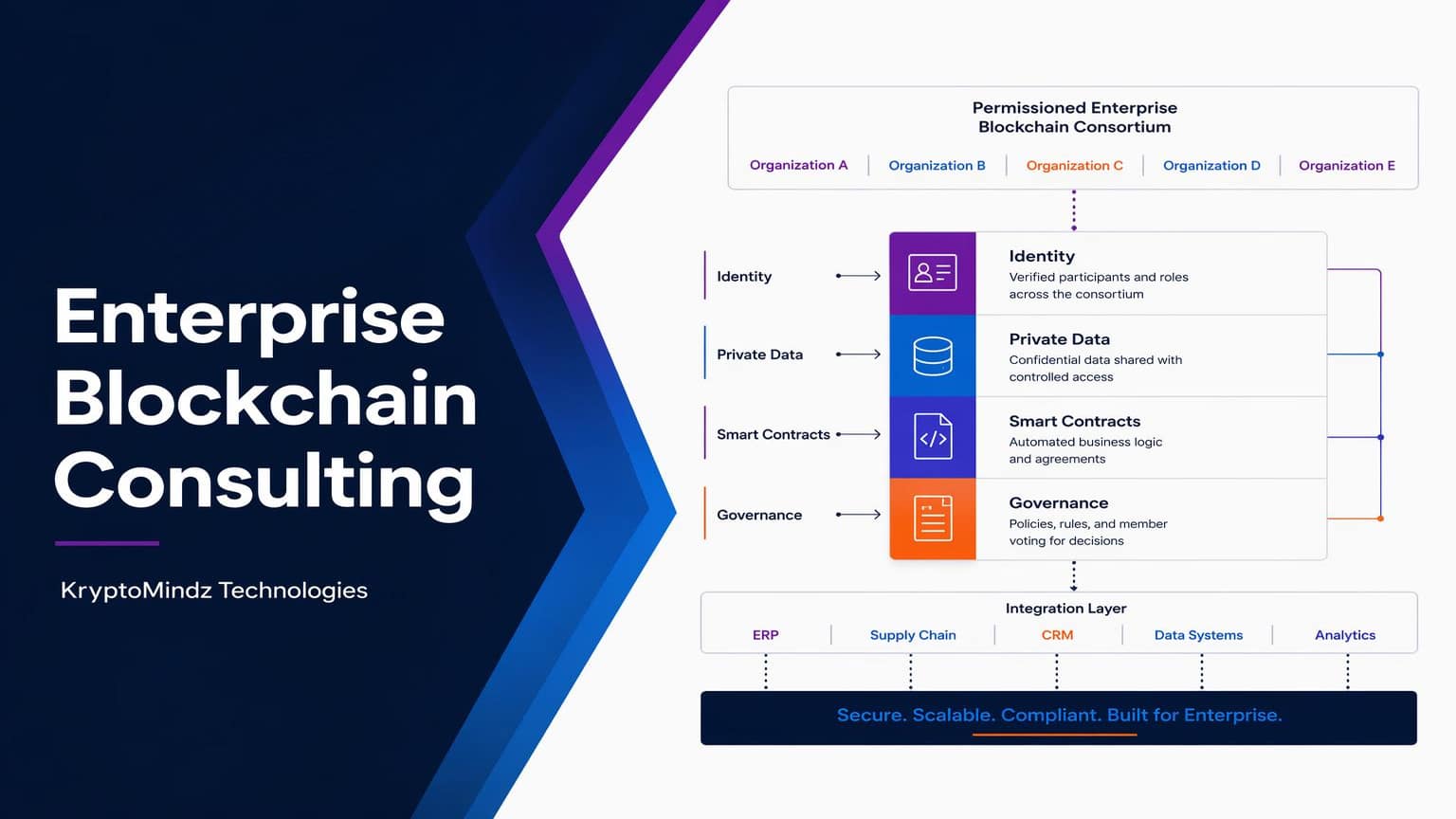
Most institutions agree that tokenization can reduce settlement cost, improve liquidity and make asset provenance programmatic. The hard part is not minting a token. It is designing the operating model around it: who can create and destroy units, how ownership and identity are proven, where keys and reserves are held, which rules apply in each jurisdiction, how investors on- and off-board, and what evidence an auditor can rely on at year-end.
Digital asset consulting defines how those parts work together. It covers token standards and smart-contract governance, custody and HSM-backed key management, MiCA and securities-law compliance, issuance and redemption workflows, settlement and reconciliation, investor identity and anti-money-laundering checks, and the integration path into core banking, fund administration and accounting systems.
The result is not a whitepaper. It is a target architecture, operating model and phased roadmap that turns a tokenization ambition into a runnable, auditable program.
The engagement adds the most value when a tokenization program must satisfy external parties — regulators, custodians, auditors, investors or partners — rather than only internal teams.
Design token structures, smart-contract governance and operating rules for funds, bonds, private credit, invoices, commodities and real estate.
Map securities-law requirements, issuance, transfer restrictions, investor eligibility and disclosure into a compliant digital-asset workflow.
Define reserve management, redemption, disclosure, authorization and operational controls for asset-referenced and e-money tokens in the EU.
Tokenize physical and digital infrastructure revenue — compute, connectivity, energy or data — with defensible attribution and payout evidence.
Tokenize invoices, receivables and letters of credit so funders can verify provenance, ownership and settlement without re-keying data.
Connect tokenized assets to regulated DeFi venues, custody networks and payment rails with controlled exposure and audit trails.
A tokenization program needs the same discipline as a payments or securities platform: custody, compliance, identity, evidence and reconciliation working as one controlled system.
HSM-backed wallets, key lifecycle, multi-signature governance, backup and recovery, and cold-storage procedures for issuer and investor assets.
Authorization paths, disclosures, reserve and redemption rules, travel-rule screening, sanctions checks and jurisdiction-specific issuance controls.
Programmable mint, burn and transfer controls with approval gates, investor eligibility checks, settlement matching and audit logging.
Immutable records of issuance, transfers, approvals and custody events that auditors and regulators can verify independently of the operator.
Atomic or near-atomic settlement across cash, tokens and securities rails with daily reconciliation against custody and fund records.
KYC, AML and accredited-investor checks linked to verifiable identity, wallet ownership and ongoing eligibility monitoring.
A disciplined architecture avoids building token infrastructure that does not improve a real business outcome.
A shared ledger is not required to fix a database, reconciliation or reporting problem. Existing systems may be the right answer.
If investors, regulators and auditors will never inspect the ledger, the cost and governance burden of tokenization is hard to justify.
Technology cannot compensate for an unresolved authorization, disclosure or redemption framework in your target jurisdiction.
Tokenization does not create demand. If the asset has no market, a token changes how it trades, not whether it trades.
The work starts from the asset, the investors and the jurisdiction — not from a technology preference — and moves to a buildable program.
Clarify the asset class, investor base, target jurisdictions, regulatory posture, distribution channels and the business outcome the program must deliver.
Evaluate legal structure, custody options, settlement rails, tax and accounting treatment, and where tokenization adds measurable value versus cost.
Define token standards, governance, eligibility rules, issuance and redemption workflows, role separation and the smart-contract control surface.
Map MiCA, securities, AML, travel-rule and sanctions obligations to controls, evidence, owners and operating procedures.
Select the ledger, custody, identity and settlement stack; define integration contracts with core banking, fund admin and accounting systems.
Scope the smallest defensible pilot, proof criteria, phased rollout, monitoring, incident response and audit-readiness checks.
Asset structure, token design, governance, roles, issuance and redemption flows, and jurisdiction decisions.
MiCA, securities, AML and sanctions obligations mapped to controls, evidence, owners and procedures.
HSM-backed wallet design, key lifecycle, multi-signature policies, backup, recovery and segregation of duties.
Approval gates, eligibility checks, mint/burn/transfer rules and upgrade governance for the token layer.
Contracts and data flows between the ledger, custody, investor onboarding, settlement and core systems.
Pilot scope, milestones, prerequisites, validation criteria, operational runbooks and audit-readiness checkpoints.
| Need | Likely Foundation | What It Does Not Solve Alone |
|---|---|---|
| Represent ownership programmatically | Token standard with controlled mint, burn and transfer | Investor eligibility, custody and regulatory disclosure |
| Protect private keys at scale | HSM-backed custody with multi-signature governance | Whether a transfer should be approved |
| Operate under MiCA | Authorization, reserve, redemption and disclosure controls | Token technology, market liquidity and investor demand |
| Prove issuance and custody events | Immutable audit records and cryptographic evidence | Day-to-day operational reconciliation by itself |
| Settle across institutions | Permissioned ledger or institutional settlement rails | KYC/AML identity governance and legal agreements |
| Onboard and verify investors | KYC, AML, accredited-investor and verifiable-identity checks | Token mechanics, market-making and liquidity |
Digital asset and RWA programs are scoped by asset class, jurisdiction, investor base and integration complexity — not by token count. A feasibility assessment for one private-credit fund is materially different from a MiCA-authorised stablecoin or a cross-border tokenized-bond platform.
KryptoMindz defines scope and commercial terms after discovery. The page does not promise a fixed result, certification or compliance outcome.
Bring one asset class, the investors you need to reach and the regulatory question your team cannot answer confidently. We will identify the right feasibility assessment or pilot scope.
Discuss Your ProjectReal-world asset (RWA) tokenization represents ownership or claims on tangible and financial assets such as funds, bonds, private credit, invoices, commodities or real estate as digital tokens on a shared ledger, making transfer, settlement and verification programmatic.
Digital asset consulting covers token design, custody and key management, MiCA and securities compliance, issuance and redemption workflows, settlement, identity and investor onboarding, audit evidence and the enterprise architecture that connects tokens to core systems.
No. Many regulated programs run on permissioned networks or institutional rails. The right choice depends on investor reach, regulatory jurisdiction, settlement model and who needs to verify ownership.
The EU Markets in Crypto-Assets Regulation (MiCA) governs stablecoins, asset-referenced tokens and utility tokens with authorization, disclosure, custody, redemption and reserve requirements that materially shape token design and operations.
An engagement is useful before committing to a technology stack, jurisdiction or operating model, when a fund, bond, invoice or real-estate program must satisfy regulators, custodians, auditors and investors with provable controls.