Document Approval
Contracts, decisions or records require integrity and signer evidence.

Cryptographic Trust Architecture
Create defensible signing and validation workflows that connect signer identity, protected keys, certificates, timestamps, revocation and retained business evidence.
KryptoMindz designs PKI hierarchy, certificate and key lifecycle, signature levels, timestamping, validation services, HSM integration and operational governance for enterprise trust.
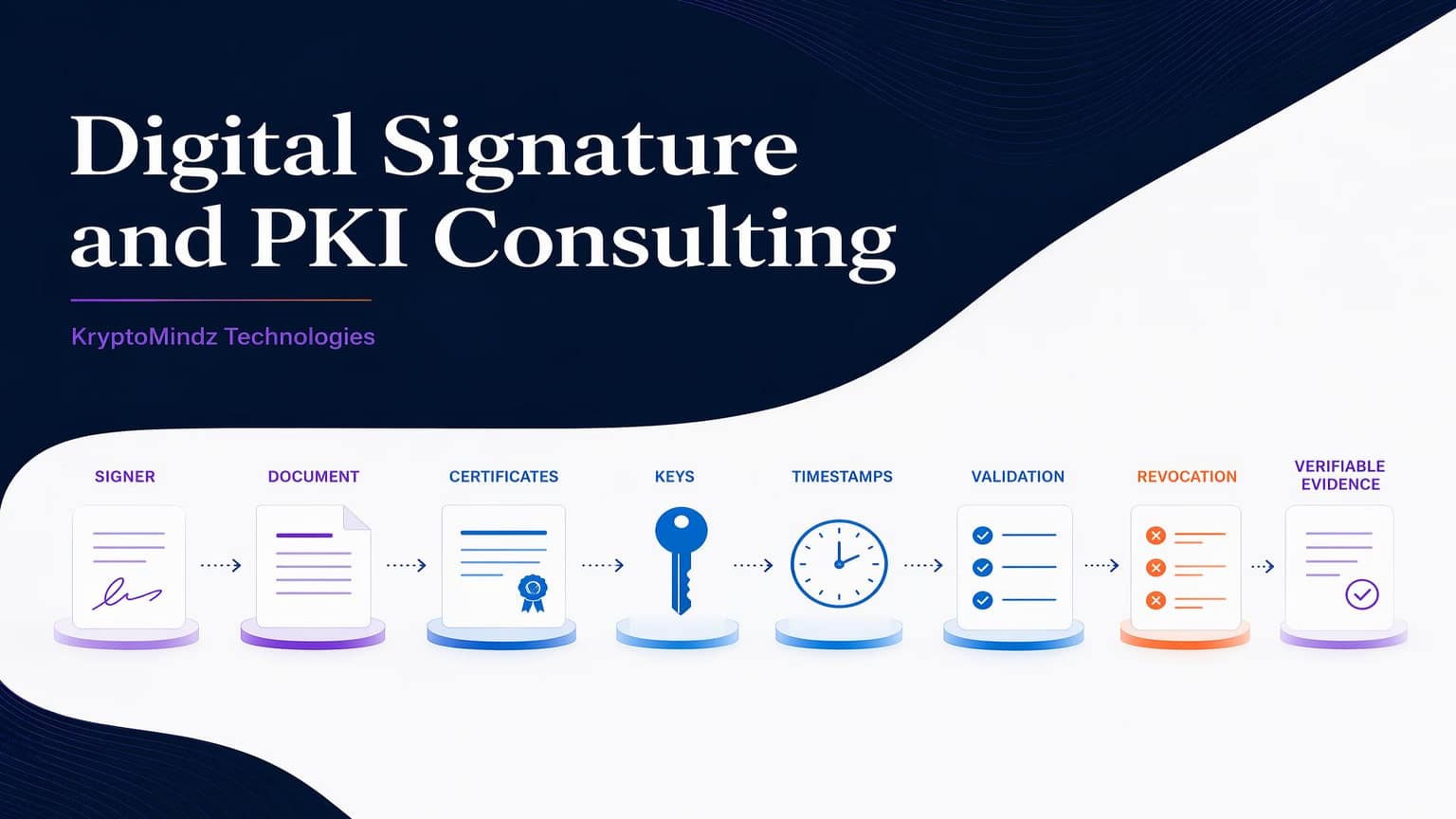
A digital signature is useful only when the verifier can establish who controlled the signing key, whether the certificate was valid, whether the document changed and what evidence remains after certificates expire.
PKI architecture connects certificate authorities, registration, key protection, policy, timestamping, revocation, validation and operational accountability.
Contracts, decisions or records require integrity and signer evidence.
Certificate services, policies or lifecycle operations need redesign.
Signing assurance, timestamps and validation evidence must be defensible.
Workloads need certificates and automated lifecycle controls.
Partners need agreed certificate policies and validation behavior.
Documents must remain verifiable after key or certificate changes.
Do not introduce high-assurance PKI or qualified-signature complexity when ordinary authentication and an application approval log meet the business and legal requirement. Signature level should be proportional to risk and jurisdiction.
Define signer, document, decision, jurisdiction, evidence and validation requirements.
Design authorities, hierarchy, policies, identities, certificates and relying-party trust.
Choose custody, HSM, algorithms, signature format, timestamp and user experience.
Define chain building, revocation, timestamps, retention and long-term validation.
Sequence issuance, renewal, automation, monitoring, ceremonies and legacy transition.
| Decision | Question | Output |
|---|---|---|
| Assurance level | What identity proof and signature meaning are required? | Signature policy |
| PKI hierarchy | Public trust, private PKI or hybrid? | Authority architecture |
| Key custody | Software, cloud KMS, remote signing or HSM? | Key protection model |
| Validation | How are trust chain, status, timestamp and policy evaluated? | Validation architecture |
| Lifecycle | How are issuance, renewal, revocation, rollover and retirement operated? | Certificate/key lifecycle |
Signer, document, approval, signature, timestamp and evidence flows.
Authorities, policies, certificates, roles and relying-party decisions.
Custody, ceremonies, algorithms, availability and integrations.
Automation, validation, monitoring, rollover and support.
Signature strength collapses when keys can be copied or used without accountable control.
A signature may be cryptographically valid but untrusted, revoked or outside policy.
Manual renewal and hidden dependencies create avoidable service failures.
Scope depends on certificate populations, assurance level, public/private trust, authority hierarchy, HSM or remote signing, signature formats, timestamping, validation and long-term evidence, automation, legacy migration and availability targets.
Bring the workflow, current architecture, participants, constraints and evidence requirements. KryptoMindz will help qualify the approach and define the smallest defensible next step.
Discuss Your ProjectIt is architecture and operations support for signing keys, certificates, trust authorities, timestamps, validation, revocation and evidence.
Not always. Digital signatures use cryptography and certificates; legal categories and required assurance vary by workflow and jurisdiction.
Not every workflow does. HSMs are useful when keys require strong non-exportability, controlled signing, audit and high-assurance operations.
Yes. Automation should include identity, authorization, issuance, deployment, monitoring, renewal, revocation and exception handling.
Typical outputs include signature flow, PKI hierarchy, policy, key/HSM design, validation evidence, lifecycle operations and migration roadmap.