Portable Claims
People or organizations need to reuse verified claims across services.

Portable Digital Trust
Create portable claims that relying parties can verify while minimizing unnecessary data disclosure and preserving clear issuer, holder and verifier accountability.
KryptoMindz designs credential use cases, schemas, issuance and presentation protocols, wallet interactions, status and revocation, trust registries, privacy and ecosystem governance.
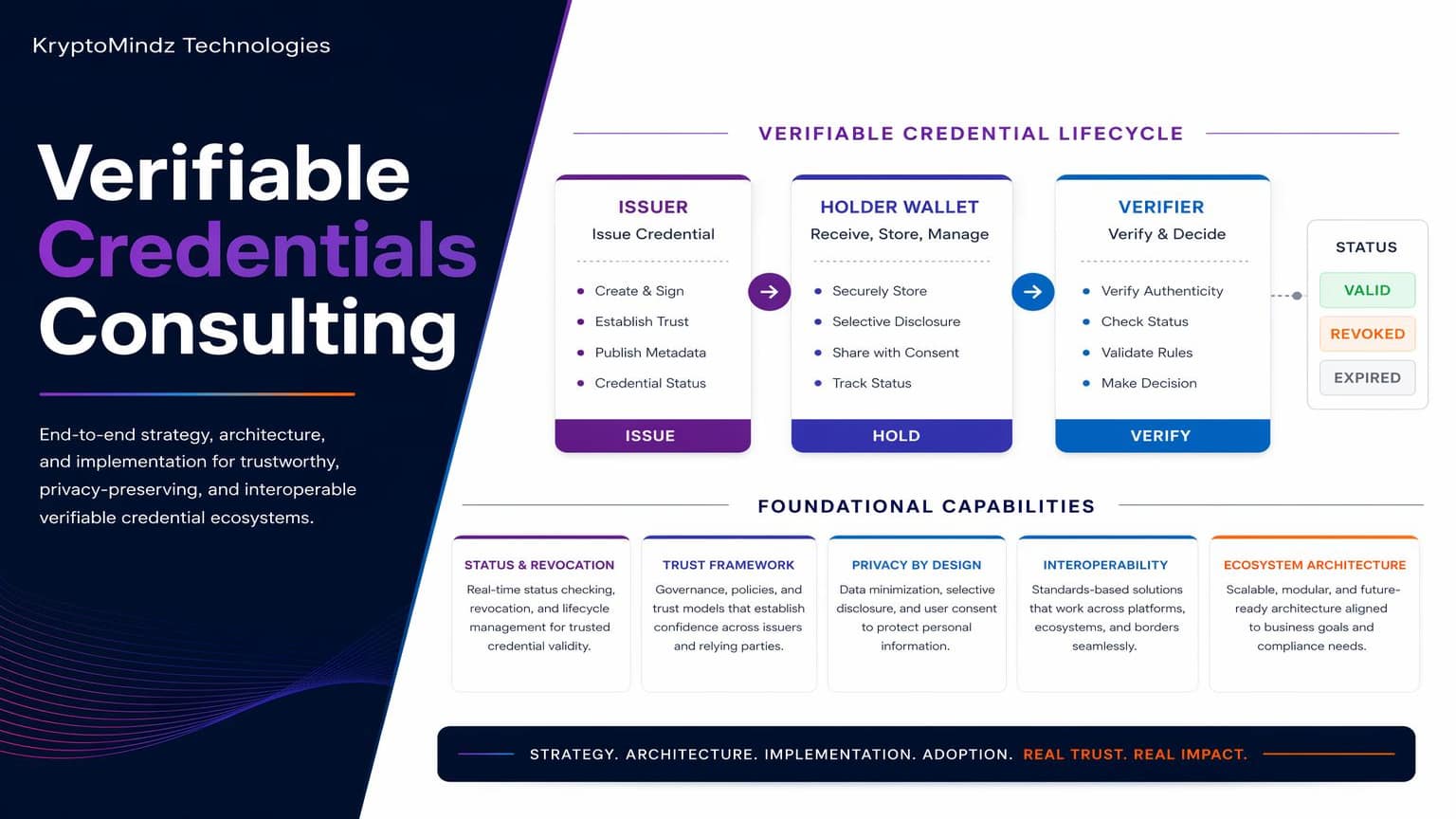
Cryptographic verification can prove that a credential was issued and has not changed. It does not by itself prove that the issuer is trusted, the claim is current, the schema is meaningful or the verifier requested proportionate data.
A production ecosystem needs governance, schemas, protocol interoperability, status, revocation, wallet behavior, privacy and operational responsibility.
People or organizations need to reuse verified claims across services.
Relying parties cannot depend on one shared account database.
A workflow should disclose only claims required for a decision.
Issuance, verification, status and audit evidence need explicit rules.
Qualifications, authority or membership must travel between organizations.
Credentials must work predictably across issuer, holder and verifier products.
Do not introduce verifiable credentials when a single organization owns issuance and verification, conventional federation solves the workflow, users gain no portability, or ecosystem participants cannot establish governance and support lifecycle operations.
Define the decision, minimum claims, issuer authority, holder experience and verifier outcome.
Define accepted issuers, registries, policies, assurance and accountability.
Specify formats, issuance, storage, presentation, status, revocation and retention.
Evaluate OpenID4VCI, OpenID4VP, DID/PKI patterns and wallet interoperability.
Define integrations, tests, support, monitoring, incidents and production gates.
| Decision | Question | Output |
|---|---|---|
| Credential model | Which claims, schema, evidence and assurance are required? | Credential definition |
| Issuance | OpenID4VCI or another secure issuance flow? | Issuance protocol design |
| Presentation | How does the holder consent and disclose proportionately? | Presentation and privacy model |
| Trust discovery | How does a verifier decide which issuers and policies to trust? | Trust registry/governance design |
| Status | How are suspension, revocation and freshness checked? | Lifecycle operations model |
Claims, semantics, assurance, formats and examples.
Issuance, wallet, presentation, consent and verification journeys.
Issuer acceptance, registries, policies, roles and disputes.
Protocols, wallet tests, status, integrations and pilot plan.
Poor claim design can recreate centralized data collection in a new format.
Cryptographic validity is insufficient without issuer authority and policy context.
Status, revocation, expiry and recovery must work after issuance.
Cost depends on credential and participant count, assurance level, schema governance, wallet support, protocol interoperability, status/revocation needs, trust registry design, privacy requirements, integrations and ecosystem onboarding.
Bring the workflow, current architecture, participants, constraints and evidence requirements. KryptoMindz will help qualify the approach and define the smallest defensible next step.
Discuss Your ProjectIt is architecture and governance support for portable digital claims across issuers, holder wallets and verifiers.
No. They can be used in decentralized or conventional identity architectures. The trust and identifier pattern should fit the ecosystem.
Yes. These protocols can be evaluated for credential issuance and presentation alongside wallet and interoperability requirements.
The ecosystem needs a status or revocation mechanism, verifier policy and operating process appropriate to privacy and freshness needs.
Typical outputs include credential schemas, trust roles, issuance/presentation flows, protocol decisions, status design, governance, pilot plan and roadmap.