Enterprise Ethereum Skills
Teams need Solidity, Web3 APIs and EVM-compatible tooling.
Enterprise Ethereum Architecture
Build an enterprise Ethereum architecture that preserves familiar EVM tooling while making participant identity, permissioning, consensus, privacy and operations explicit.
KryptoMindz helps teams qualify Besu, design permissioned network topology, choose consensus and privacy patterns, integrate Solidity contracts and plan resilient node operations.
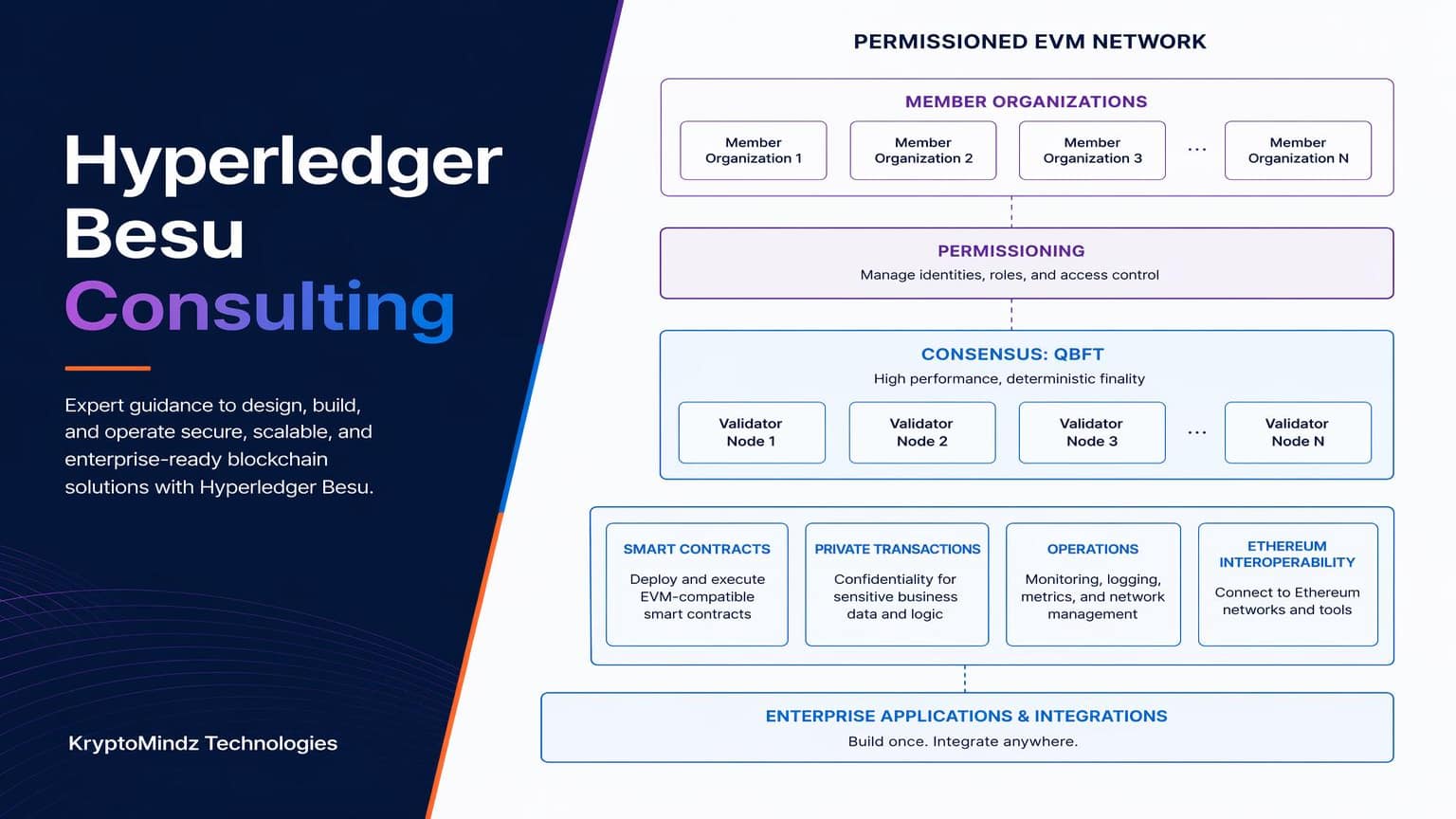
Besu gives enterprise teams Ethereum-compatible execution and tooling, but a permissioned network still needs participant governance, node architecture, consensus, key management, privacy and change control.
The pivotal question is not whether Solidity is familiar. It is whether the workflow benefits from shared EVM state and whether the consortium can operate the network responsibly.
Teams need Solidity, Web3 APIs and EVM-compatible tooling.
Known participants require node and account permissioning.
Organizations need shared smart-contract state and governed upgrades.
The architecture may anchor or interoperate with public Ethereum.
A known validator set needs immediate finality and fault-tolerant consensus.
Shared assets or settlement logic benefit from Ethereum standards.
Do not deploy a private Besu network when one organization owns every node and decision, EVM compatibility creates no integration value, or a database and signed event trail provide the required assurance at lower cost.
Test participants, shared state, EVM need, privacy, governance and alternatives.
Define node identities, accounts, validators, onboarding and removal.
Choose validator topology, QBFT parameters and private transaction patterns.
Define EVM contract boundaries, APIs, events, off-chain records and upgrades.
Plan keys, nodes, monitoring, backup, recovery, releases and incident ownership.
| Decision | Question | Output |
|---|---|---|
| Network model | Permissioned private network, public Ethereum or hybrid? | Network decision record |
| Consensus | How many validators and what failure assumptions apply? | QBFT topology and governance |
| Permissioning | Who may connect, transact, deploy and administer? | Node/account policy model |
| Privacy | Private transactions, application encryption or separate storage? | Data placement decision |
| Interoperability | Which Solidity, wallet, Web3 and public-chain interfaces matter? | Integration architecture |
Members, nodes, validators, zones, RPC and integration paths.
Node/account policies, roles, custody and lifecycle.
EVM boundaries, upgrades, private transactions and off-chain data.
Tests, environments, monitoring, resilience and consortium onboarding.
A weak validator distribution can undermine consortium trust assumptions.
Node APIs require strong network, authentication, rate and administrative controls.
EVM familiarity does not solve upgrade authority, emergency control or audit evidence.
Scope varies with member and validator count, privacy requirements, smart-contract complexity, Ethereum/public anchoring, key custody, integration volume, transaction performance, environments, resilience and consortium governance.
Bring the workflow, current architecture, participants, constraints and evidence requirements. KryptoMindz will help qualify the approach and define the smallest defensible next step.
Discuss Your ProjectIt is architecture and implementation planning for enterprise Ethereum networks using Besu, including EVM contracts, permissioning, consensus, privacy, integrations and operations.
Besu uses the Ethereum execution model and Solidity ecosystem. Fabric uses MSP identities, endorsement policies, channels and private data collections.
Yes. Besu supports node and account permissioning and enterprise consensus such as QBFT.
Yes, depending on architecture. Teams may use Ethereum-compatible tooling, public anchoring or other hybrid patterns.
Typical outputs include topology, permissioning, consensus, privacy, contract, integration, key, operations and roadmap decisions.