Credential Holder Experience
Users need to receive, organize and present portable claims.

User-Controlled Digital Identity
Turn wallet requirements into a secure product and ecosystem architecture across credential issuance, storage, presentation, consent, recovery and relying-party verification.
KryptoMindz helps teams define wallet roles, threat boundaries, credential lifecycle, OpenID4VCI/OpenID4VP interoperability, key custody, privacy, recovery and operational support.
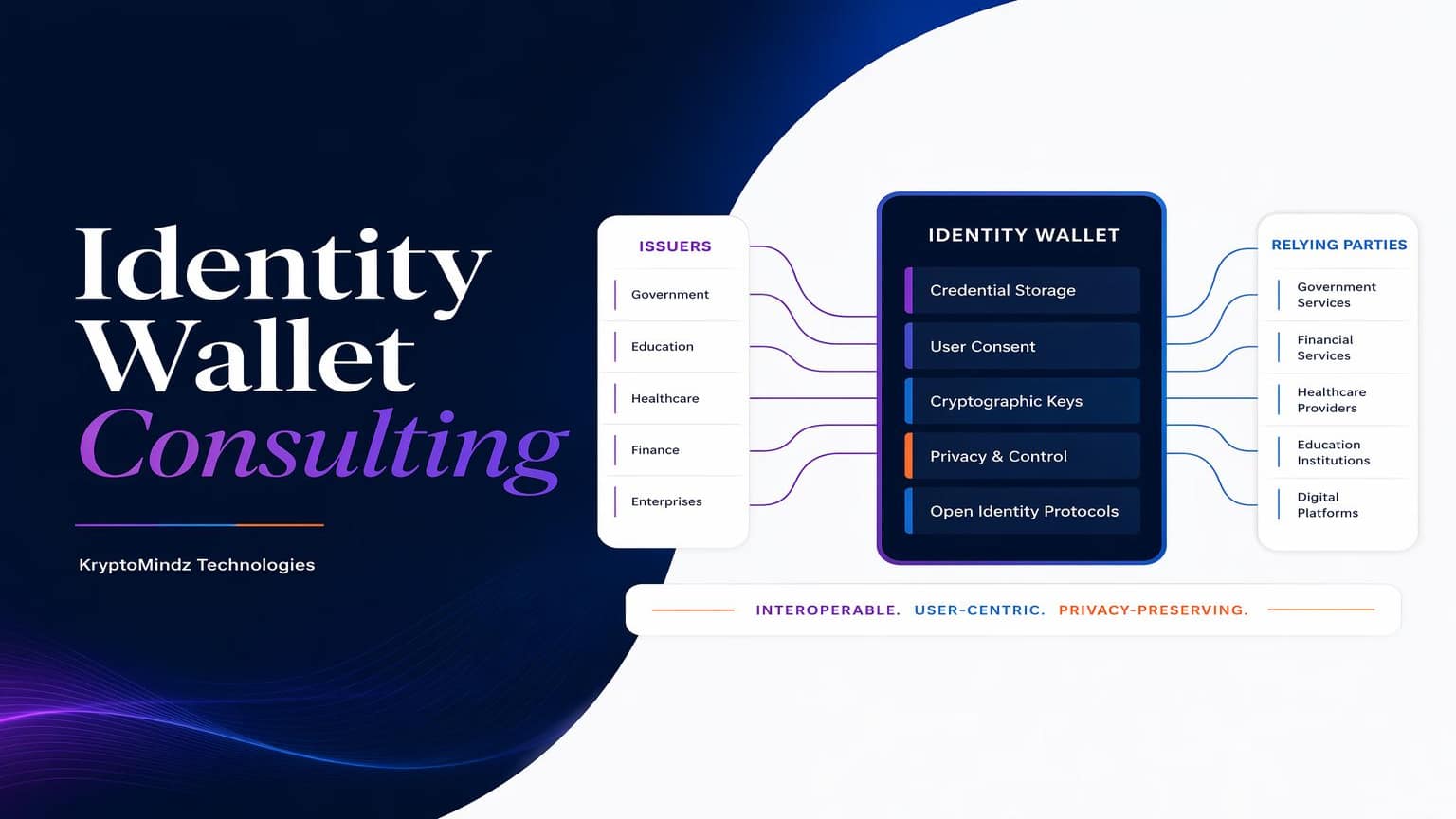
Identity wallets hold or mediate credentials, keys, consent and high-consequence presentations. Product decisions affect privacy, account recovery, device migration, phishing resistance, accessibility and ecosystem interoperability.
The wallet cannot be designed in isolation. Issuers, relying parties, trust registries, protocols and support operations determine whether the user journey actually works.
Users need to receive, organize and present portable claims.
Products need wallet/relying-party interaction and credential-flow planning.
Employees or contractors need portable qualifications and authority.
Users can present verified claims with less repeated document collection.
Organizations need interoperable business or representative credentials.
Consent and selective disclosure must be explicit and inspectable.
Do not build a wallet when a standard account, federation or secure document exchange solves the workflow, when no issuer/verifier ecosystem exists, or when users would carry operational burden without meaningful portability or privacy benefit.
Define users, credentials, issuers, relying parties, decisions and support needs.
Model device, application, key, backup, recovery, malware, phishing and privacy threats.
Define formats, OpenID4VCI/OpenID4VP flows, consent, presentation and status.
Connect issuers and relying parties while designing comprehensible user decisions.
Set interoperability tests, telemetry, support, incident, recovery and release criteria.
| Decision | Question | Output |
|---|---|---|
| Wallet model | Native, web, platform or hybrid experience? | Product architecture |
| Key custody | Device-bound, cloud-assisted, recoverable or externally secured? | Key and recovery model |
| Protocols | Which issuance and presentation profiles must interoperate? | OpenID4VCI/OpenID4VP profile |
| Consent | How are requests explained, minimized and approved? | Consent and disclosure design |
| Recovery | What happens after device loss, compromise or credential replacement? | Recovery and incident model |
Components, trust boundaries, storage, APIs and integration paths.
Keys, device binding, backup, migration, threats and incidents.
Issuance, consent, presentation, status and relying-party flows.
Protocol profiles, wallets, issuers, verifiers and pilot acceptance.
Strong custody without usable recovery can harm users and support operations.
Complex requests can make privacy controls meaningless.
Nominal standards support does not guarantee ecosystem interoperability.
Scope depends on wallet platform count, credential types, custody and recovery model, device security, biometric or platform integration, protocol profiles, relying-party journeys, accessibility, interoperability testing, support and regulatory assurance.
Bring the workflow, current architecture, participants, constraints and evidence requirements. KryptoMindz will help qualify the approach and define the smallest defensible next step.
Discuss Your ProjectIt is product, security and ecosystem architecture support for wallets that receive, store and present digital credentials.
No. Wallets can use PKI, OpenID-based, DID-based or mixed trust patterns depending on ecosystem requirements.
Yes. Issuance and presentation profiles can be designed and tested with issuer and relying-party integrations.
Recovery must balance theft resistance, user support, device migration and credential reissuance; there is no universal mechanism.
Typical outputs include wallet architecture, threat model, key/recovery design, credential flows, protocol profiles, UX decisions and pilot roadmap.