
1. Executive Context
Digital identity is the control plane for modern enterprise activity. It establishes which person, organization, workload or device is participating; what evidence supports that identity; which credentials and authenticators it controls; and what it may do in a particular context. Cloud services, partner ecosystems, regulated customer journeys and AI agents all depend on those decisions.
Portable credentials and wallets add a new architecture option. An issuer can provide a signed credential to a holder, who later presents appropriate evidence to a verifier. This can improve portability, privacy and user control, but only when governance, assurance, lifecycle and interoperability are designed together.
2. Identity Fundamentals
An entity is represented through identifiers, attributes, relationships and credentials. None is automatically trustworthy. An enterprise decides which authority can assert which claim, under what evidence and policy, for how long, and with what recourse when the claim is wrong.
| Decision | Question | Typical evidence |
|---|---|---|
| Identification | Which subject is referenced? | Identifier and namespace |
| Proofing | What binds the subject to an identity? | Authoritative records and validated evidence |
| Authentication | Does the claimant control an approved authenticator? | Cryptographic key, passkey or token |
| Authorization | May this subject perform this action now? | Policy, claims, risk and transaction context |
Assurance is contextual
NIST distinguishes identity, authenticator and federation assurance. Apply assurance according to consequence, attack likelihood and available mitigation. A newsletter preference and a high-value account recovery should not use the same process.
3. Enterprise Identity Strategy and Scope
Define populations and journeys before platforms: workforce, customers, partners, suppliers, organizations, devices and workloads. For each journey, record channel, proofing, authentication, credential, relying service, authorization, recovery and support responsibility.
Choose the interaction model deliberately
Central identity providers remain efficient for many enterprise sessions. Federation reduces password duplication. Portable credentials can reduce repeated proofing and disclose narrower claims. These patterns coexist; an enterprise should not force every interaction into SSI.
Set measurable outcomes
Measure onboarding completion, fraud and false rejection, authentication success, recovery time, support burden, credential acceptance, privacy exposure and integration lead time. Issuing a credential is a milestone, not a business outcome.
Define ecosystem boundaries
A closed workforce program can mandate profiles. A cross-sector ecosystem needs shared governance, certification, metadata, legal agreements, conformance testing and support. Interoperability is a property of a profile and ecosystem, not a standards logo.
4. Enterprise Digital Identity Reference Architecture
A durable architecture separates relying applications from identity orchestration, core identity services, portable credential infrastructure and cross-cutting governance. This permits different assurance paths while preserving policy and evidence.
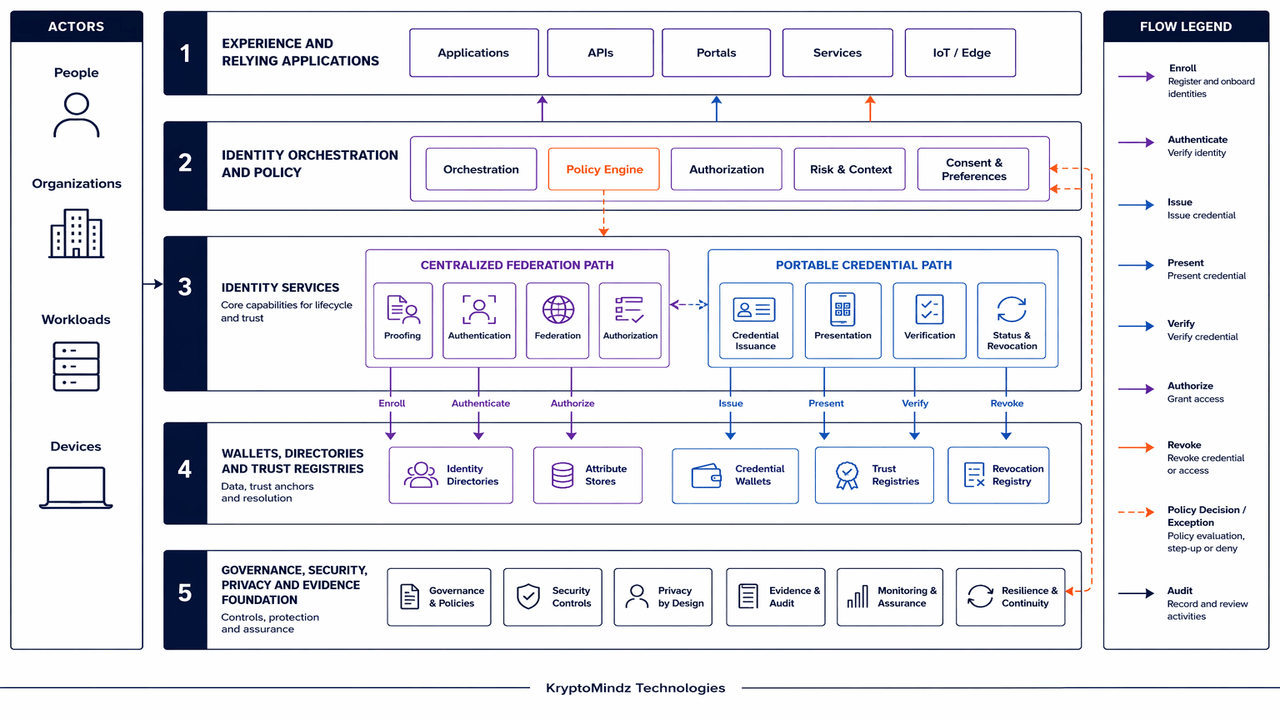
Experience and relying services
Web, mobile, workforce and machine channels request identity capabilities. The relying service owns the business transaction and final authorization; possession of a credential is not blanket access.
Identity orchestration
Journey and policy services select proofing, authentication, issuance or verification based on risk. Keep workflow state, retries and case management outside opaque protocol interactions.
Trust and evidence foundation
Registries, issuer and verifier metadata, schemas, policies, keys, status and audit evidence span all layers. A trust registry informs decisions but does not replace local risk policy or accountability.
5. Identity Lifecycle and Assurance
Identity is a lifecycle, not a login screen. Joiner, mover and leaver events; legal or organizational changes; key rotation; device loss; credential suspension; recovery and retention all change what should be trusted.
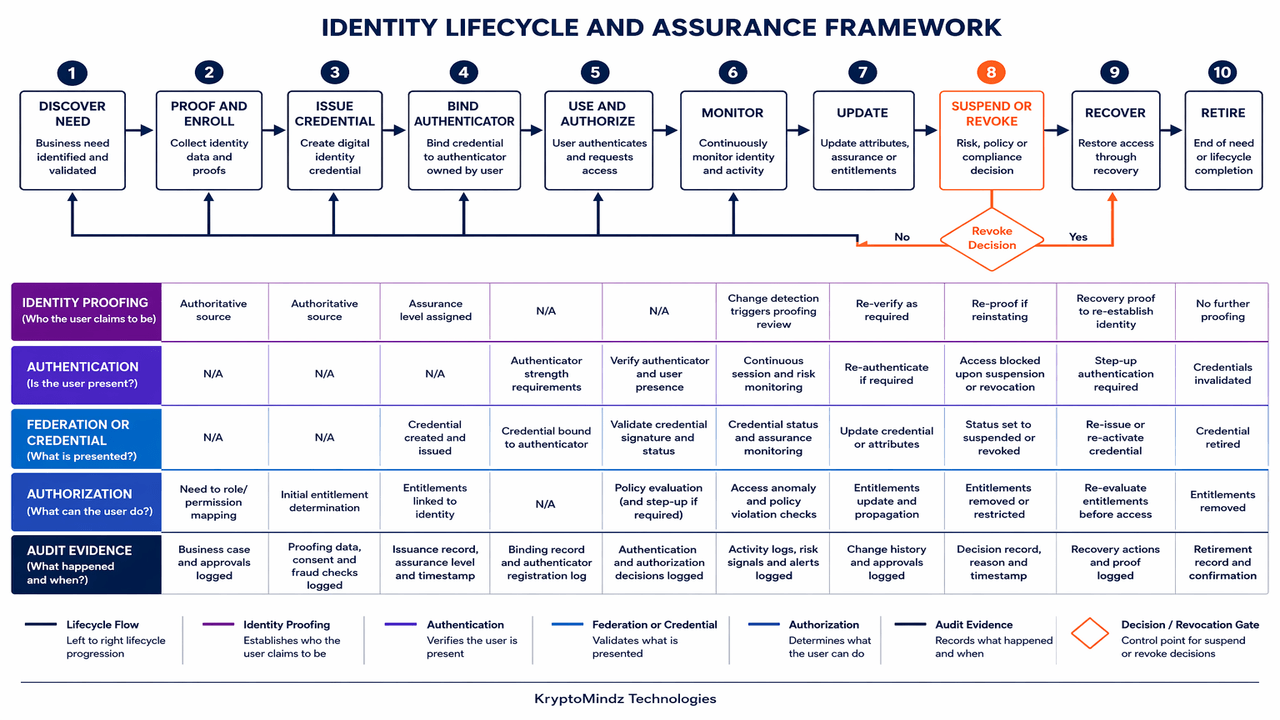
Source-driven change
Define authoritative sources and event ownership. Propagate meaningful changes with known service levels. A credential can remain cryptographically valid while its underlying claim has become false.
Recovery is a high-risk ceremony
Account and wallet recovery commonly bypass strong authentication. Apply proportionate re-proofing, notifications, fraud review, key rotation and reissuance. Test support channels as part of the attack surface.
6. Identity Proofing and Verification
Identity proofing collects and validates evidence, resolves it to one identity and binds the applicant to that identity. Remote document and biometric checks can help, but architecture must account for deepfakes, injection, stolen identity data, accessibility and legitimate users without conventional evidence.
Design from consequence
Select evidence, fraud controls and human review according to impact. Do not infer high assurance from a vendor score whose inputs and error behavior are unknown.
Separate proofing from authentication
A strong enrollment does not compensate for weak authenticators or recovery. Bind phishing-resistant authentication where practical and preserve evidence that the correct authenticator was issued to the proofed subject.
Minimize evidence
Collect only what the purpose needs, protect transmission and storage, restrict operator access, define retention and deletion, and provide correction and redress.
7. Self-Sovereign Identity and Trust Models
SSI gives holders greater agency over portable credentials and reduces dependence on a central identity provider during every transaction. The system still includes issuers, wallet providers, verifiers, registries and governance authorities.
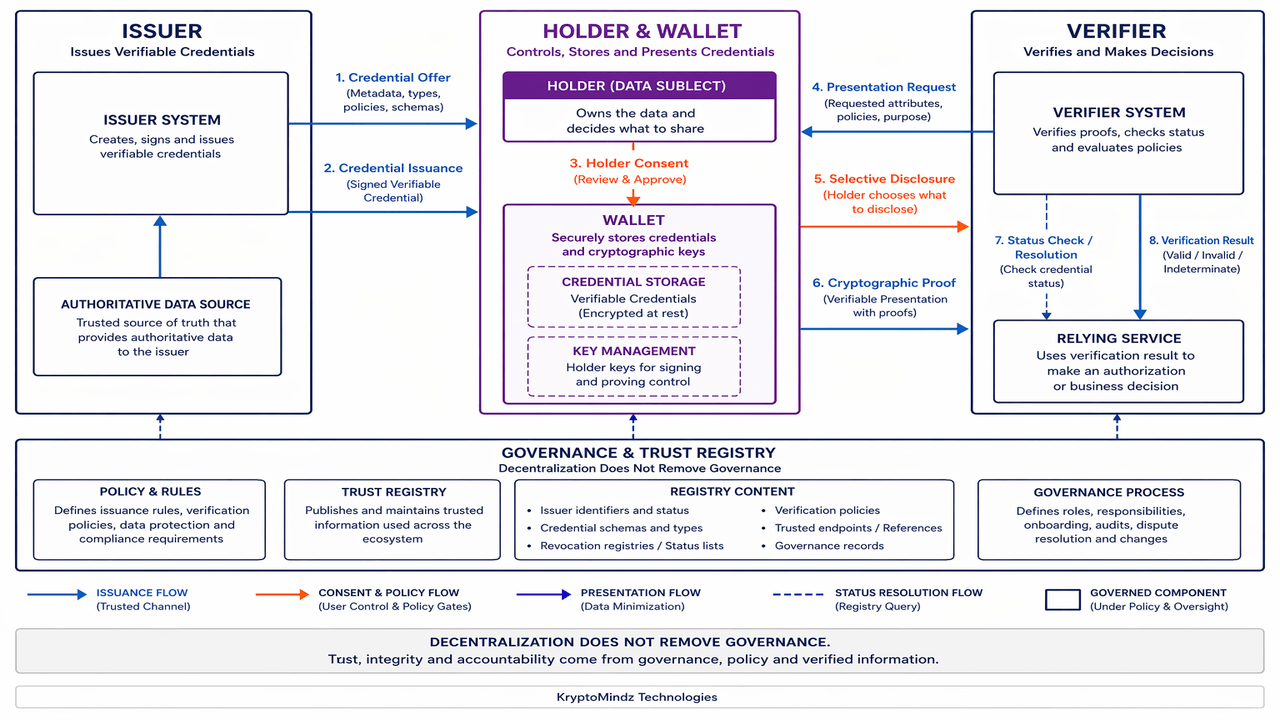
Trust is distributed, not absent
Verifiers decide whether to trust the issuer, credential type, proof, status and holder binding. Issuers decide eligibility. Wallets mediate keys and consent. Governance defines participation, liability, conformance and disputes.
Privacy needs design
Use pairwise identifiers, selective disclosure and minimal requests where profiles permit. Avoid stable correlators, unnecessary issuer contact and wallet telemetry that reconstructs holder activity.
Choose SSI where portability matters
Good candidates cross organizational boundaries and repeat trusted claims. Poor candidates have one issuer and verifier, rapidly changing data, no governance or no credible wallet adoption path.
8. Decentralized Identifiers
A DID is a URI associated with a DID method. Resolution can produce a DID document containing verification methods and service information. The method defines creation, update, resolution and deactivation and carries its own governance assumptions.
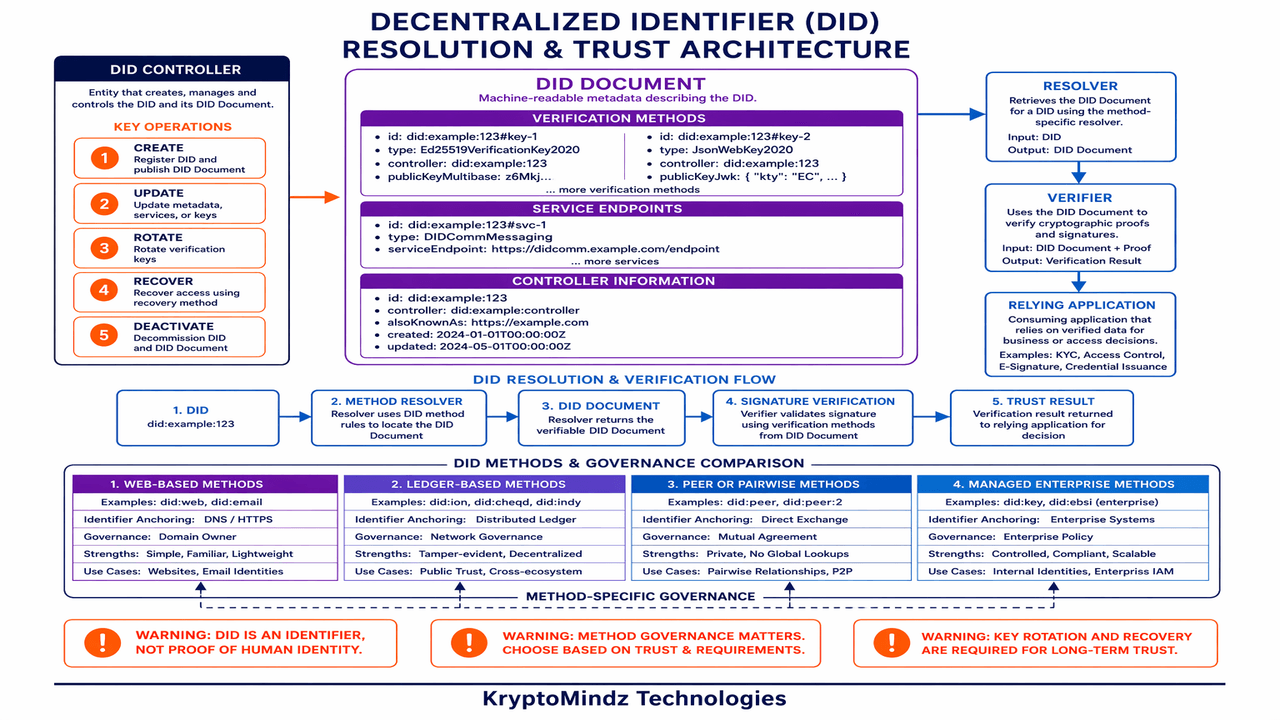
Select the method, not the acronym
Evaluate governance, availability, privacy, recovery, update rights, cost, finality, dependency risk and deactivation. A ledger-based method is not automatically more trustworthy than a web-based or peer method.
Operate keys as production infrastructure
Define controller authority, protection, rotation, compromise recovery and continuity. Cache resolved documents carefully and respect freshness and version semantics.
Avoid personal data in DID documents
DID documents can be public or replicated. Keep them minimal and consider whether service endpoints create correlation or operational exposure.
9. Verifiable Credentials
The W3C model defines issuer, holder, credential subject, claims and proofs. A verifier checks integrity and authenticity, then applies policy. Cryptographic validity does not establish issuer authority or claim sufficiency.
Design semantics first
Give each credential a clear purpose, owner, schema, authoritative source, issuance criteria, validity, status, privacy classification and version policy. Stable semantics matter more than reproducing a plastic card.
Select a narrow profile
Evaluate format, selective disclosure, holder binding, algorithm agility, implementation maturity and ecosystem mandates. Publish a constrained supported profile rather than accepting every possible representation.
Status and freshness
Choose expiration, refresh and status according to change rate and risk. Plan for registry outage, offline use, issuer key compromise and mass revocation without exposing holder activity.
10. Digital Identity Wallets
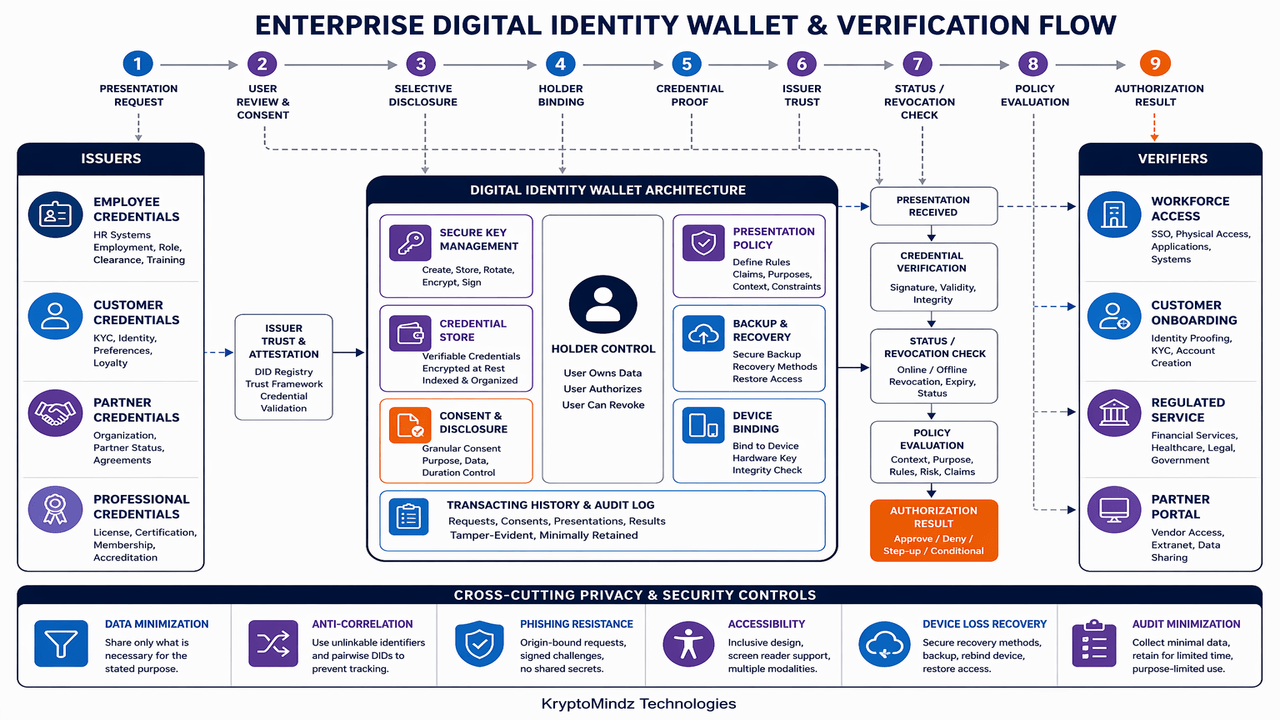
A wallet coordinates keys, credentials, consent and presentations. It may be an app, operating-system capability, cloud-assisted service or enterprise component. Trust differs for employee, consumer, organizational and machine wallets.
Key and device security
Use secure storage appropriate to assurance. Bind privileged operations to user verification, protect against cloning and replay, and define device migration, compromise and disposal.
Meaningful consent
Show who requests which claims, for what purpose and with what consequence. Prevent dark patterns and claim bundling. Help holders distinguish legitimate issuers and verifiers.
Backup and recovery
Decide whether credentials are synchronized, exported, reissued or device-bound. Balance availability against theft and correlation. Include accessible and assisted journeys.
11. OpenID4VCI Architecture and Flow
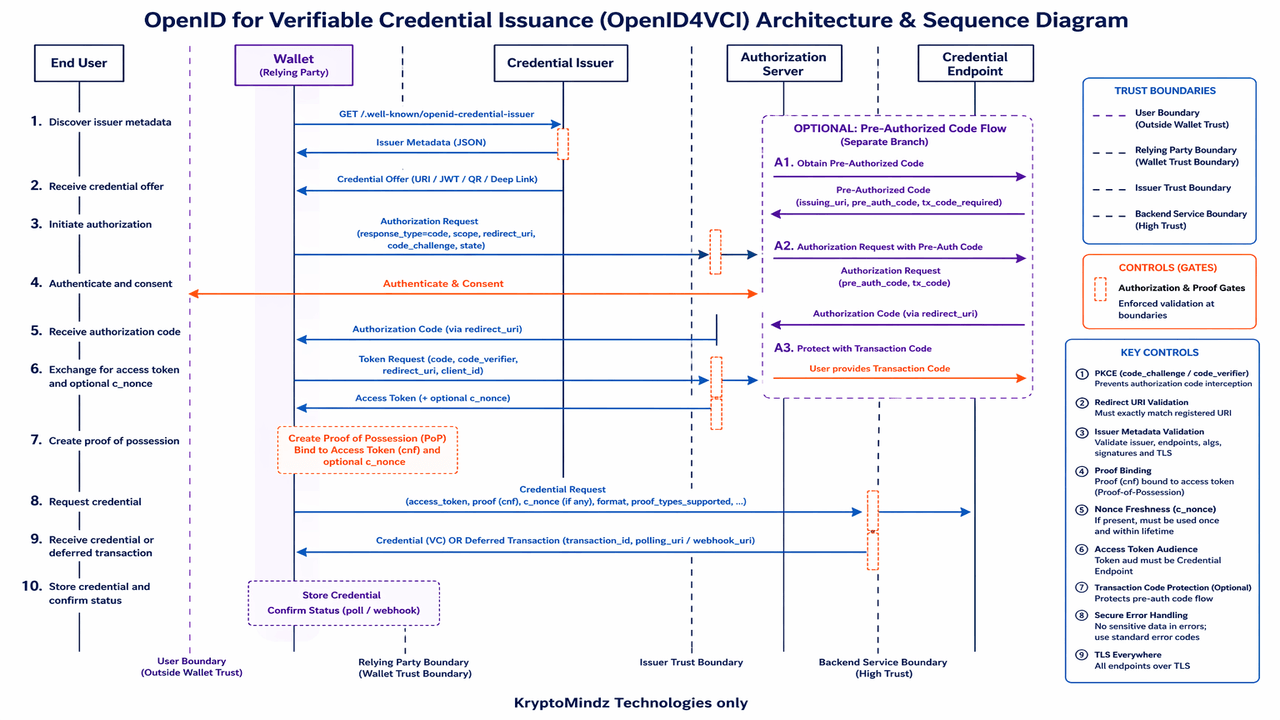
OpenID4VCI defines how a wallet discovers issuer metadata, obtains authorization and requests a credential. It supports authorization-code and pre-authorized-code patterns, multiple formats, proof mechanisms and deferred issuance. Implement the published 1.0 specification and ecosystem profile, not an older draft.
Metadata and role separation
Validate issuer identifiers, endpoints, supported configurations and cryptographic capabilities. Credential issuer and authorization server roles may be separate, so audience and issuer checks matter.
Authorization-code flow
Use current OAuth security practice including PKCE and exact redirect handling. The credential endpoint validates the access token and required proof before issuing the approved configuration.
Pre-authorized-code flow
The offer may be stolen. Use a transaction code where required, protect delivery, limit lifetime and attempts, and prevent redemption from issuing a broader credential than authorized.
Proof, nonce and deferred issuance
Validate proof type, signature, key binding, audience and freshness. Handle nonce updates without weakening replay protection. Protect deferred transaction identifiers and define expiry.
12. Presentation and Verification
Issuance and presentation are separate phases. OpenID4VP defines requesting and returning presentations, while ecosystem profiles determine formats and trust. Request only the minimum claims and evaluate each response against explicit policy.
Verification pipeline
- Establish the requesting verifier where required.
- Validate protocol state, nonce, audience and response origin.
- Parse only supported formats.
- Verify signatures, algorithms, issuer keys and holder binding.
- Evaluate validity, status, schema, trust framework and claim constraints.
- Apply transaction authorization and retain proportionate evidence.
Prevent replay and phishing
Bind presentations to verifier, nonce and transaction where supported. Use authenticated requests and clear context. A QR code alone does not establish who requests data.
Handle failure precisely
Distinguish malformed, untrusted, expired, revoked, insufficient and temporarily unverifiable credentials. Fail safely and provide alternate paths for legitimate users.
13. Security, Privacy and Threat Modeling
Threat-model enrollment, issuance, storage, presentation, verification, status and recovery. Include impersonation, synthetic identity, phishing, malicious participants, key theft, replay, correlation, metadata substitution and denial of service.
Use phishing resistance
Passkeys and hardware-backed authenticators can strengthen account and wallet access. Bind sensitive issuance and recovery to the intended transaction and do not silently downgrade to weak support processes.
Design against correlation
Minimize stable identifiers and claims, use pairwise identifiers where suitable, choose privacy-preserving status and limit telemetry. Analyze collusion among issuers, wallets and verifiers.
Plan cryptographic agility
Inventory algorithms, keys and validation libraries; support rotation and migration; reject unsupported choices. Separate trust in key control from trust in claim authority.
14. Trust Governance and Operations
A trust framework defines participants, eligible credentials, assurance, technical profiles, certification, liability, privacy, incidents, dispute resolution and termination. Machine-readable metadata can express decisions, but cannot replace accountability.
| Role | Accountability | Evidence |
|---|---|---|
| Trust authority | Participation and profile | Policy, registry and conformance |
| Issuer owner | Claim authority and lifecycle | Source, approval, keys and status |
| Wallet provider | Key, consent and presentation behavior | Security and interoperability tests |
| Verifier owner | Minimization and transaction policy | Purpose, rules and redress |
| Operations | Availability and recovery | Service levels, alerts and exercises |
Interoperability and conformance
Test metadata, authorization, issuance, proof, presentation, status, errors, algorithms and negative cases across independent implementations. A happy-path demo is not conformance.
Operational metrics
Track proofing completion and fraud, issuance success, wallet activation, presentation success, false rejection, status availability, recovery, privacy exceptions and time to revoke or rotate.
15. Implementation Roadmap
- Choose a bounded journey: define outcome, parties, consequence and ecosystem.
- Map trust: record who asserts, holds, verifies, governs, supports and accepts liability.
- Set assurance: define proofing, authentication, holder binding, freshness and recovery.
- Publish a profile: constrain protocols, formats, proofs, algorithms, metadata and status.
- Threat-model the lifecycle: include enrollment, issuance, presentation, recovery and retirement.
- Build interoperability evidence: test independent components and negative cases.
- Run a controlled pilot: measure completion, fraud, privacy, support and accessibility.
- Operationalize: assign service ownership, incidents, key rotation and change governance.
- Issuer and verifier owners are explicit.
- Identity and authenticator assurance are documented.
- Credential semantics and sources are owned.
- Wallet consent and recovery are tested.
- OpenID4VCI proof and error paths pass tests.
- Status and key compromise are exercised.
- Correlation and data are minimized.
- Fallback and redress serve legitimate users.
Related KryptoMindz capabilities include Digital Identity Consulting, Enterprise Blockchain Consulting and Blockchain Security Consulting.
16. Enterprise Identity Anti-Patterns
Protocol-first architecture
A team selects DIDs before defining assurance. Remedy: begin with transaction, consequence and trust.
Credential equals authorization
Any valid credential unlocks a service. Remedy: verify issuer, type, status, holder binding and claims before a separate policy decision.
Blockchain as identity database
Personal data is replicated for immutability. Remedy: minimize public data and justify every anchor.
No recovery architecture
A wallet becomes unusable after device loss or easily stolen through support. Remedy: test risk-based recovery from the start.
Universal identifier
One identifier follows a person across contexts. Remedy: use contextual identifiers and minimal claims.
Happy-path interoperability
One issuer and wallet exchange a sample credential. Remedy: publish a profile and test lifecycle failures.
Permanent validity
Credentials outlive employment or authority. Remedy: combine expiry, status, refresh and events.
Consent theater
A wallet asks users to approve opaque bundles. Remedy: show verifier, purpose, claim-level disclosure and alternatives.
17. Frequently Asked Questions
What is enterprise digital identity?
Enterprise digital identity is the architecture, governance and lifecycle used to establish, represent, authenticate and authorize people, organizations, workloads and devices across business services.
How are identity proofing, authentication and authorization different?
Proofing establishes evidence about an identity. Authentication establishes control of an authenticator or credential. Authorization decides whether the authenticated subject may perform a specific action.
What is self-sovereign identity?
Self-sovereign identity gives a holder greater control over portable credentials and disclosure. It does not remove issuers, verifiers, governance, legal accountability or trust decisions.
What is a decentralized identifier?
A DID is a URI defined by the W3C DID standard that resolves according to a DID method, commonly to verification methods and service information. A DID alone is not proof of a real-world identity.
What is a verifiable credential?
A verifiable credential is a tamper-evident set of claims and metadata whose authorship can be cryptographically verified. Trust still depends on issuer authority, semantics, status and holder binding.
What is a digital identity wallet?
A digital identity wallet manages keys, credentials, consent and presentations. Enterprise architecture must also address recovery, device loss, accessibility, privacy, interoperability and wallet trust.
What is selective disclosure?
Selective disclosure lets a holder reveal only the claims or derived facts needed for a transaction rather than the complete credential, subject to the credential format and proof mechanism.
What is OpenID4VCI?
OpenID for Verifiable Credential Issuance is an OpenID Foundation specification defining API flows used by a wallet to obtain verifiable credentials from a credential issuer.
Does OpenID4VCI define credential presentation?
No. OpenID4VCI covers issuance. OpenID for Verifiable Presentations defines presentation flows.
Can OpenID4VCI use OAuth 2.0?
Yes. It builds on OAuth 2.0 concepts and defines credential-specific metadata, authorization details, proof and credential endpoints.
What is holder binding?
Holder binding provides evidence that the presenter controls key material or another binding associated with the credential, reducing credential copying and replay risk.
How should credential revocation be handled?
Use a privacy-conscious status mechanism appropriate to the credential and risk. Define suspension, revocation, freshness, availability, issuer retirement and offline behavior.
Should enterprises put personal data on a blockchain?
Usually not. Public or replicated ledgers create privacy, correction and retention problems. Store only minimal anchors when the trust model justifies them.
Are passkeys verifiable credentials?
No. Passkeys are phishing-resistant authenticators. Verifiable credentials represent claims. They can complement each other in an identity architecture.
How do enterprises choose a credential format?
Choose from business and ecosystem requirements: data model, selective disclosure, holder binding, privacy, cryptographic agility, ecosystem profile and wallet support.
How should wallet recovery work?
Recovery should be explicit, tested and proportionate to risk, with strong re-proofing, key rotation, credential reissuance or suspension, anti-fraud monitoring and user support.
What should an identity proof-of-concept prove?
It should prove trust governance, interoperability, end-to-end issuance and presentation, privacy, lifecycle events, recovery, support and measurable business value.
What should an enterprise identity assessment deliver?
It should deliver actor and journey maps, assurance requirements, trust framework, target architecture, protocol decisions, threat model, lifecycle controls and roadmap.
Sources, Author and Technical Review
This guide prioritizes primary standards and authoritative guidance. Identity standards and profiles evolve; verify current editions and obtain qualified privacy, legal and sector advice.
- NIST SP 800-63-4, Digital Identity Guidelines
- NIST SP 800-63A-4, Identity Proofing and Enrollment
- NIST SP 800-63B-4, Authentication and Authenticator Management
- NIST SP 800-63C-4, Federation and Assertions
- W3C Verifiable Credentials Data Model v2.0
- W3C Decentralized Identifiers v1.0
- W3C Bitstring Status List v1.0
- OpenID for Verifiable Credential Issuance 1.0
- OpenID for Verifiable Presentations 1.0
- OpenID Federation 1.0
- FIDO Alliance, Passkeys
- ISO/IEC 29115, Entity authentication assurance framework
Build an Identity Architecture People and Partners Can Trust
KryptoMindz can turn identity journeys into a governed target architecture, credential and wallet profile, security model, interoperability plan and roadmap.
Discuss Your Digital Identity Strategy