
1. Introduction
Digital services now make decisions that affect money, identity, access, safety, employment, healthcare and public participation. Those services cross cloud platforms, partner organizations, mobile devices, APIs, AI agents and cryptographic systems. Security controls remain essential, but security alone does not answer the full business question: should a customer, partner, regulator or operator have justified confidence in the service and the evidence behind its decisions?
Enterprise digital trust is the architecture and operating discipline used to produce that justified confidence. It connects identity, authorization, cryptography, privacy, resilience, governance, compliance and verifiable evidence. It also makes distrust explicit. A mature design names what must be verified, which authority is accepted, when confidence expires, how a decision can be challenged and what happens after compromise.
2. What Is Enterprise Digital Trust?
Digital trust is justified confidence that a digital actor, service, record or transaction will behave as represented within defined boundaries. “Justified” matters. Confidence should arise from verifiable identity, controlled authority, sound cryptography, protected operations, transparent policy and reviewable evidence rather than reputation or network location alone.
A trust decision usually combines several claims: who or what is acting, which authority attests to that identity, whether the credential is current, what action is requested, which policy applies, what risk signals are present and whether additional approval is required. The outcome is contextual. A credential sufficient to read a low-risk record may be insufficient to move funds, sign a regulated document or change an AI agent's tool permissions.
Digital trust is broader than cybersecurity
Cybersecurity protects confidentiality, integrity and availability against threats. Digital trust also asks whether data use is legitimate, decisions are accountable, services are resilient, claims can be verified, users can understand material consequences and evidence can support review. Privacy, safety, accessibility, governance and compliance are therefore design concerns rather than external paperwork.
Trust is bounded and revocable
No identity, certificate, vendor, model or control should be treated as permanently trustworthy. State the purpose, audience, assurance level, time window and conditions under which trust is withdrawn. Revocation, expiry, policy change, incident response and recovery are part of the normal lifecycle.
3. Digital Trust Principles
- Verify explicitly: evaluate identity, context, policy and risk for each material decision.
- Minimize authority: grant the smallest scope and duration needed for the task.
- Separate key purposes: do not reuse trust anchors, signing, encryption and workload keys.
- Minimize data: disclose and retain only what the decision requires.
- Design for failure: include expiry, revocation, compromise, denial and recovery paths.
- Make control ownership visible: every critical policy and trust anchor needs an accountable owner.
- Retain proportionate evidence: preserve enough context to reconstruct high-impact actions.
- Prefer open verification: use standards and portable evidence where ecosystem boundaries require it.
These principles expose trade-offs. More evidence can improve accountability while increasing privacy and retention risk. Stronger key protection can increase assurance while creating availability and recovery dependencies. Centralized policy can improve consistency while concentrating failure and administrative power. Architecture should make those consequences reviewable.
4. Enterprise Digital Trust Reference Architecture
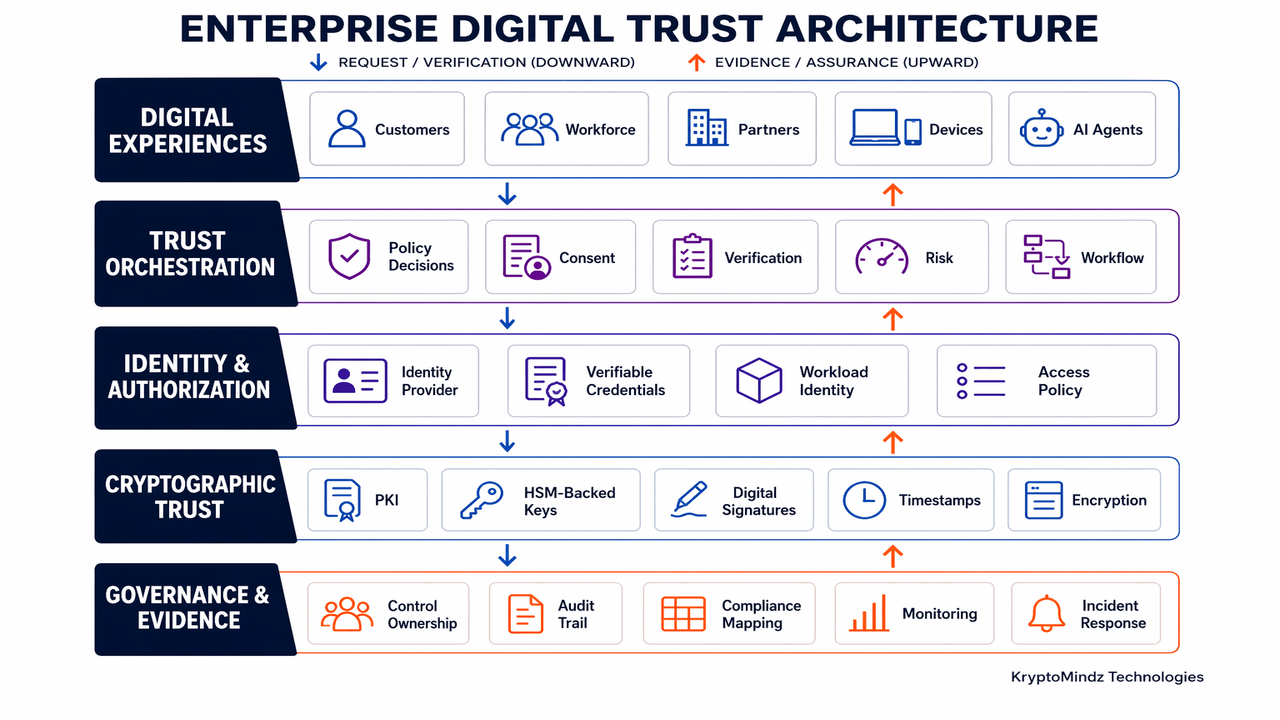
A useful reference architecture separates digital experiences, trust orchestration, identity and authorization, cryptographic trust, and governance and evidence. Business applications remain responsible for their outcomes. Shared trust services provide reusable verification and control without becoming an opaque gatekeeper for every decision.
Digital experiences and relying services
Customers, employees, partners, devices and AI agents interact through portals, APIs and workflows. Each relying service should define the action, required assurance, acceptable issuers or authenticators, data sensitivity and failure behavior. Authentication success is an input, not the complete authorization decision.
Trust orchestration
Policy services combine verified identity, credential status, device or workload posture, consent, fraud signals and business context. High-impact actions may require step-up authentication, a second approver or a human decision. Keep policy versions and decision reasons so operators can explain why access was allowed or denied.
Foundational trust services
Identity providers, credential issuers, PKI, HSM-backed signing, encryption, timestamping and verification services form the cryptographic foundation. Their availability and privileged administration are critical dependencies. Governance defines accepted trust anchors, control owners, change thresholds and evidence retention.
5. Digital Identity and Trust
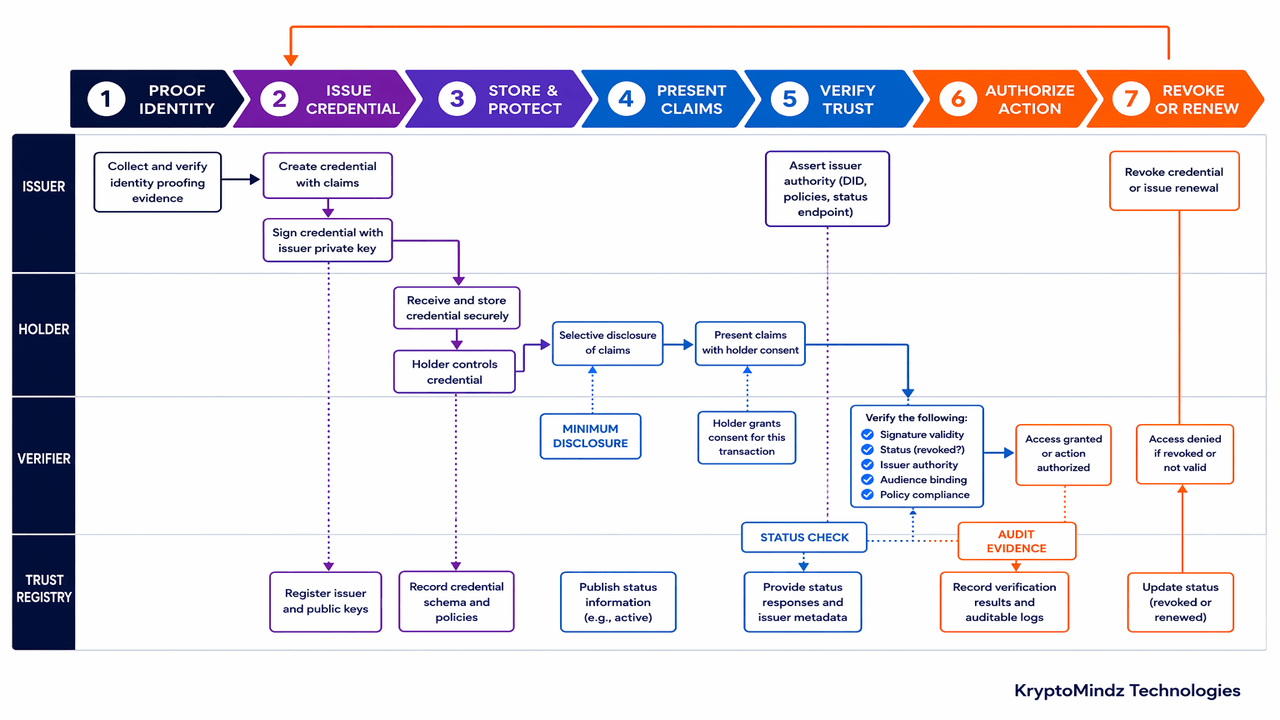
Enterprise identity includes people, organizations, workloads, devices and increasingly autonomous agents. Each identity needs a proofing or enrollment basis, a credential, an authentication method, authorized roles or attributes, lifecycle ownership and recovery. A username or wallet address alone does not establish an accountable entity.
Proofing and enrollment
NIST SP 800-63 separates identity proofing, authentication and federation because each has different risks and assurance choices. Match proofing strength to consequence. Verify organizational representatives and service accounts as carefully as end users when they can approve high-value actions.
Credentials and federation
Conventional federation works well inside managed enterprise relationships. X.509 certificates establish machine and organizational trust. Verifiable credentials can carry portable claims where issuers, holders and verifiers operate across organizational boundaries. The W3C data model defines a credential format and roles, but the ecosystem must still govern issuer authority, schemas, status, privacy and verifier policy.
Wallets, recovery and revocation
Wallet design must protect keys and credentials while giving users a workable recovery path. Recovery that bypasses assurance weakens the entire system; recovery that is impossible creates exclusion and support risk. Define credential expiry, suspension, status checking, device change, delegated use and account closure before deployment.
See Digital Identity Consulting, Verifiable Credentials Consulting and Identity Wallet Consulting for implementation-specific architecture.
6. Cryptography and Key Management
Cryptography supports confidentiality, integrity, authentication and non-repudiation claims only when algorithms, implementations and keys are managed correctly. Most enterprise failures occur around key exposure, shared credentials, weak recovery, expired certificates, excessive privilege or misunderstood trust anchors rather than a mathematical break.
Cryptographic inventory
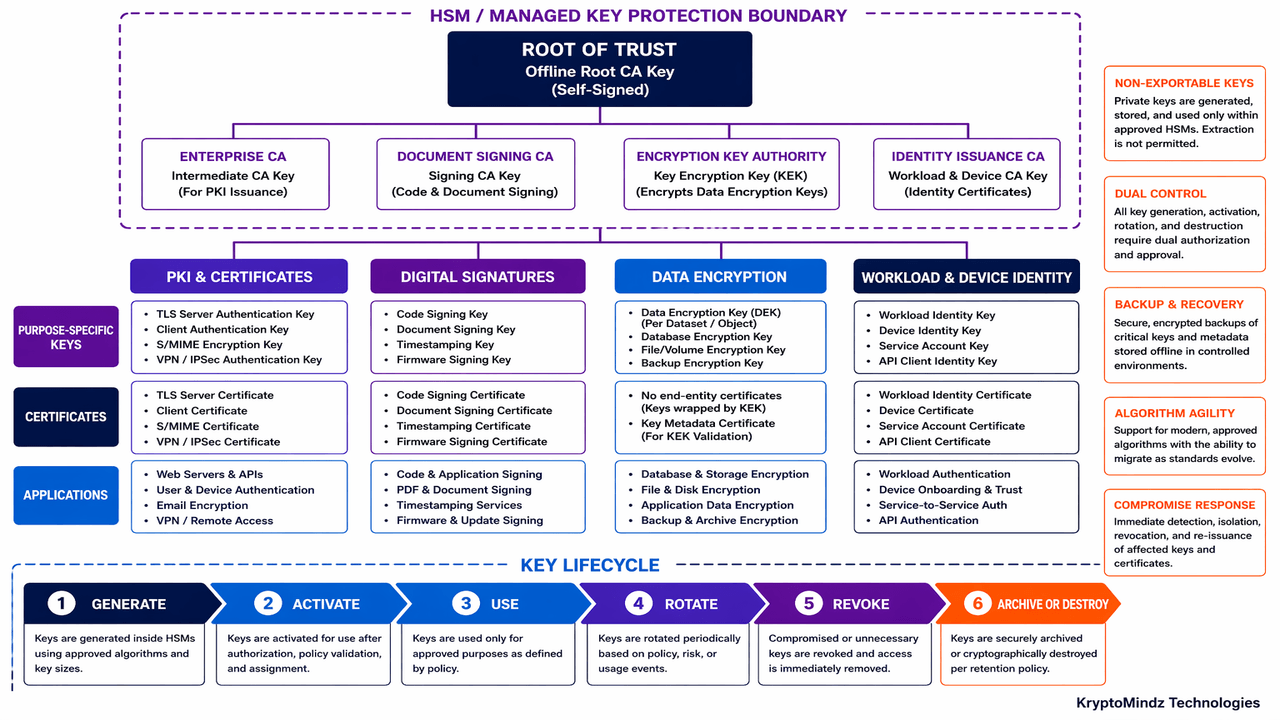
Inventory trust anchors, certificate authorities, signing keys, encryption keys, API credentials, device identities, protocols, algorithms, libraries and long-lived signed records. Record owner, purpose, location, protection, dependencies, cryptoperiod, rotation method, recovery and compromise action. Unknown cryptography cannot be governed or migrated.
Purpose separation and key hierarchy
Root and issuing CA keys, document-signing keys, data-encryption keys, TLS keys, code-signing keys and workload identities need distinct policies. Purpose separation limits compromise and permits independent migration. Use envelope encryption and managed key hierarchies where they reduce direct exposure of root material.
Cryptographic agility
Post-quantum transition is an architecture problem before it is an algorithm swap. Avoid hard-coded algorithms and certificate assumptions, know which evidence needs long-term verification, test dual or hybrid transitions where standards support them, and preserve the ability to reissue identities and re-sign or timestamp critical records.
7. PKI, Digital Signatures and Timestamps
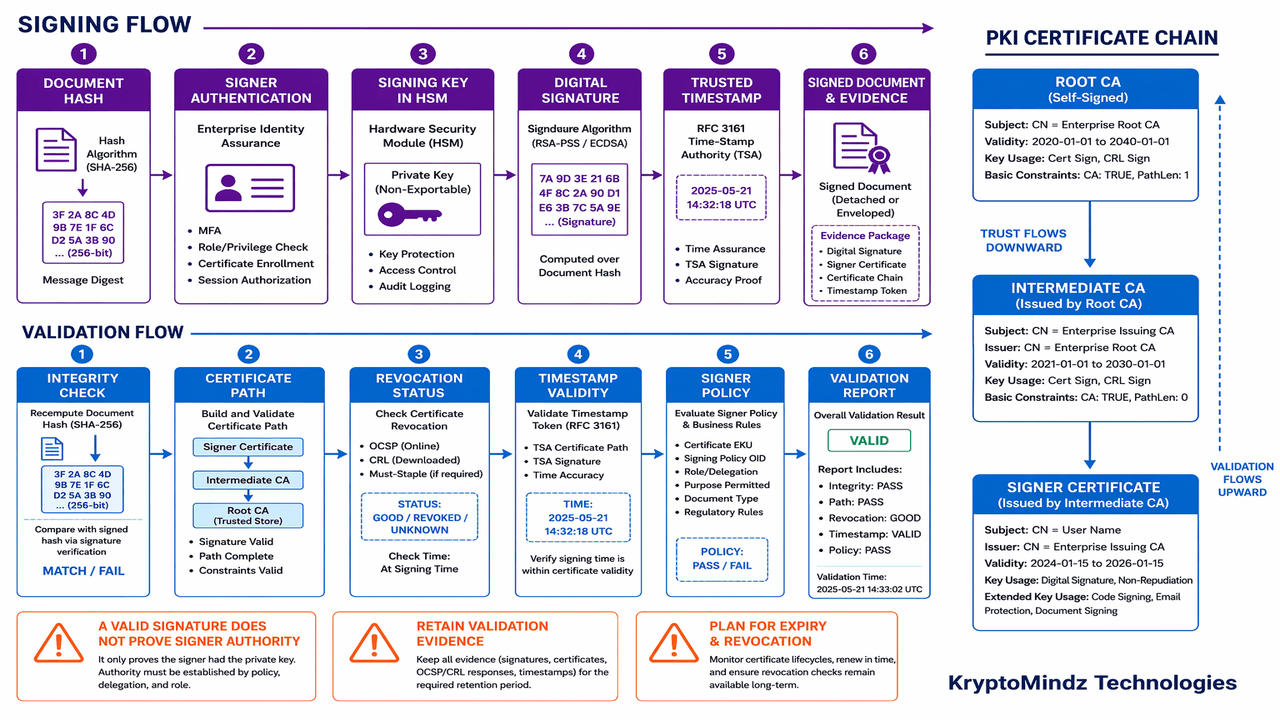
PKI binds public keys to subjects through certificates issued under defined policy. A relying party validates the certificate path to an accepted trust anchor, checks validity time and constraints, evaluates revocation status and confirms the certificate is appropriate for the intended purpose. RFC 5280 defines the Internet X.509 path-validation profile; enterprise profiles must narrow acceptable authorities and uses.
Signing is a business ceremony
A digital signature proves possession or use of a private key over specific data. The business meaning depends on signer authentication, document representation, intent, authority, certificate policy and retained evidence. Present the exact material being signed, bind relevant context and record approval without exposing sensitive payloads unnecessarily.
Validation and long-term evidence
Validation should capture the signed object, signature value, certificate chain, revocation information, trusted time and applicable policy. RFC 3161 describes trusted timestamp tokens; OCSP and certificate revocation lists provide status information with different availability and privacy trade-offs. Long-term validation requires preserving evidence that may no longer be retrievable after certificates expire or services change.
Digital Signature and PKI Consulting covers trust hierarchy, signing workflow, validation, migration and operating design.
8. HSM Integration and Root-of-Trust Operations
Hardware security modules can generate and use non-exportable keys inside a protected boundary, enforce roles and provide auditable operations. They are appropriate for certificate authorities, high-value signing, payment keys, regulated custody, code signing and other trust anchors where assurance justifies cost and operational complexity.
An HSM does not make an unsafe workflow trustworthy. Architecture must define partitions or domains, client authentication, operator and security roles, quorum, key attributes, backup wrapping, high availability, capacity, audit export and failure behavior. Application teams should know whether an HSM outage blocks signing, authentication, decryption or recovery.
Ceremony, resilience and migration
Root and recovery ceremonies should be scripted, witnessed and evidenced. Test restoration with the exact firmware, client, authentication and backup dependencies required in a disaster. Plan key and HSM migration before a product reaches end of support; non-exportability can create vendor and availability lock-in if replacement paths are ignored.
See HSM Integration Consulting for topology, key lifecycle, integration and recovery decisions.
9. Zero Trust Architecture
NIST SP 800-207 defines Zero Trust as removing implicit trust based on network location or asset ownership. Applications protect resources through explicit policy decisions informed by identity and context. Microsegmentation and modern access proxies may support the model, but the architecture is fundamentally about decisions, enforcement and continuous evaluation.
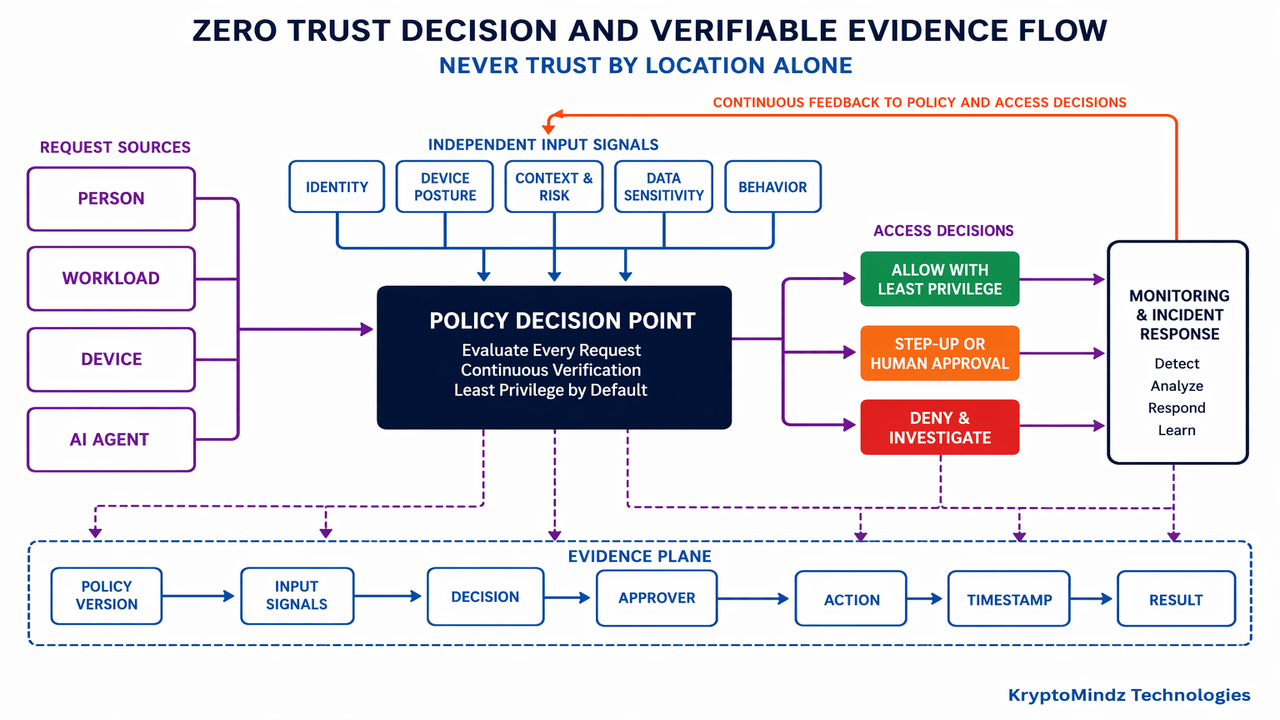
Policy decision and enforcement
The policy decision point evaluates subjects, resources, requested actions, environmental context and risk. Enforcement points apply the decision close to the resource. Separate these responsibilities so policy can be reviewed and changed without embedding every rule in application code, while avoiding a single global dependency that can stop all services.
Workloads, devices and AI agents
Machine identities need short-lived credentials, bounded audiences and automated rotation. Device posture is an input, not a permanent trusted state. AI agents require workload identity plus policy over tools, data, transaction value and autonomy. High-risk actions should support step-up, human approval, rate limits and immediate revocation.
Continuous evaluation
Re-evaluate long sessions and material actions when context changes. Feed identity events, certificate status, device telemetry, behavior and incidents into policy. Preserve the policy version and material signals used for important decisions so assurance teams can distinguish a control failure from a policy choice.
10. Privacy and Data Trust
Trustworthy systems give data subjects, business owners and regulators justified confidence about how information is collected, used, shared, retained and corrected. Security prevents unauthorized access; privacy also governs authorized use. Data classification, purpose, consent or other lawful basis, minimization, disclosure and retention belong in architecture decisions.
Minimize claims and metadata
Ask only for attributes required by the decision. A verifier may need proof that a person is over a threshold rather than a full birth date, or proof of professional authority rather than a complete personnel record. Selective disclosure and derived claims can reduce exposure, but metadata such as issuer, timing, correlation identifiers and repeated presentations still needs assessment.
Correction, deletion and audit
Design how subjects and data owners correct errors, revoke consent where applicable, challenge decisions and receive incident notice. Immutable logs and ledgers can conflict with minimization and deletion obligations if personal data is stored directly. Keep sensitive records in controlled stores and retain compact evidence only when purpose and retention are justified.
11. Verifiable Evidence and Trust Decisions
Evidence turns an asserted control into something an operator, customer, partner or auditor can inspect. For high-impact decisions, retain who or what acted, the verified credential or identity reference, policy version, material inputs, approval, cryptographic result, timestamp, action and outcome. Evidence should support reconstruction without becoming a duplicate sensitive-data warehouse.
Evidence qualities
- Authentic: the producing system and signing authority are identifiable.
- Integral: unauthorized change is detectable.
- Complete enough: the decision can be understood in context.
- Minimized: sensitive content is not retained without purpose.
- Available: authorized reviewers can retrieve it through the required period.
- Interpretable: policy, schema, time and identity semantics remain available.
Evidence is not truth by itself
A valid signature proves that a key signed bytes; it does not prove the underlying claim is true. A tamper-evident log proves sequence and integrity under its assumptions; it does not prove that an operator had lawful authority. Evidence systems need source validation, governance and dispute handling.
12. Compliance by Design
Compliance by design translates applicable laws, contracts, standards and internal policies into owned control objectives and implementation requirements before go-live. It does not mean claiming that a framework automatically guarantees compliance. Qualified legal and compliance professionals must interpret jurisdiction-specific obligations.
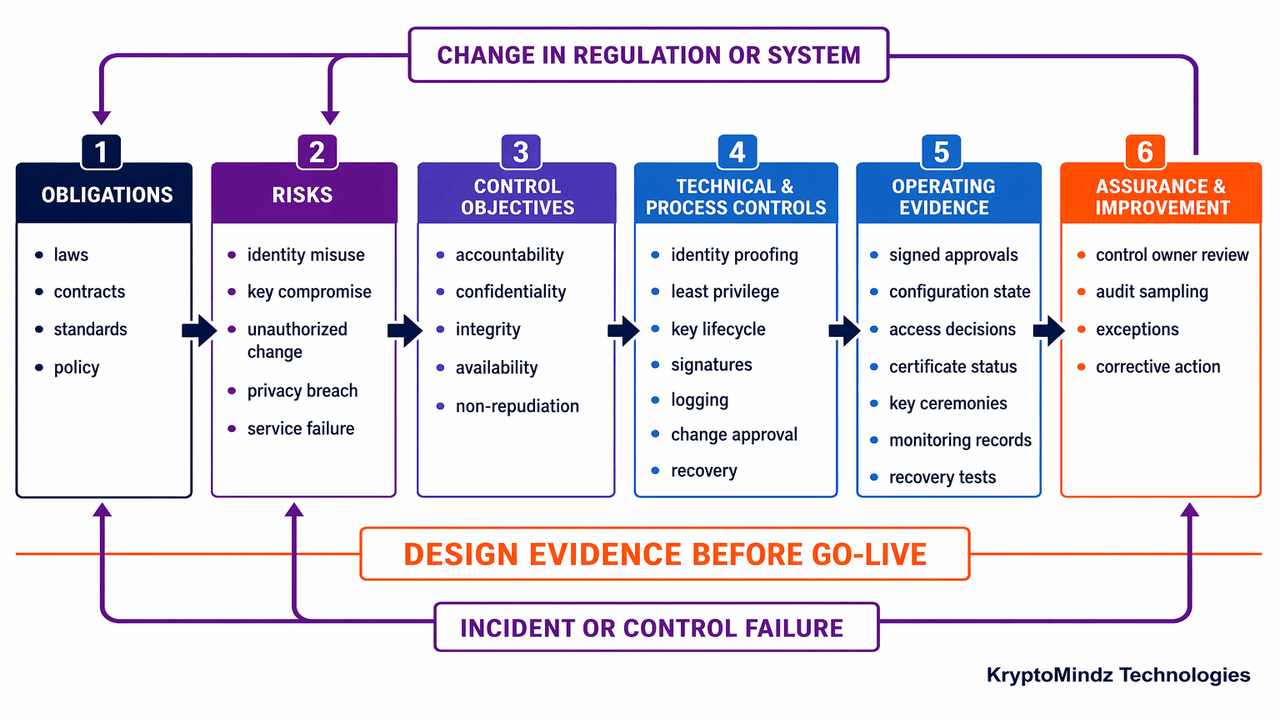
Control-to-evidence mapping
For each obligation, record the affected service and data, risk, control objective, control owner, technical or process implementation, evidence source, review frequency and exception path. Automate evidence collection where reliable, but do not confuse a configuration snapshot with proof that a workflow behaves correctly.
Regulated trust services
eIDAS and other trust-service regimes introduce specific legal roles and assurance requirements for electronic identification, signatures, seals, timestamps and related services. Architecture should separate general PKI capability from regulated service claims and verify the exact jurisdiction, trust list, certification and liability requirements.
Change and corrective action
Regulation, business scope, vendors and systems change. Reassess controls after material changes and incidents. Exceptions need accountable approval, expiry and remediation. A compliance dashboard without ownership and corrective action creates reporting, not assurance.
13. Enterprise Trust Governance
Governance defines which authorities the enterprise accepts, who may change trust, how exceptions are approved and what evidence supports accountability. Establish a cross-functional trust forum spanning business ownership, identity, security, privacy, legal, compliance, architecture and operations. The purpose is decision ownership, not another meeting layer.
| Decision | Accountable owner | Required evidence | Review trigger |
|---|---|---|---|
| Accepted identity proofing and issuers | Identity owner | Assurance profile and issuer due diligence | Issuer, risk or regulation change |
| Root certificates and signing authorities | PKI/security owner | Policy, ceremony and inventory | Expiry, compromise or algorithm change |
| Access and agent policy | Resource/business owner | Policy version, tests and approvals | New action, data or threat |
| Evidence retention | Data owner | Purpose, access and retention schedule | Legal or system change |
| Control exceptions | Risk owner | Rationale, compensating controls and expiry | Expiry or incident |
Third-party trust
Cloud, identity, certificate, HSM, wallet and verification providers can become critical trust dependencies. Evaluate administrative access, key custody, availability, incident notification, sub-processors, assurance reports, portability and exit. Contractual claims should map to technical controls and observable service behavior.
Trust registry and policy management
Ecosystems often need registries of approved issuers, schemas, certificate roots, service endpoints and status mechanisms. Protect changes with separation of duties and review. A registry centralizes authority even when credentials are decentralized; its governance must be explicit.
14. Trusted AI, Agents and Blockchain
AI systems introduce uncertain outputs, dynamic behavior and delegated action. Digital trust architecture should identify the model and policy version, data and tool boundaries, workload identity, approvals, evaluation results, monitoring and responsibility for outcomes. Do not treat a model provider's reputation as sufficient assurance.
Agent trust pattern
An enterprise agent authenticates with a workload identity, receives narrow tool and data permissions, submits a material action to policy, obtains required approval, executes through a governed interface and emits evidence. Monitoring watches for unusual scope, volume, destinations and failed controls. Human escalation remains available for ambiguity and high consequence.
Blockchain as an optional evidence mechanism
A distributed ledger can preserve shared state or evidence where organizations do not accept one unilateral record owner. It does not replace identity, source validation, privacy, secure keys or governance. Use conventional signed logs when one accountable owner and independent verification meet the requirement; add blockchain only when the multi-party control model justifies it.
Related architecture services include AI Agent Security Consulting and Enterprise Blockchain Consulting.
15. Digital Trust Implementation Roadmap
- Frame the journey: select a business workflow and name actors, decisions, assets, harm, obligations and measurable outcomes.
- Map current trust: inventory identity providers, credentials, trust anchors, keys, policies, evidence, vendors and manual approvals.
- Threat-model trust boundaries: assess impersonation, excessive authority, compromised keys, false claims, policy bypass, privacy leakage and service failure.
- Define target decisions: specify assurance, acceptable issuers, context, least privilege, escalation, denial and recovery.
- Design cryptography and evidence: separate key purposes, choose protection, define validation and retain proportionate decision evidence.
- Pilot one end-to-end journey: include expiry, revocation, denial, incident and recovery rather than only the happy path.
- Operationalize: assign owners, service objectives, monitoring, ceremonies, reviews and corrective action.
- Scale through reusable patterns: standardize proven policies and trust services without forcing unlike risks into one template.
Production readiness gates
- Actors, claims and relying decisions have named owners.
- Accepted trust anchors and issuer criteria are documented.
- Credential, certificate and key lifecycles are tested.
- Access policies include denial and escalation behavior.
- Evidence is sufficient, minimized and retrievable.
- Privacy, legal and compliance reviews cover real data flows.
- Provider failure and exit paths are understood.
- Compromise, revocation and recovery exercises have run.
Trust Architecture Consulting can turn these gates into a scoped current-state assessment and target-state roadmap.
16. Digital Trust Anti-Patterns
Trust as a product purchase
A platform is expected to solve identity, governance, assurance and compliance without agreed business rules. Remedy: map decisions and evidence first, then select capabilities against those requirements.
Authentication equals authorization
A valid login grants broad access without considering action, resource, context or risk. Remedy: evaluate explicit policy and least privilege at material actions.
One key for every purpose
Signing, encryption, transport and administration share credentials, expanding compromise. Remedy: separate key domains and lifecycle ownership.
HSM as a compliance checkbox
Keys are hardware-protected while applications, operators, quorum, recovery and audit remain weak. Remedy: design the complete signing and key-management workflow.
Immutable evidence warehouse
Full personal and business records are copied into tamper-evident storage indefinitely. Remedy: minimize evidence, protect source records and justify retention.
Decentralized identity without ecosystem governance
Credentials are technically verifiable but issuers, schemas, status and liability are undefined. Remedy: establish issuer acceptance and relying-party policy.
Zero Trust as network tooling
New gateways are deployed while static privileges and unowned policies remain. Remedy: redesign decisions, identities, enforcement and continuous evaluation.
Compliance evidence after go-live
Teams reconstruct approvals and configurations during an audit. Remedy: define evidence sources, ownership and retention with the control design.
17. Enterprise Architecture Workbooks
Trust-decision inventory
For each material action, record subject, resource, requested operation, consequence, acceptable identity and credential, context, policy owner, escalation, evidence and recovery. Use this inventory to find inconsistent assurance and hidden administrator paths.
Trust-anchor and issuer register
List root CAs, identity providers, credential issuers, timestamp authorities, verification services and policy registries. Record acceptance rationale, assurance, owner, dependencies, expiry, status method, monitoring and exit path.
Cryptographic dependency map
Map algorithms, protocols, certificates, HSMs, libraries, devices, signed artifacts and verification periods. Identify hard-coded dependencies, unsupported products, shared secrets and records that must remain verifiable beyond current algorithm lifetimes.
Evidence design worksheet
Start from a reviewer question: who approved this payment, why did this agent receive access, which policy denied this request, or was this document valid at signing time? Define the minimum evidence needed to answer it and protect that evidence by sensitivity.
Failure and recovery exercise
Simulate compromised issuer, stolen signing credential, unavailable HSM, expired root, incorrect policy deployment, false credential, evidence-store outage and vendor exit. Record detection, containment, revocation, continuity, communication and proof of recovery.
Control accountability matrix
Assign accountable owners for proofing, authentication, access policy, trust anchors, key lifecycle, privacy, evidence, provider risk, incident response and control assurance. Contributors may be shared; accountability should not be.
18. Metrics, Monitoring and Assurance
Measure whether trust controls operate and support business outcomes. Avoid a single “trust score” that hides incompatible risks. Use a balanced set of journey, identity, cryptographic, policy, evidence and resilience indicators.
| Domain | Example measures | Decision supported |
|---|---|---|
| Identity | Proofing exceptions, authentication failures, recovery abuse, stale accounts | Assurance and lifecycle improvement |
| Credentials and PKI | Expiry horizon, revocation latency, validation failures, unknown roots | Trust continuity and hygiene |
| Keys and HSM | Unmanaged keys, rotation status, privileged operations, recovery tests | Compromise and resilience risk |
| Policy | Allow, deny, step-up, exceptions, unused privilege, rule drift | Least privilege and user impact |
| Evidence | Completeness, retrieval time, unauthorized access, retention exceptions | Accountability and privacy |
| Service | Decision latency, dependency failure, recovery time, incident recurrence | Reliability and investment |
Assurance combines automated control monitoring, targeted sampling, penetration and abuse testing, ceremony review, recovery exercises and independent assessment. Findings need owners, severity, due dates and verification of closure. Publish customer-facing trust information only when claims are evidence-backed and do not expose defensive detail.
19. Frequently Asked Questions
What is enterprise digital trust?
Enterprise digital trust is justified confidence that identities, systems, data and digital actions will behave as represented within defined risk, governance and accountability boundaries.
Is digital trust the same as cybersecurity?
No. Cybersecurity is essential, but digital trust also includes identity, privacy, safety, resilience, governance, compliance, transparency and evidence that controls operate as intended.
What is a trust architecture?
A trust architecture maps actors, assets, claims, decision points, cryptographic controls, governance, evidence and failure handling across a complete digital service.
What is a trust layer?
A trust layer is a coordinated set of reusable identity, policy, cryptography, verification and evidence capabilities. It is a logical architecture concept, not necessarily one product or platform.
Does Zero Trust mean trusting nobody?
No. Zero Trust removes implicit trust based on network location. Access decisions use verified identity, device or workload posture, context, least privilege and continuous evaluation.
What role does digital identity play?
Digital identity connects a person, organization, workload or device to accountable claims and permitted actions. It requires proofing, credential lifecycle, authentication, authorization and recovery.
Are verifiable credentials required?
No. They are useful when portable, cryptographically verifiable claims improve an ecosystem. Conventional federation and PKI may be more appropriate for other trust relationships.
What does PKI provide?
PKI binds public keys to named subjects or roles through certificates and trust chains, with issuance, validation, renewal, revocation and policy controls.
When should an enterprise use an HSM?
Use an HSM when high-value keys require strong non-exportability, controlled signing, separation of duties, assurance evidence or regulated protection that justifies the operational cost.
Does a valid digital signature prove legal authority?
Not by itself. It proves that a private key produced a signature over specific data. Identity proofing, certificate policy, signer intent, authorization, timestamps and legal context determine what that signature means.
What is verifiable evidence?
Verifiable evidence is retained information that lets an authorized reviewer reconstruct a decision or action, including identity, policy version, inputs, approvals, cryptographic proof, time and outcome.
Can blockchain create digital trust?
Blockchain can support shared evidence and jointly governed state, but it does not establish source truth, lawful authority, privacy, secure keys or sound governance by itself.
What is compliance by design?
Compliance by design translates applicable obligations into owned control objectives, system requirements, operational evidence, review and corrective action before go-live.
How should AI agents fit into digital trust?
AI agents should use workload identity, bounded permissions, approved tools, policy checks, human escalation, monitored actions and retained evidence proportionate to risk.
How is privacy incorporated?
Classify and minimize data, define lawful purpose and retention, limit disclosure, protect sensitive attributes, preserve correction and revocation paths, and test metadata exposure.
What are the main digital trust metrics?
Useful measures include identity and credential failures, access-policy outcomes, key and certificate health, signing validation, privileged changes, evidence completeness, incidents and recovery performance.
How should post-quantum risk be handled?
Maintain a cryptographic inventory, separate key purposes, build algorithm agility, monitor standards and plan migration for certificates, signatures, protocols, devices and long-lived evidence.
What should a digital trust assessment deliver?
It should deliver a trust-boundary map, identity and cryptographic inventory, control and evidence model, risk findings, target architecture, prioritized remediation and an implementation roadmap.
Sources, Author and Technical Review
This guide prioritizes primary standards and authoritative public guidance. Standards, regulation and platform capabilities change; verify the current edition and obtain qualified legal advice for jurisdiction-specific decisions.
- NIST SP 800-207, Zero Trust Architecture
- NIST SP 800-63-4, Digital Identity Guidelines
- NIST SP 800-57 Part 1 Rev. 5, Key Management
- NIST Cybersecurity Framework 2.0
- NIST Privacy Framework
- W3C Verifiable Credentials Data Model 2.0
- W3C Decentralized Identifiers (DIDs) v1.0
- IETF RFC 5280, Internet X.509 PKI Certificate and CRL Profile
- IETF RFC 3161, Time-Stamp Protocol
- IETF RFC 6960, Online Certificate Status Protocol
- CISA Zero Trust Maturity Model 2.0
- European Commission, eIDAS Regulation
Design a Defensible Enterprise Trust Architecture
KryptoMindz can map trust boundaries, identity, cryptography, policy, evidence and compliance requirements into a practical target architecture and implementation roadmap.
Discuss Your Digital Trust Strategy