
1. Executive Context
Enterprise AI has moved from isolated prediction and chat experiments into workflows that retrieve internal knowledge, generate business content, recommend decisions and act through software tools. That shift creates real value, but it also changes the architecture problem. An AI system is not only a model. It is a continuously changing combination of data, prompts, retrieval, software, tools, policies, people, providers and operating evidence.
Trusted enterprise AI means creating justified confidence that this complete system will pursue an approved purpose within defined performance, security, legal and ethical boundaries. It does not mean claiming that an AI model is always correct. It means knowing where uncertainty exists, designing controls around consequence, measuring behavior, assigning accountability and remaining able to stop, investigate and improve the system.
2. What Is Trusted Enterprise AI?
Trusted enterprise AI is an operating discipline that aligns AI behavior with business purpose, stakeholder expectations and enforceable boundaries. Trust is contextual: a model that is appropriate for summarizing internal notes may be unacceptable for autonomous financial approval, clinical advice or employment decisions. The required assurance rises with impact, autonomy, scale, sensitivity and difficulty of reversal.
Trust applies to the system, not only the model
Model benchmarks reveal only part of production behavior. Prompts, retrieved documents, tool descriptions, identity, memory, application logic and user interaction can materially change an outcome. Assess the end-to-end system under realistic conditions, including failures and malicious inputs.
Trust must be evidenced
Policies and principles are useful only when they influence design and operation. A defensible system retains proportionate evidence of its purpose, owner, approved data and models, evaluations, control decisions, changes, incidents and outcomes. This evidence supports improvement as well as assurance.
Uncertainty is a design input
Generative models produce probabilistic outputs. Design workflows that tolerate uncertainty through grounding, constrained choices, independent verification, confidence-aware routing, human review and reversible actions. Do not place a fluent interface in front of a brittle business process and call it transformation.
3. Enterprise AI Strategy
An enterprise AI strategy connects a small number of business priorities to reusable capabilities, responsible adoption and an investment model. It should explain where AI creates distinct value, which decisions remain human, what the organization will build or buy, how data and platforms will be governed, and how benefits and risks will be measured.
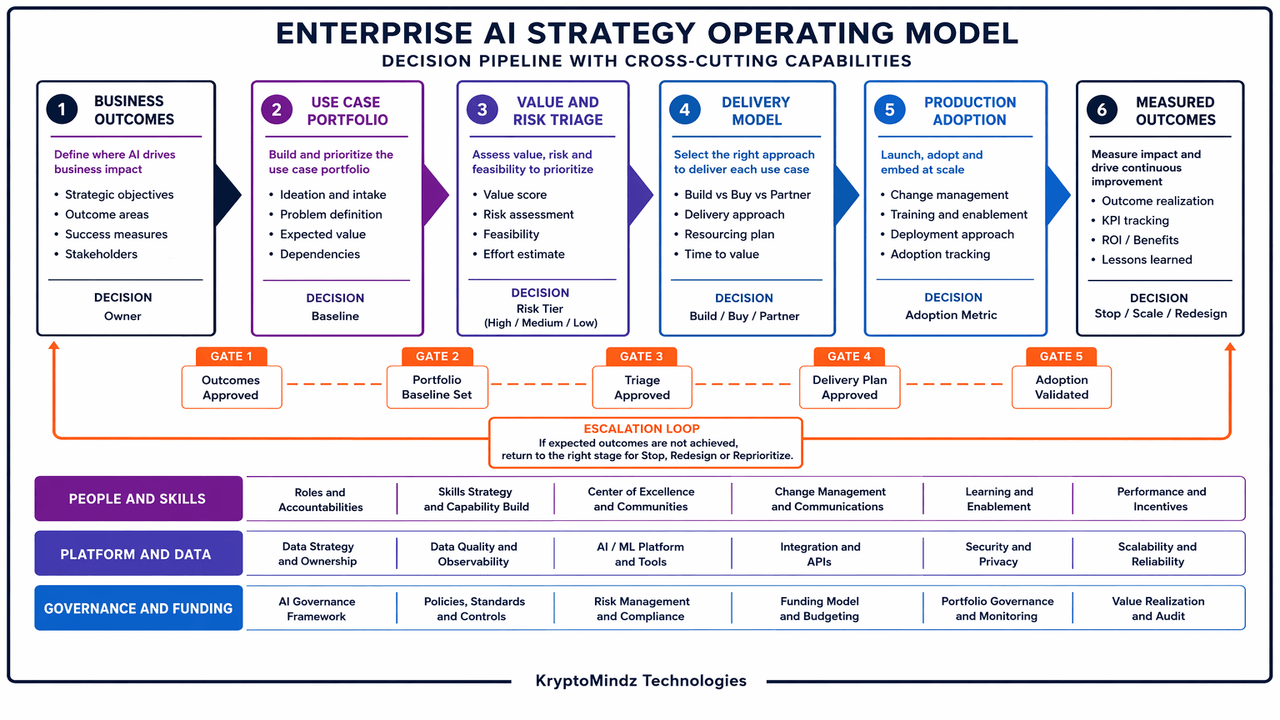
Begin with an outcome thesis
Define the baseline, target, beneficiaries, process owner and time horizon. Useful targets include lower resolution time, improved analyst throughput, reduced loss, higher conversion or better service quality. “Use generative AI” is a technology intention, not a business outcome.
Choose a strategic posture
Most enterprises combine three postures: consume AI embedded in approved products, compose applications from managed models and enterprise data, and selectively create differentiated models or agents. Make the posture explicit for each capability because talent, cost, control and intellectual-property implications differ.
Fund shared foundations with products
A platform without use cases becomes infrastructure inventory; use cases without foundations duplicate integration and controls. Fund model access, identity, evaluation, observability and governance as shared capabilities while product teams remain accountable for their outcomes.
4. Use-Case Portfolio and Prioritization
Capture proposed and existing AI use in one inventory, including features purchased inside SaaS products. For each use case, record purpose, owner, users, affected stakeholders, decisions, data, model, integrations, autonomy, scale, geography, expected value and potential harm.
| Dimension | Questions | Portfolio effect |
|---|---|---|
| Value | What measurable outcome changes from a known baseline? | Prioritize material, owned outcomes |
| Feasibility | Are data, workflow, integration and adoption conditions ready? | Avoid demonstration-only value |
| Consequence | Who can be harmed and can the outcome be reversed? | Set risk tier and oversight |
| Autonomy | Does the system inform, recommend, decide or act? | Increase controls with authority |
| Evidence | Can quality, control operation and outcome be measured? | Define evaluation before funding |
Use progressive commitment
Move from discovery to controlled pilot and production only when evidence supports the next investment. Stop use cases that have weak economics, unavailable data, unacceptable residual risk or no workflow owner. A healthy portfolio includes explicit stop decisions.
Apply risk tiers early
Risk tier determines evaluation depth, approval, monitoring, human oversight and change control. Tier before procurement and design so requirements shape the solution rather than being added after a vendor or model has been selected.
5. Trusted Enterprise AI Reference Architecture
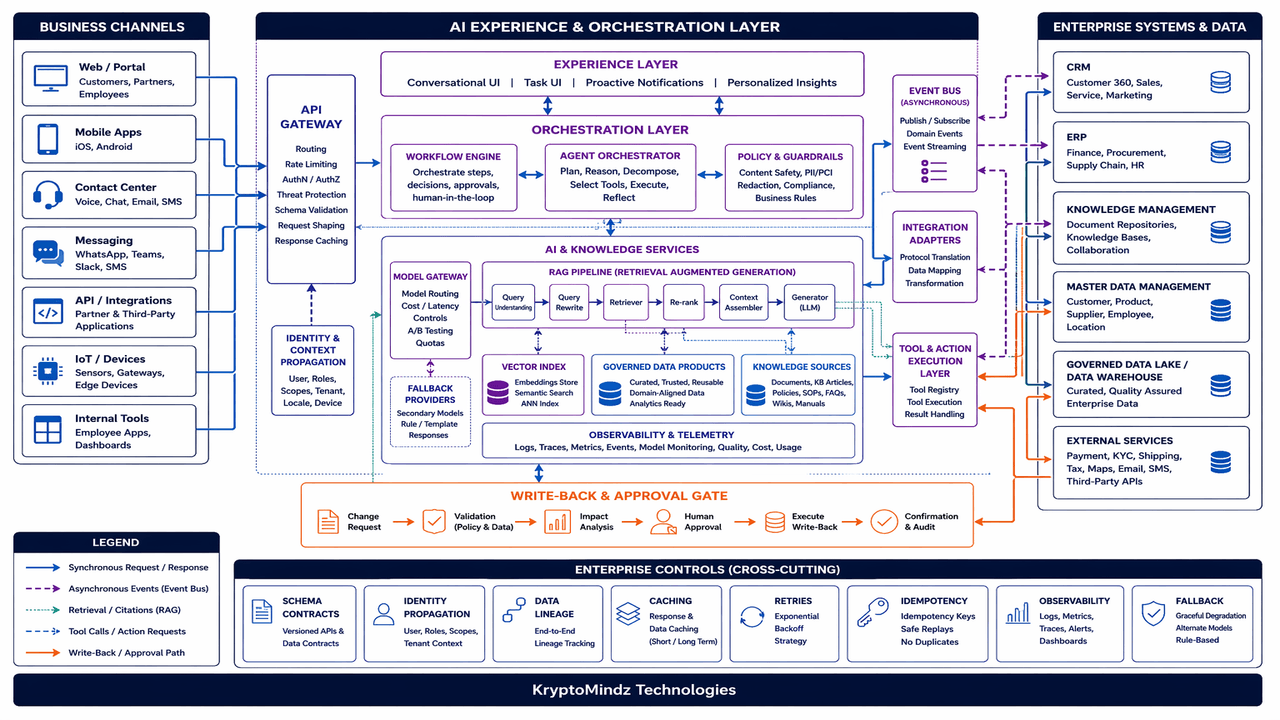
A reference architecture separates business experience, orchestration, shared AI platform services, governed data and integrations, and cross-cutting security and governance. This separation permits controlled model replacement, consistent policy, observable workflows and independent evolution of business applications.
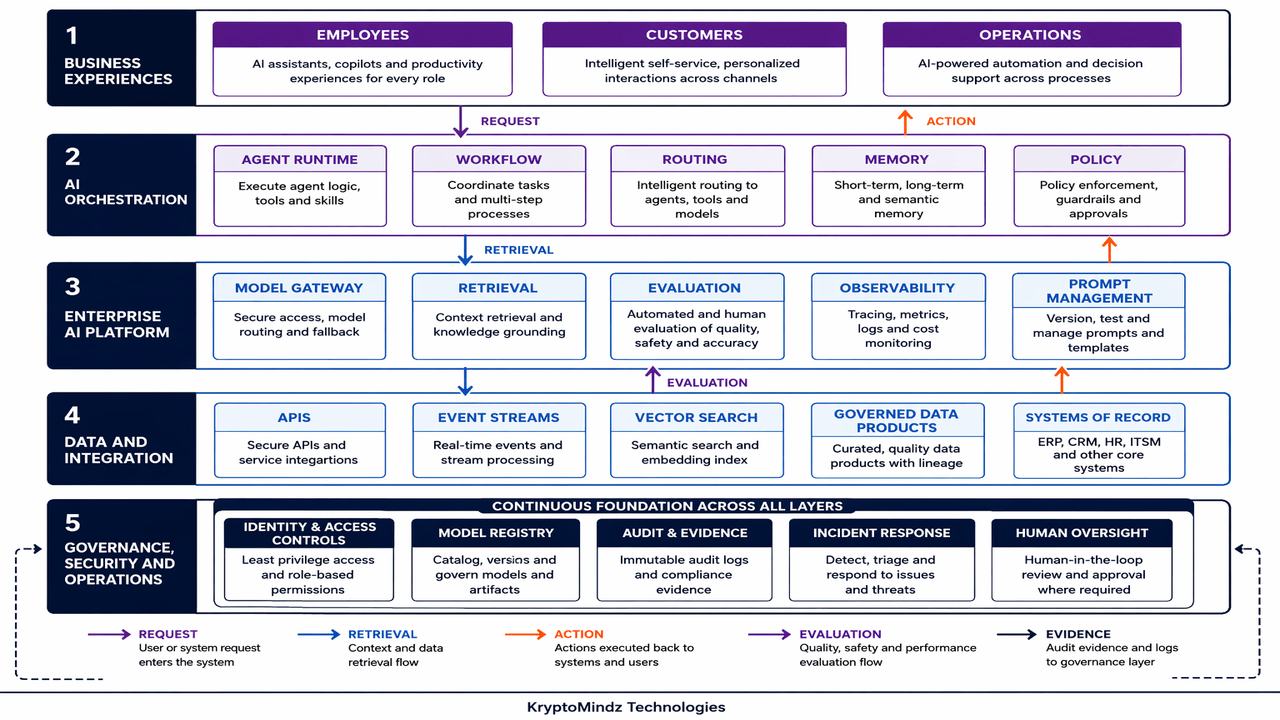
Experience and workflow
Users interact through existing business applications, copilots, APIs and automated processes. The application owns user context, accessibility, disclosures and fallback. It should never imply certainty or authority the underlying system does not possess.
Orchestration and agent runtime
Orchestration coordinates prompts, retrieval, models, tools, memory, policy and human tasks. Keep business workflow state outside opaque model context. Idempotent steps, timeouts, retries, transaction boundaries and compensation remain ordinary software-engineering responsibilities.
Shared AI platform
A model gateway, approved catalog, evaluation service, prompt and configuration registry, observability, content controls and cost policy provide reusable guardrails. Preserve provider portability where practical, but do not reduce all models to a lowest-common-denominator interface when differentiated capability creates value.
Governance and evidence foundation
Identity, policy, inventories, approvals, lineage, incidents and assurance evidence span every layer. Make control decisions observable and versioned. A governance portal that is disconnected from runtime behavior cannot provide strong assurance.
6. Agentic AI and Bounded Autonomy
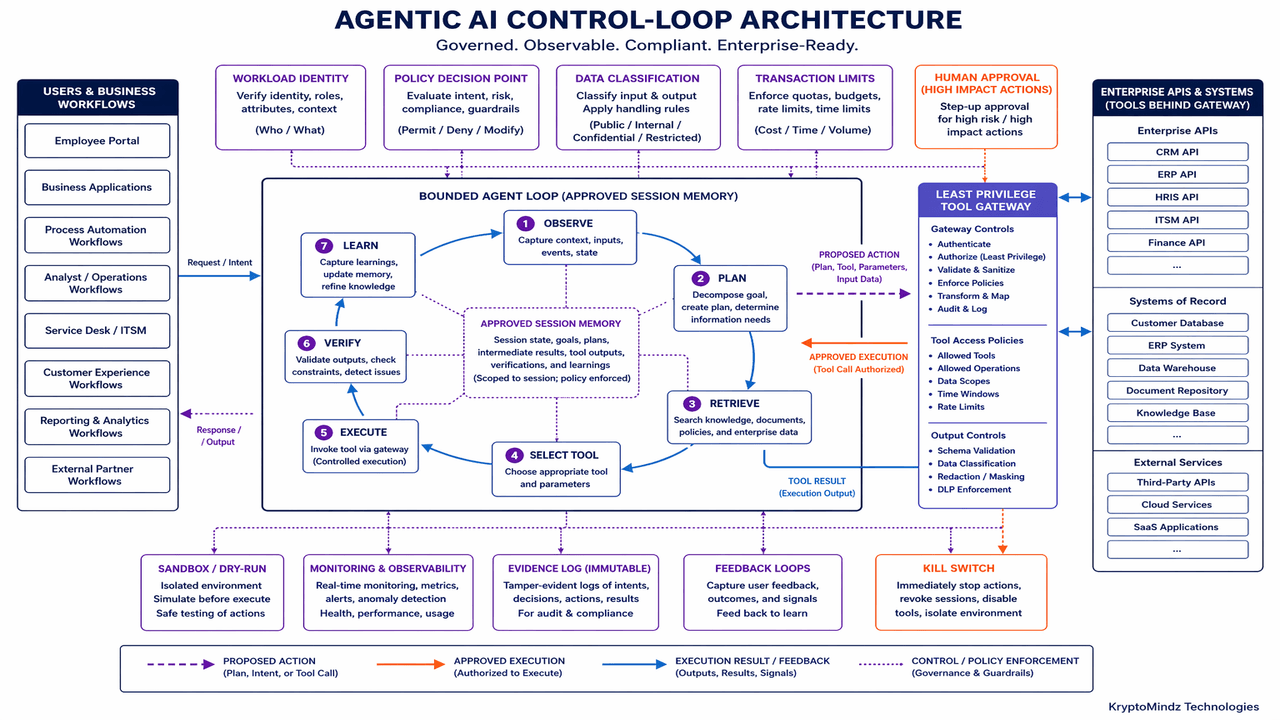
An AI agent uses a model inside a loop to interpret goals, build or revise a plan, retrieve context, select tools, act and evaluate results. This can automate complex work, but it also turns generated output into operational authority. The central architecture question is not whether an agent appears intelligent; it is what the agent is permitted to do when it is wrong, manipulated or uncertain.
Identity and delegated authority
Give each agent or agent service a workload identity. Bind permissions to business purpose, tool, data scope, tenant, transaction limit and duration. A user session should not silently grant an agent every permission the user possesses.
Tool mediation
Expose narrow, typed operations through a governed tool gateway. Validate parameters independently of model text, keep secrets outside prompts, classify read and write operations, enforce rate and value limits, and make material writes idempotent. Treat tool descriptions and retrieved content as untrusted input.
Human oversight that works
Escalation must provide the proposed action, source evidence, uncertainty, alternatives and potential consequence. Approval fatigue is not oversight. Route only meaningful decisions to qualified reviewers and measure override, rejection and response outcomes.
Multi-agent systems
Agent-to-agent delegation expands identity, provenance and failure complexity. Record which agent requested, approved and performed each action; constrain delegation depth and authority; and prevent one agent’s untrusted output from becoming another agent’s instruction without policy and validation.
7. Secure Enterprise AI Architecture
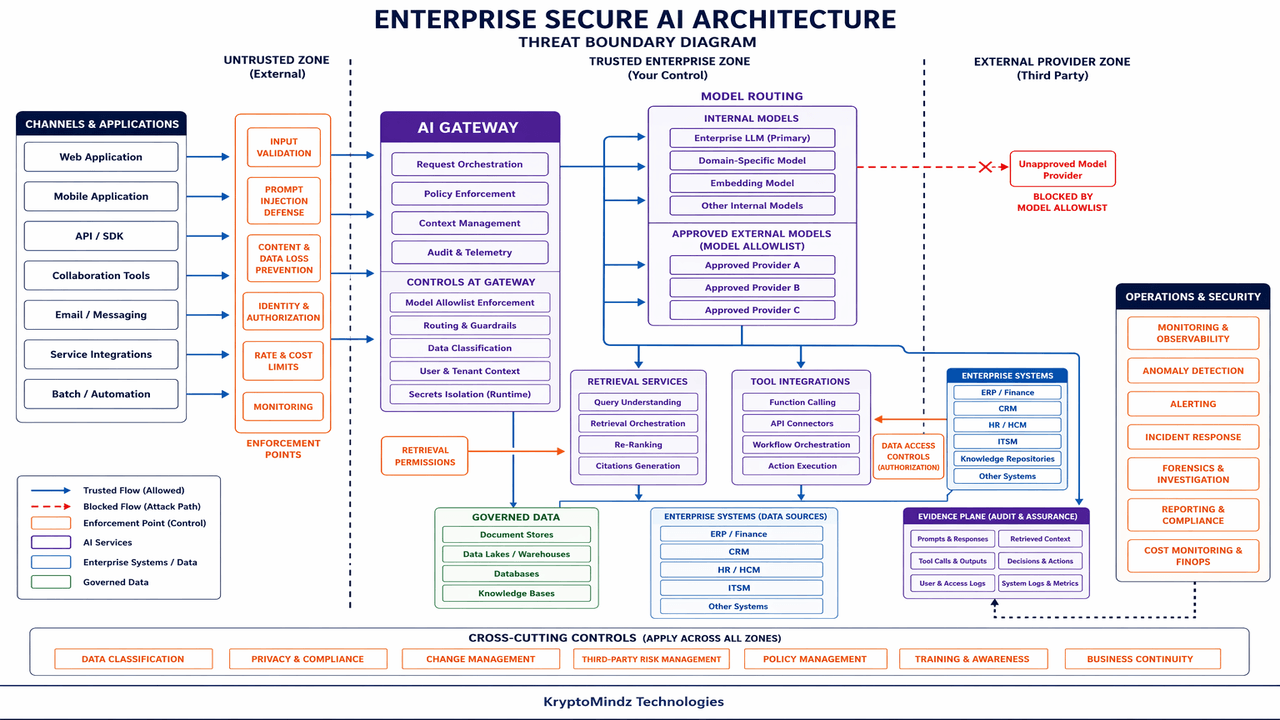
AI security extends secure software and cloud engineering with model-specific and interaction-specific threats. Relevant scenarios include prompt injection, sensitive information disclosure, poisoned knowledge, unsafe tool use, model or configuration theft, excessive agency, denial of service and insecure output handling. Use OWASP guidance and MITRE ATLAS as inputs to a threat model, not as substitute checklists.
Assume instructions can be hostile
Prompts, documents, web pages, emails and tool results may contain instructions designed to redirect the model. Separate system policy from untrusted content, restrict available tools, validate actions outside the model and test indirect prompt injection through real retrieval paths.
Protect data across the lifecycle
Control data in prompts, embeddings, fine-tuning sets, caches, logs, evaluations and provider telemetry. Verify contractual and technical retention, training, residency and isolation behavior. Apply authorization at retrieval time; a vector index must not flatten source permissions.
Secure the AI supply chain
Inventory models, adapters, datasets, libraries, containers, prompts and providers. Verify provenance and integrity where possible, scan dependencies, restrict deployment sources and define response for vulnerable or withdrawn models. Model updates are production changes even when an API name remains constant.
Design containment and recovery
Support provider isolation, tool revocation, model rollback, feature disablement, traffic throttling and evidence preservation. Exercise compromised prompt configuration, poisoned retrieval, leaked credentials, anomalous tool activity and unavailable providers before an incident.
8. Data, Retrieval and Enterprise Knowledge
Enterprise AI quality depends on the authority, meaning, permission and freshness of its context. A model cannot repair an unowned knowledge estate. Build governed data products and retrieval services that preserve source identity, access rights, classification, effective dates and lineage.
Retrieval-augmented generation
RAG can ground output in enterprise sources without embedding all knowledge in model weights. Define ingestion eligibility, chunking, metadata, ranking, permission filtering, citation, freshness and deletion. Evaluate retrieval separately from generation so teams can identify whether failure came from missing evidence, poor ranking or model synthesis.
Training and adaptation
Use fine-tuning when repeated behavior or domain conventions cannot be achieved reliably through prompts and retrieval alone. Record dataset purpose, rights, provenance, representativeness, filtering, versions and evaluation. Adaptation can introduce memorization, regression and maintenance obligations.
Memory and personalization
Session and long-term memory need explicit purpose, user control, isolation, retention and correction. Do not allow a model to decide unilaterally which sensitive facts become permanent memory. Separate workflow state from conversational convenience.
Provenance and citations
Citations improve inspectability only when they point to the actual supporting material and the user can access it. Verify entailment, prevent fabricated references and display source date or authority where it changes interpretation.
9. Enterprise Integrations and Tool Boundaries
Production AI connects to CRM, ERP, content, analytics, communication and operational systems. Integrations should preserve identity, schema, transaction semantics and ownership rather than turning every system into unrestricted text context.
API-first tool contracts
Wrap capabilities in narrow APIs with typed parameters, documented side effects and business validation. Keep model-facing descriptions concise and testable. Never rely on generated text as the final authorization or validation layer.
Events and long-running workflows
Use durable workflows and event infrastructure for work that spans time, systems or approvals. Carry correlation identifiers and identity context, define retries and dead-letter handling, and ensure repeat requests do not duplicate business transactions.
Protocol and provider boundaries
Standards can reduce integration friction, but dynamic tool discovery also changes the attack surface. Maintain an allowlist, authenticate servers, pin trust where appropriate, inspect tool changes, constrain scopes and log invocation. Treat external connectors as third-party software dependencies.
Fallback and continuity
Define behavior when models, retrieval or downstream systems are slow or unavailable. Options include deterministic rules, human queues, read-only mode, alternate providers or clear service refusal. Silent quality degradation is rarely an acceptable fallback.
10. Evaluation, Testing and Assurance
Evaluation translates “works well” into evidence tied to a use case. Build representative test sets from approved, privacy-conscious sources and include expected routine, edge, adversarial and failure behavior. Define release thresholds before results are available.
Evaluate the complete system
Measure retrieval relevance, answer groundedness, task completion, tool choice, parameter correctness, policy compliance, human override, latency and cost. A strong model score does not compensate for an unsafe tool path or poor source permissions.
Use multiple evaluation methods
Combine deterministic checks, domain-expert review, model-assisted scoring with calibration, red teaming and production outcome analysis. Model judges are scalable but can share blind spots with the system being judged; validate them against human decisions.
Test security and abuse
Exercise direct and indirect prompt injection, data extraction, unauthorized retrieval, cross-tenant leakage, tool misuse, excessive consumption, poisoned context and output injection. Verify that controls fail closed where required and that operators receive actionable signals.
Control changes
Version models, prompts, retrieval configuration, tools, policies and test sets. Route changes according to risk and observed impact. Re-run regression and adversarial suites after material changes, including provider-side model revisions.
11. Enterprise AI Governance
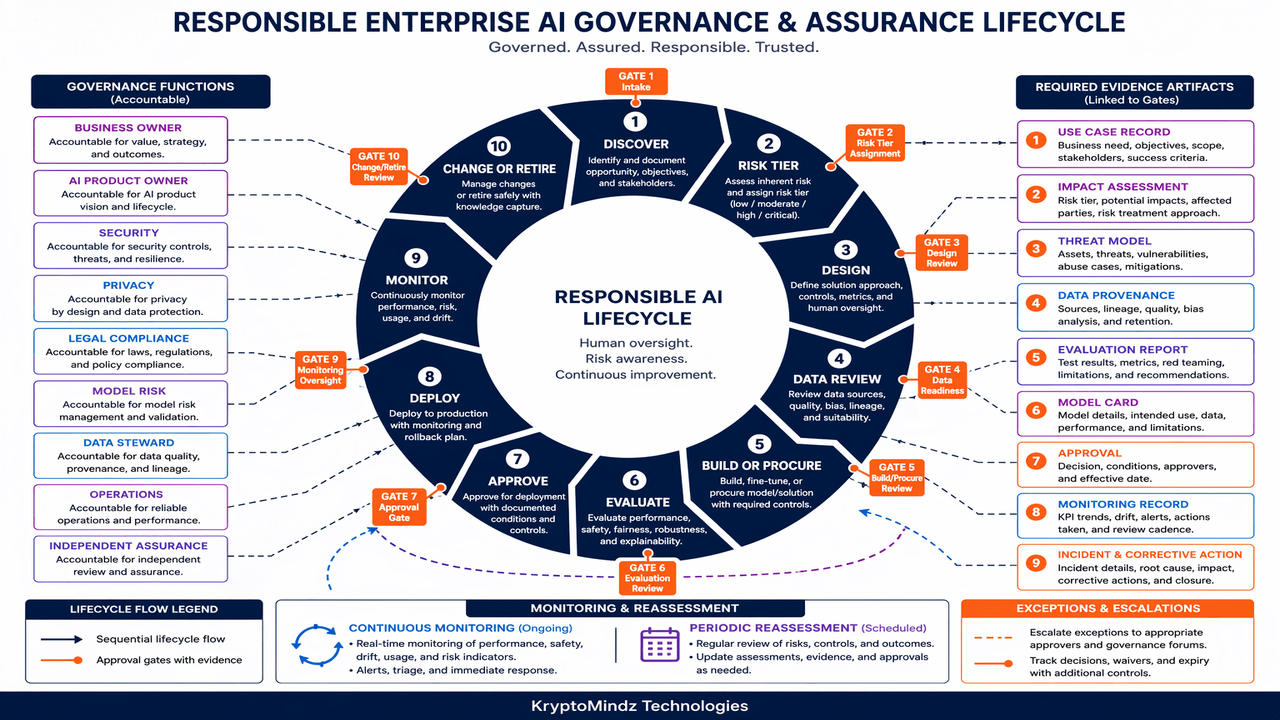
AI governance assigns decision rights and makes them operational. A central council can set policy, risk tiers and shared standards, but business owners remain accountable for use-case outcomes. Security, privacy, legal, compliance, data, procurement, architecture and affected-domain experts contribute distinct judgments.
Minimum governance records
Maintain an AI system and use-case inventory, accountable owners, purpose, risk tier, affected stakeholders, models and providers, data, integrations, evaluations, approvals, monitoring, incidents, changes and retirement status. Reconcile the inventory with procurement, cloud and application records to find shadow AI.
Policies and standards
Separate durable principles from testable standards and use-case procedures. Define prohibited use, approval thresholds, acceptable providers, sensitive-data handling, evaluation, human oversight, incident reporting, evidence and exception expiry.
Third-party governance
Assess model and SaaS providers for data use, security, development practices, model change notification, evaluation access, sub-processors, availability, incident response, intellectual property, compliance evidence and exit. Contractual commitments should align with technical configuration and monitoring.
AI management system
ISO/IEC 42001 can support repeatable policy, objectives, roles, risk treatment, competence, operation, performance evaluation and improvement. Certification scope and evidence matter; the standard does not declare every deployed AI output safe or lawful.
12. AI Risk Management
NIST AI RMF organizes work into Govern, Map, Measure and Manage. Use these functions iteratively: establish accountability, understand context and affected parties, measure risks with appropriate methods, and prioritize treatment and monitoring. The Generative AI Profile extends this approach to risks such as confabulation, information integrity, privacy, security, intellectual property and harmful content.
Map risk to consequence
Consider impact on individuals, organizations, society and the environment. Assess severity, scale, reversibility, detectability and exposure. Include people who understand the affected workflow and population rather than relying only on platform teams.
Treat risk through design choices
Options include removing the AI component, narrowing scope, reducing autonomy, changing data, choosing another model, adding verification, requiring approval, limiting scale, improving transparency, transferring risk contractually or accepting documented residual risk.
Regulation and sector obligations
Map applicable law and sector rules to actual system roles, geography, data and use. The EU AI Act uses risk-based obligations and specific roles; implementation timelines and guidance evolve. Obtain qualified legal advice and avoid inferring compliance from a generic architecture framework.
Incident management
Extend incident processes to harmful output, unsafe action, systemic bias, sensitive disclosure, policy bypass, model or data compromise and provider change. Preserve evidence, contain authority, assess affected parties, correct root causes and verify remediation.
13. Responsible Adoption and Human Factors
Responsible adoption aligns AI with human agency, meaningful transparency, accessibility, fairness, privacy and safe operating practice. It is not a communications layer applied after technical deployment. Product and process decisions determine whether people can understand, challenge or recover from AI-influenced outcomes.
Design the human-AI workflow
State whether the system assists, recommends, decides or acts. Show material limitations at the point of use, distinguish generated from authoritative content, make sources inspectable and provide escalation. Do not use interface confidence to conceal model uncertainty.
Prepare the workforce
Train people for their actual role: users need data and verification practice; reviewers need decision criteria; engineers need secure AI patterns; leaders need risk and outcome literacy; responders need containment and evidence procedures. Measure demonstrated competence, not attendance.
Assess fairness and accessibility
Where outcomes affect people, evaluate relevant groups and intersectional conditions using domain-appropriate methods. Investigate underlying process and data, provide accommodation and appeal, and avoid publishing a single fairness number without context.
Communicate change honestly
Explain the business purpose, expected role changes, retained human accountability, monitoring and feedback path. Adoption metrics should not reward unverified output volume or punish appropriate escalation.
14. AI Product and Platform Operating Model
Organize around durable AI products and shared platform capabilities. A product team owns business outcome, user workflow, data, evaluation, controls and lifecycle. A platform team supplies approved model access, deployment patterns, retrieval, evaluation, observability and policy enforcement. Governance sets rules and independently challenges higher-risk systems.
| Role | Primary accountability | Evidence |
|---|---|---|
| Business owner | Purpose, value, affected process and residual risk | Outcome baseline, approval, periodic review |
| AI product owner | End-to-end behavior and adoption | Requirements, evaluations, monitoring |
| Platform owner | Shared AI services and reliability | Catalog, controls, service objectives |
| Data owner | Permitted use, quality, access and lineage | Data record and access decisions |
| Security and privacy | Threat, control and data-risk challenge | Assessments, tests and exceptions |
| Independent assurance | Review proportionate to risk | Findings and verified remediation |
FinOps and capacity
Track cost per successful business outcome, not only tokens. Set budgets and limits by product, model and environment; monitor retries, unused context, retrieval expansion and agent loops. Design graceful capacity controls before scale.
Service management
Define service objectives for quality, availability, latency and control operation. Include provider dependencies in continuity planning. Operational ownership must extend beyond the team that built the pilot.
15. Trusted AI Implementation Roadmap
- Set direction: name priority outcomes, strategic posture, principles, executive accountability and investment guardrails.
- Inventory use: find internally built, vendor-embedded and unofficial AI; record owners, data, models, integrations and impact.
- Tier risk: define consequence and autonomy levels with required review, evidence, monitoring and change control.
- Establish foundations: implement identity, approved model access, data controls, evaluation, observability and use-case records.
- Select a bounded pilot: choose material value, available data, an accountable workflow owner and controlled consequence.
- Threat-model and design: map trust boundaries, misuse, data exposure, tool authority, human decisions, fallback and recovery.
- Evaluate before release: test representative quality, safety, security, fairness where relevant, performance and economics against thresholds.
- Operate and learn: monitor outcomes and controls, manage incidents and change, reassess risk, and scale reusable patterns.
Production readiness gates
- Purpose, owner, users, affected parties and risk tier are recorded.
- Approved models, providers, data, tools and regions are explicit.
- Identity and permissions enforce least privilege at runtime.
- Evaluation covers normal, edge, adversarial and failure scenarios.
- Human approval and appeal are meaningful where required.
- Monitoring connects technical behavior to business outcomes.
- Fallback, disablement, incident and evidence procedures are tested.
- Residual risk and production release have accountable approval.
KryptoMindz services for implementation include AI Agent Security Consulting, AI Data Leakage Protection, AI Infrastructure Consulting and MCP Consulting.
16. Enterprise AI Anti-Patterns
Demo-driven strategy
Fluent prototypes receive investment without baseline, workflow ownership or adoption economics. Remedy: require outcome and risk evidence at progressive funding gates.
Policy without runtime controls
Teams sign acceptable-use rules while applications can send any data to any provider. Remedy: enforce identity, approved models, data policy and monitoring through shared services.
RAG as an authorization bypass
Documents are copied into one index and source permissions disappear. Remedy: preserve classification and enforce subject-level access at retrieval.
Agent with user-equivalent authority
An agent inherits broad credentials and can execute irreversible actions from generated plans. Remedy: use workload identity, scoped tools, limits, verification and approval.
One benchmark means production ready
A generic score replaces task-specific, security and workflow evaluation. Remedy: test the end-to-end system against pre-defined release thresholds.
Human in the loop as a label
Reviewers receive too many requests or too little evidence to challenge the system. Remedy: design qualified, risk-based review and measure decisions.
Logging everything
Sensitive prompts, retrieved records and tool output accumulate indefinitely. Remedy: define proportionate evidence, access, redaction and retention.
Uncontrolled model drift
Provider and prompt changes reach production without regression evidence. Remedy: version the complete system and route material changes through evaluation.
17. Enterprise AI Architecture Workbooks
Use-case and autonomy canvas
Record outcome, baseline, owner, users, affected parties, decision or action, data, model, integrations, scale, autonomy, reversibility, risk tier and success measure. This is the minimum common language for portfolio review.
AI system boundary map
Draw channels, application logic, orchestration, models, prompts, retrieval, datasets, tools, systems, people, providers, identity, regions and evidence. Mark trust boundaries and which team controls each component.
Agent authority matrix
List each tool operation, data scope, read or write effect, credential, limit, approval, verification, rollback and evidence. Test that the runtime enforces the matrix instead of relying on prompt instructions.
Evaluation scorecard
Define scenario categories, datasets, metrics, thresholds, evaluators and failure disposition. Separate quality, groundedness, safety, security, fairness, latency, cost and business outcome to avoid hiding a critical failure in an average.
Model and provider register
Record approved purpose, owner, version behavior, hosting, data terms, region, dependencies, evaluations, known limitations, change notice, cost, incident path and exit plan.
AI incident exercise
Simulate prompt injection causing a proposed write, sensitive retrieval leakage, harmful output at scale, model quality regression, poisoned knowledge, provider outage and unauthorized shadow AI. Verify detection, containment, communication, evidence and return to service.
18. Metrics, Monitoring and Continuous Assurance
Combine outcome, adoption, behavior, control, risk and economics. Avoid a universal trust score: it obscures different failure modes and encourages weak trade-offs. Metrics should trigger decisions such as scale, redesign, restrict, investigate or retire.
| Domain | Example measures | Decision supported |
|---|---|---|
| Business value | Cycle time, quality, conversion, avoided loss, cost per successful task | Scale or stop investment |
| Quality | Task success, groundedness, citation support, expert acceptance | Model and workflow improvement |
| Human factors | Adoption, override, escalation, appeal, automation complacency | Training and interaction design |
| Security and privacy | Injection attempts, blocked data, unauthorized tools, leakage events | Control and threat response |
| Agent behavior | Tool failures, approval rejections, loop depth, write rollback | Authority and orchestration limits |
| Operations | Latency, availability, drift, fallback, spend, incident recurrence | Reliability and capacity |
Production observation
Monitor samples and aggregates according to data sensitivity. Detect shifts in input, retrieval, output, tool activity and downstream outcome. Join model telemetry with product and incident information without creating an unrestricted repository of user content.
Continuous assurance
Combine automated control evidence, evaluation suites, red teaming, expert sampling, user feedback, incident analysis and independent review. Findings need severity, accountable owners, deadlines and verified closure. Reassessment should follow material change as well as calendar schedules.
19. Frequently Asked Questions
What is trusted enterprise AI?
Trusted enterprise AI is the disciplined design, deployment and operation of AI systems so that their business value, behavior, security, risk, accountability and evidence remain within defined boundaries.
How should an enterprise start its AI strategy?
Start with measurable business outcomes and a governed portfolio of use cases. Rank each use case by value, feasibility, data readiness and consequence before choosing models or platforms.
What is agentic AI?
Agentic AI uses models within a control loop that can plan, retrieve context, select tools, take actions and react to results. Enterprise agents need identity, bounded authority, policy enforcement, verification and human escalation.
Is generative AI governance different from traditional model governance?
The foundations are similar, but generative systems add open-ended outputs, prompt injection, retrieval and tool risks, rapid model change and harder-to-predict behavior. Controls and evaluation must reflect those differences.
Should enterprises use one AI model for everything?
Usually not. Route work according to capability, sensitivity, latency, cost, residency and assurance needs. A governed model gateway can enforce approved choices without exposing every application to provider-specific integrations.
What belongs in a secure AI architecture?
A secure architecture includes workload identity, data and tool authorization, model and content gateways, input and output controls, isolation, secrets protection, monitoring, evidence, incident response and tested fallback behavior.
How do we prevent AI data leakage?
Classify data, minimize prompts, enforce retrieval permissions, isolate tenants, apply content and data-loss controls, restrict provider retention and training, protect logs, and test indirect disclosure paths.
What is retrieval-augmented generation?
Retrieval-augmented generation supplies a model with selected enterprise information at request time. It can improve grounding, but it still requires source permissions, provenance, freshness, citation and output evaluation.
How should AI agents access enterprise tools?
Agents should call approved tools through a governed gateway using short-lived workload identity, explicit scopes, validated parameters, transaction limits, idempotency and approval for high-impact writes.
When is human approval required?
Require human review when consequence, uncertainty, novelty, legal obligation or reversibility exceeds the organization’s approved autonomy threshold. Approval must include enough context to make a real decision.
What is an AI impact assessment?
It is a structured review of purpose, stakeholders, potential benefits and harms, data, affected rights, security, performance, oversight, alternatives, evidence and residual risk before use or material change.
How should enterprises evaluate generative AI?
Use task-specific test sets and adversarial scenarios to measure quality, groundedness, safety, security, fairness where relevant, latency and cost. Define acceptance thresholds before seeing production results.
Can an enterprise fully eliminate AI hallucinations?
No. Grounding, constrained outputs, verification and human review can reduce harmful errors, but probabilistic systems still require failure-aware workflows and proportionate controls.
What should be logged for AI systems?
Retain proportionate evidence such as system and model version, policy, data and tool references, evaluation results, approvals, actions and outcomes while minimizing sensitive prompts and personal data.
Which AI governance frameworks should enterprises use?
NIST AI RMF and its Generative AI Profile provide practical risk guidance. ISO/IEC 42001 provides an AI management system standard. Sector rules and applicable law must also be mapped to controls.
How often should an AI system be reassessed?
Reassess after material model, data, prompt, tool, workflow, vendor or regulatory changes, after incidents or performance drift, and periodically according to risk tier.
What are the most useful enterprise AI metrics?
Track business outcome, adoption, task quality, groundedness, override and escalation, security events, policy violations, drift, latency, cost, incident recurrence and evidence completeness.
What should a trusted AI assessment deliver?
It should produce a use-case inventory, risk tiers, current and target architecture, data and integration map, control gaps, evaluation plan, governance model, prioritized roadmap and accountable owners.
Sources, Author and Technical Review
This guide prioritizes primary standards and authoritative public guidance. AI technology, standards and regulation change quickly; verify current editions and obtain qualified legal advice for jurisdiction-specific obligations.
- NIST AI Risk Management Framework (AI RMF 1.0)
- NIST AI 600-1, Generative AI Profile
- NIST AI RMF Playbook
- NIST Secure Software Development Framework SP 800-218
- NIST Cybersecurity Framework 2.0
- ISO/IEC 42001, Artificial intelligence management system
- ISO/IEC 23894, Guidance on AI risk management
- OWASP Top 10 for Large Language Model Applications
- MITRE ATLAS, Adversarial Threat Landscape for AI Systems
- CISA, Guidelines for Secure AI System Development
- European Commission, Regulatory framework for AI
- OECD AI Principles
Build AI the Enterprise Can Defend and Scale
KryptoMindz can turn AI ambitions into a governed portfolio, secure target architecture, agent control model, evaluation program and practical adoption roadmap.
Discuss Your Enterprise AI Strategy