
1. Executive Context
AI governance is how an enterprise turns principles and obligations into repeatable decisions. It determines which AI uses are acceptable, who owns outcomes, what evidence is required, which controls must operate, and when a system must be changed or stopped.
The hard problem is not publishing another policy. It is connecting strategy, law, risk, product delivery, security and operations without creating a committee bottleneck. Effective governance is proportionate: low-impact tools move through a light path, while consequential systems receive deeper assessment and independent challenge.
2. AI Governance Foundations
A governance system needs explicit scope, principles, decision rights, risk appetite, controls, evidence and escalation. It covers internally built, purchased, embedded and employee-used AI, including predictive models, generative AI and autonomous agents.
Separate accountability from activity
Teams can perform evaluations and reviews, but the business owner remains accountable for the system’s purpose and consequences. Independent functions challenge risk, and governing bodies oversee aggregate exposure.
Make policy executable
Turn statements such as “AI must be fair” into scoped requirements: affected groups, metrics, thresholds, test data, review frequency, exception authority and response when performance falls outside tolerance.
Use proportionality
Depth should follow impact, exposure, autonomy, reversibility and legal obligation. A universal heavyweight process drives shadow AI; a universal light process leaves material risk unmanaged.
3. AI Governance Framework and Compliance Crosswalk
No single framework answers every enterprise need. NIST AI RMF organizes risk work through Govern, Map, Measure and Manage. ISO/IEC 42001 specifies an AI management system. Laws such as the EU AI Act impose role- and risk-dependent duties. A crosswalk maps all three into one control library.
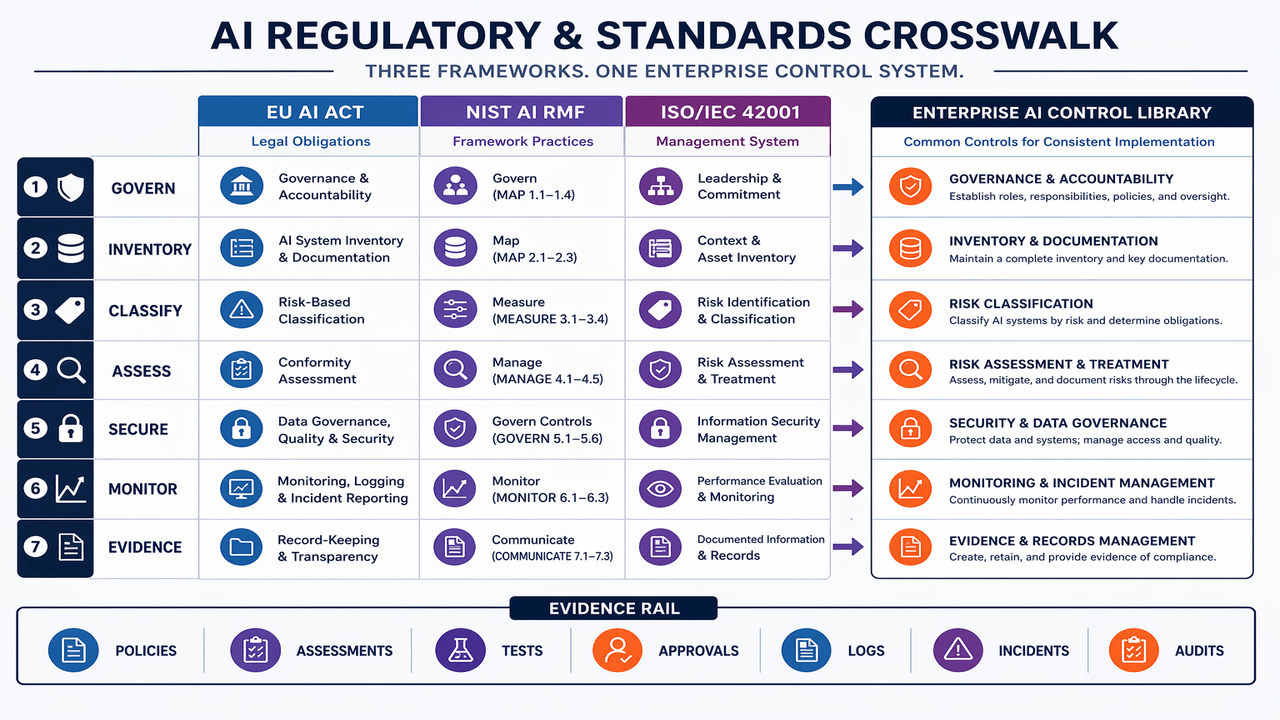
| Source | Primary value | Enterprise use |
|---|---|---|
| NIST AI RMF | Voluntary risk outcomes | Structure governance and assessment |
| ISO/IEC 42001 | Management-system requirements | Operate and improve governance |
| EU AI Act | Binding risk-based obligations | Determine roles, classification and duties |
| Internal policy | Risk appetite and business rules | Set minimum controls across jurisdictions |
Keep obligation interpretation legally owned and versioned. A crosswalk supports traceability; it is not legal advice or proof of compliance by itself.
4. Enterprise AI Governance Operating Model
The operating model connects board oversight to portfolio governance and delivery decisions. Central teams define common policy, taxonomy, controls and evidence. Federated product and business teams apply them with domain knowledge.
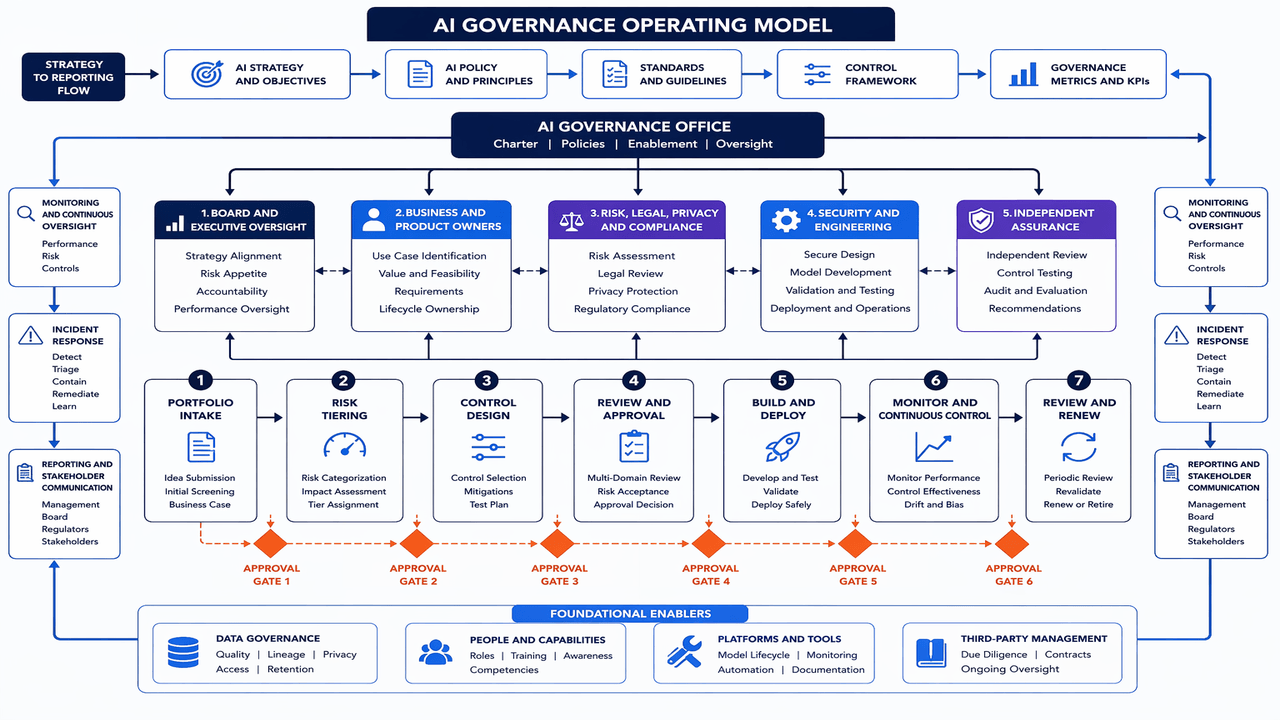
Three lines with practical collaboration
Business and product teams own use and risk. Risk, compliance, privacy and security provide policy, expertise and challenge. Internal audit independently evaluates design and effectiveness. Collaboration during design should not compromise later assurance.
Governance forums
Use forums for defined decisions, not status theater. Publish mandate, quorum, delegated authority, required evidence, conflicts, conditions, expiry and appeal. Record who accepted residual risk.
Board and executive oversight
Report portfolio exposure, high-impact uses, exceptions, incidents, control effectiveness, vendor concentration and regulatory change. Avoid dashboards that count projects but conceal consequences.
5. AI Inventory and Ownership
An enterprise cannot govern what it cannot identify. Inventory the business system and use case, not only models. Include AI embedded in SaaS, APIs, employee tools, automation and third-party decisions.
Minimum inventory record
Capture purpose, owner, provider, model, users, affected parties, decisions influenced, data, integrations, autonomy, jurisdictions, deployment state, risk tier, assessments, approvals, monitoring and retirement.
Discovery and reconciliation
Combine intake with procurement, cloud and API discovery, software composition, expense data and interviews. Reconcile the authoritative inventory with engineering and vendor records rather than relying on annual surveys.
Change control
Define material changes such as a new purpose, population, model, data source, tool permission or deployment region. Material change must trigger reassessment rather than silently inheriting an old approval.
6. AI Risk Classification and Triage
Classification routes systems to the right controls. Evaluate context, affected parties, scale, rights and safety impact, sensitivity, autonomy, human dependence, reversibility, external exposure and legal category.
| Route | Typical characteristics | Governance response |
|---|---|---|
| Prohibited or unacceptable | Outside law or risk appetite | Reject, stop or redesign |
| High or consequential | Material rights, safety or livelihood impact | Full assessment and independent approval |
| Moderate | Meaningful but bounded impact | Standard control set and owner approval |
| Limited | Low impact and reversible | Light review, transparency and monitoring |
Regulatory classification and internal risk tiering should be linked but remain distinct. An AI system can fall outside a statutory high-risk category and still exceed enterprise risk appetite.
7. AI Risk and Impact Assessments
Assessment establishes context, foreseeable benefit and harm, affected parties, threats, control adequacy and residual risk. It should be a decision instrument supported by evidence, not a questionnaire completed to unlock deployment.
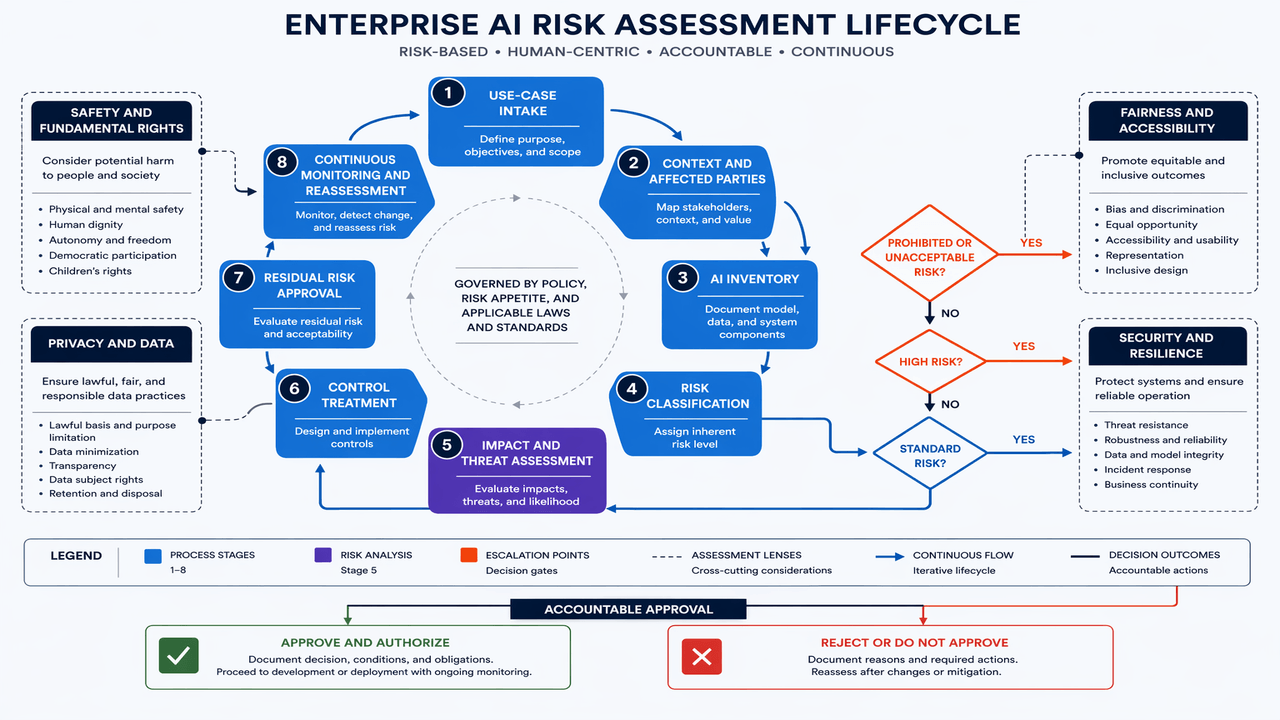
Map impact and misuse
Consider intended use, reasonably foreseeable misuse, over-reliance, exclusion, manipulation, discrimination, privacy, security, safety, environmental and workforce effects. Include downstream users and people who cannot meaningfully opt out.
Measure before accepting
Use appropriate evaluation data, baselines, subgroup analysis, stress tests and uncertainty. Document limitations and where measurement is not yet reliable. A polished aggregate score can hide severe localized harm.
Residual risk decision
State treatment, remaining exposure, conditions, monitoring and review date. Acceptance belongs to an authorized accountable owner; reviewers should not implicitly own the business risk.
8. Responsible AI as an Engineering System
Responsible AI principles become credible only when tied to architecture, tests and operations. Define outcomes in the context of the system and affected parties, then assign measurable controls across the stack.
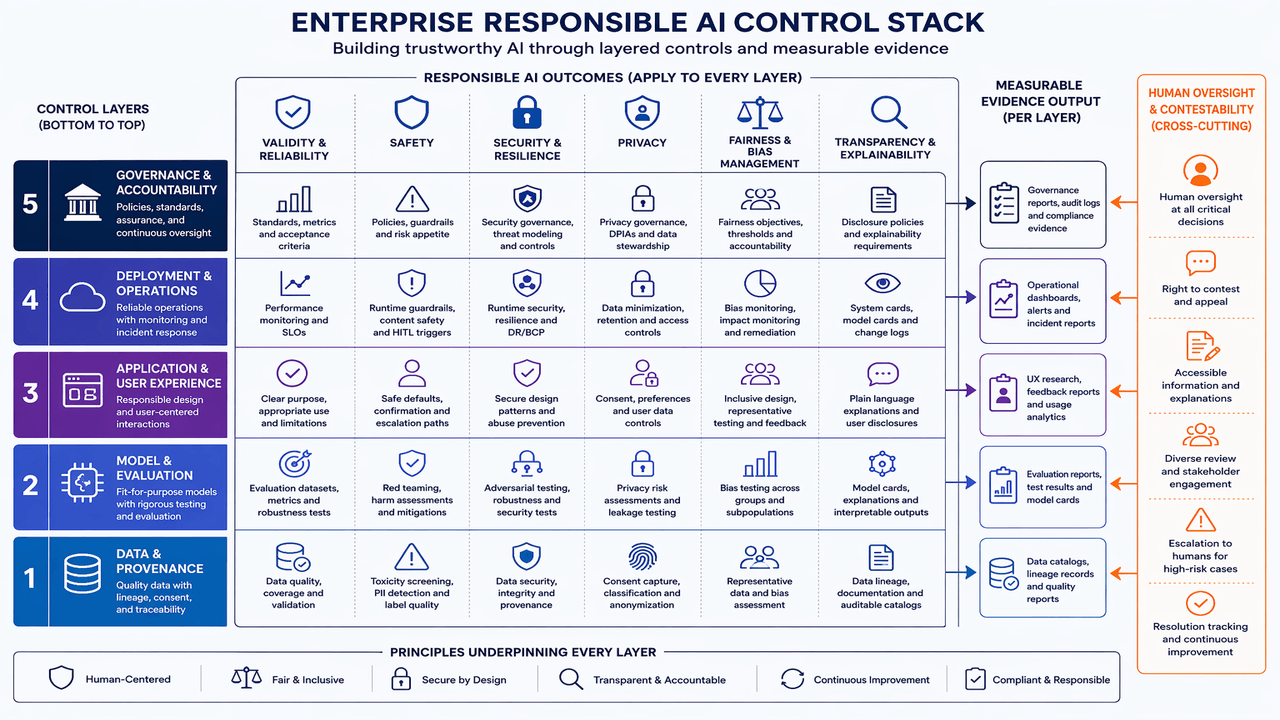
Validity, reliability and safety
Define acceptable performance, uncertainty, operational envelope, fallback and safe failure. Test representative and adverse conditions and prevent users from inferring capabilities the system does not possess.
Fairness, privacy and transparency
Identify relevant groups and harm, evaluate data and outcomes, minimize personal data, communicate AI involvement and limitations, and provide explanation and contestability appropriate to consequence.
Human oversight
Specify what a human can see, decide, interrupt and reverse. Train reviewers, avoid automation bias, measure override quality and ensure workloads permit meaningful review.
9. AI Security Reviews and Release Gates
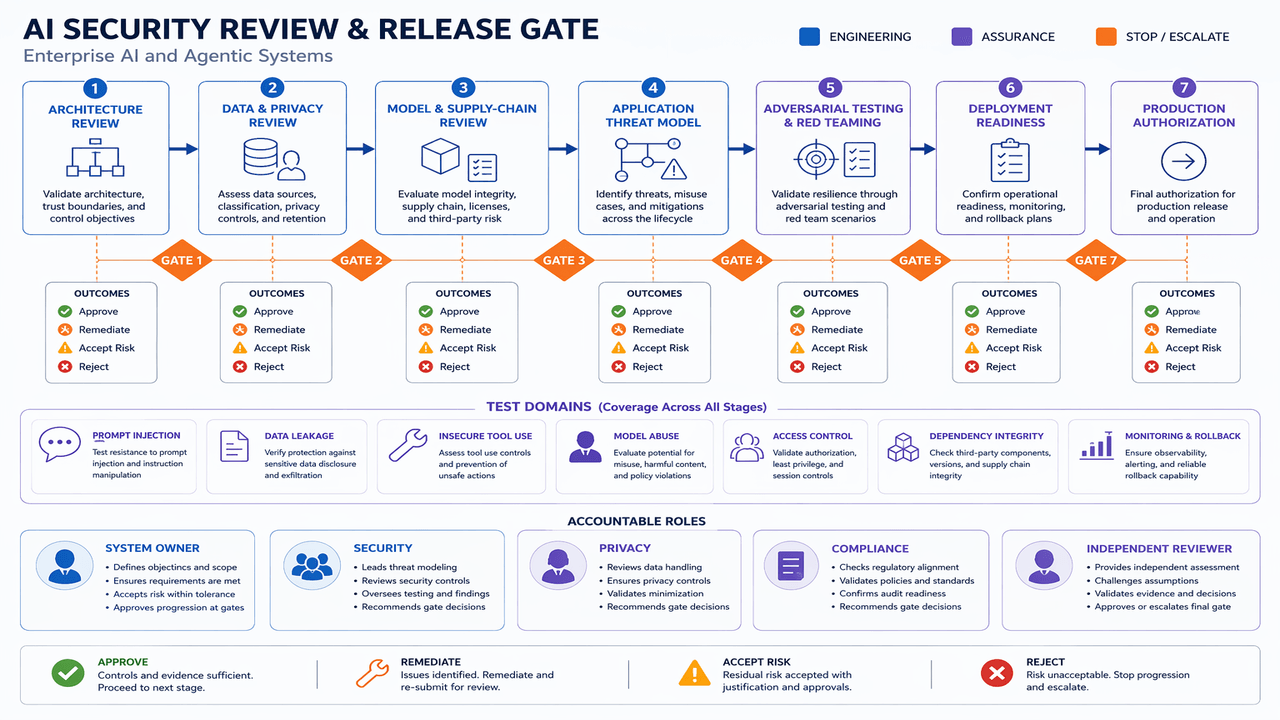
AI security extends application security with model behavior, prompt and context manipulation, training and retrieval data, model supply chain, unsafe output and autonomous tool use. Review the complete system and its trust boundaries.
Threat-model architecture and abuse
Map assets, identities, data flows, models, retrieval, memory, tools, external content and human approval. Include prompt injection, sensitive disclosure, poisoning, excessive agency, privilege escalation, denial of service and model theft.
Test adversarially
Red-team realistic actors and goals, including indirect attacks through documents, websites or tool responses. Track test coverage, reproducibility, severity, remediation and retest.
Authorize production deliberately
Require known owners, resolved or accepted findings, least privilege, telemetry, rate and spend limits, rollback, incident playbooks and a review date. Material change invalidates stale security evidence.
10. Regulatory Compliance and the EU AI Act
Start with role, jurisdiction, system definition and use. Under the EU AI Act, obligations differ for providers, deployers, importers, distributors and product manufacturers, and classification drives additional duties. Maintain legal analysis separately from technical risk scoring.
Build an applicability record
Record the legal entity, role, market and affected location, system and model scope, exclusions, prohibited-practice assessment, high-risk analysis, transparency duties and supporting rationale.
Operationalize obligations
Where applicable, connect risk management, data governance, technical documentation, records, transparency, human oversight, accuracy, robustness, cybersecurity, quality management, conformity and post-market monitoring to owned controls.
Track regulatory change
Maintain horizon scanning, interpretation ownership, implementation dates, standards dependencies and control changes. Preserve the version of law and guidance used for each decision.
11. Governance Across the AI Lifecycle
Controls begin at strategy and procurement and continue through retirement. Each stage should have entry criteria, required evidence, accountable decisions and triggers that reopen review.
- Discover: define problem, benefit, affected parties and alternatives.
- Design: set requirements, risk tier, data and oversight.
- Build or buy: manage provenance, suppliers, access and versions.
- Validate: test performance, impacts, security and operations.
- Deploy: authorize with limits, communications and rollback.
- Operate: monitor, investigate, change and report.
- Retire: disable access, preserve required evidence and dispose of data.
For generative and agentic systems, treat prompts, retrieval collections, policies, tools and orchestration as governed configuration alongside model versions.
12. Third-Party and Foundation Model Governance
Vendor claims do not replace due diligence. Assess the service in your use context and determine which controls the provider owns, which are shared and which remain entirely yours.
Due diligence
Review model and service documentation, data use and retention, security, privacy, evaluation, content controls, subprocessors, geographic processing, incident history, accessibility and business continuity.
Contract and change
Address permitted use, confidentiality, training on customer data, intellectual property, audit evidence, incidents, regulatory cooperation, model changes, deprecation, availability, portability, termination and deletion.
Continuous supplier control
Monitor provider notices, model drift, policy changes, vulnerabilities, incidents and concentration. Maintain an exit plan for services that become noncompliant, unsafe, unavailable or commercially untenable.
13. Monitoring, Incidents and Continual Improvement
Monitoring should connect technical behavior to business and human outcomes. Establish baselines, thresholds and owners before release, then collect only telemetry needed for safety, security, compliance and improvement.
Monitor multiple layers
Track data and concept drift, performance, subgroup outcomes, unsafe output, human overrides, access, tool calls, security events, complaints, cost, latency and provider change.
AI incident response
Define severity and reportability for harmful decisions, data exposure, manipulation, unsafe autonomy, systemic bias, model failure and prohibited use. Provide containment, rollback, notification, redress and evidence preservation.
Management review
Use incidents, audits, monitoring, complaints and regulatory change to improve controls and risk appetite. ISO-style continual improvement should change operational behavior, not merely produce meeting minutes.
14. Compliance by Design and Evidence Architecture
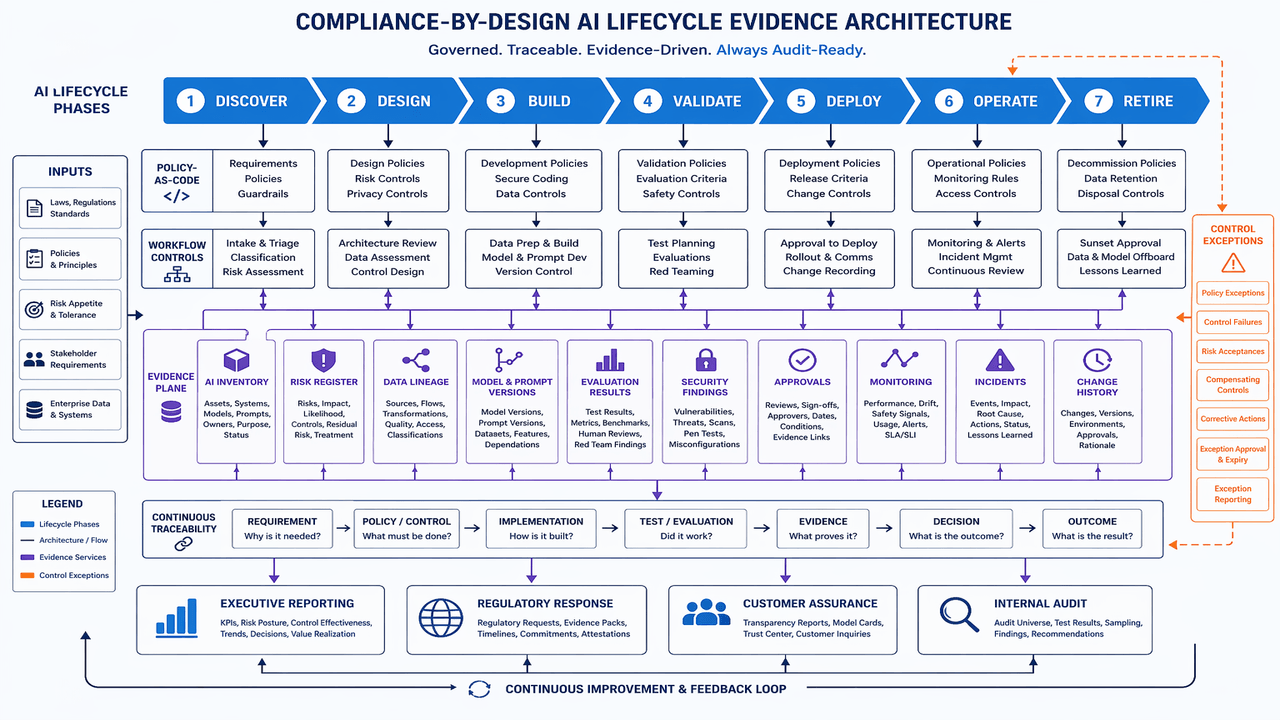
Compliance by design embeds obligations and control checks in delivery workflows. Evidence should be captured when work happens, linked to the governed version and protected from unauthorized change.
One traceability chain
Map requirement to policy, control, owner, implementation, test, result, exception, approval and monitoring. Use identifiers and versioning so an auditor can establish which evidence supported which release.
Automate carefully
Workflow and policy-as-code can enforce required fields, route risk, run tests and block release. Automation should expose rationale, support authorized exceptions and avoid converting ambiguous legal judgments into hidden binary rules.
Protect evidence
Apply access control, integrity, retention, confidentiality and legal hold. Avoid collecting sensitive prompts or personal data merely because storage is cheap.
15. AI Governance Implementation Roadmap
- Establish mandate: define scope, executive sponsor, accountable owners and risk appetite.
- Discover the portfolio: create a minimum AI inventory and uncover shadow use.
- Harmonize requirements: crosswalk law, frameworks, contracts and policy into controls.
- Design routing: implement classification, intake, assessment and approval authority.
- Set minimum controls: define evidence for data, evaluation, security, oversight and operations.
- Pilot on real systems: choose one low-risk and one consequential use case.
- Integrate workflows: connect procurement, engineering, privacy, security and change management.
- Measure and improve: report exposure, exceptions, incidents, cycle time and effectiveness.
- AI scope and terminology are consistent.
- Every production system has an accountable owner.
- Inventory reconciles with procurement and engineering.
- Risk routes have objective triggers.
- Assessments address affected parties and misuse.
- Security review covers models, context and tools.
- Approvals identify residual risk and expiry.
- Evidence is versioned and traceable.
- Monitoring can trigger rollback and reassessment.
- Retirement and vendor exit are tested.
Related capabilities include AI Governance Consulting, Enterprise AI Consulting, Secure AI Agents Services and the Trusted Enterprise AI Guide.
16. AI Governance Anti-Patterns
Policy without workflow
Principles exist but delivery never encounters them. Remedy: embed controls and evidence in intake, procurement, engineering and release.
One committee approves everything
Low-risk work stalls while consequential decisions receive shallow review. Remedy: tier requirements and delegate authority explicitly.
Model-only inventory
The enterprise catalogs algorithms but misses use and impact. Remedy: inventory business systems, contexts and affected parties.
Compliance checklist as assessment
Teams complete yes/no forms without evidence or analysis. Remedy: require context, tests, limitations and residual risk decisions.
Responsible AI theater
Principles are promoted while metrics and redress remain undefined. Remedy: attach each outcome to an owner, requirement, test and response.
Vendor exception
Purchased AI bypasses governance. Remedy: govern the enterprise use and allocate shared controls contractually.
Approval forever
Systems change while old evidence remains accepted. Remedy: define material-change triggers, expiry and reassessment.
Evidence after the fact
Teams rebuild history for audits. Remedy: capture versioned evidence continuously through delivery workflows.
17. Frequently Asked Questions
What is enterprise AI governance?
Enterprise AI governance is the system of decision rights, policies, roles, controls and evidence used to direct and oversee AI across its lifecycle.
How is AI governance different from AI compliance?
Governance defines how the enterprise makes and oversees AI decisions. Compliance demonstrates that applicable legal, regulatory, contractual and policy obligations are satisfied.
Which AI governance framework should an enterprise use?
Most enterprises need a harmonized control system rather than one framework. NIST AI RMF can structure risk activity, ISO/IEC 42001 can structure the management system, and applicable laws define mandatory obligations.
What is an AI management system?
An AI management system is the organizational framework of policy, objectives, responsibilities, processes, resources, measurement and continual improvement used to govern AI, as addressed by ISO/IEC 42001.
Does the EU AI Act apply outside the European Union?
It can apply to providers or deployers outside the EU when conditions in the regulation are met, including certain AI systems whose output is used in the EU. Qualified legal analysis is required.
What belongs in an AI inventory?
Record the system and use case, owner, purpose, users, affected parties, model and provider, data, integrations, jurisdictions, risk class, controls, approvals, versions, incidents and retirement status.
When should an AI risk assessment occur?
Assess before procurement or development, before material release, when use, data, model or context changes, after incidents, and periodically according to risk.
What is an algorithmic impact assessment?
It is a structured assessment of an AI system’s context, affected parties, potential impacts, mitigations, accountability and residual risk. Its scope should match the use case and jurisdiction.
What does responsible AI mean operationally?
It means translating outcomes such as validity, safety, fairness, privacy, transparency and accountability into measurable requirements, tests, controls, decisions and redress.
Who should approve a high-risk AI system?
Approval should include the accountable business owner and the independent risk, compliance, privacy, security or safety functions required by policy. No committee should erase individual accountability.
What should an AI security review cover?
Review architecture, data flows, identity and access, model and dependency supply chains, prompt injection, tool use, privacy, adversarial abuse, monitoring, incident response, rollback and recovery.
Are vendor AI systems exempt from internal governance?
No. Procurement changes control ownership but not enterprise accountability. Assess provider evidence, contract terms, data use, change notification, security, monitoring, exit and concentration risk.
How should generative AI be governed?
Apply the same lifecycle and accountability foundation while adding controls for open-ended output, retrieval, prompts, grounding, content safety, model change, tool use and human review.
How should AI agents be governed?
Govern the agent’s identity, delegated authority, tools, data, memory, action limits, approval points, transaction evidence, monitoring, shutdown and recovery.
What is compliance by design for AI?
Compliance by design embeds obligations, control checks, evidence capture and approval into product, engineering, procurement and operations workflows instead of reconstructing compliance later.
What evidence should AI governance retain?
Retain proportionate evidence linking requirements to controls and decisions, including inventory records, assessments, data lineage, versions, evaluations, reviews, approvals, monitoring, incidents and changes.
How should AI incidents be managed?
Define reportable events, severity, containment, human escalation, rollback, affected-party response, regulatory and contractual notification, root cause and control improvement.
What should an AI governance implementation deliver first?
Start with decision rights, a scoped AI inventory, risk taxonomy, intake and assessment workflow, minimum controls, approval authority, evidence model and a pilot on real systems.
Sources, Author and Technical Review
This guide prioritizes primary regulation, standards bodies and authoritative technical resources. Requirements and standards evolve; verify current editions and obtain qualified legal, privacy, security and sector advice.
- Regulation (EU) 2024/1689, Artificial Intelligence Act
- NIST AI Risk Management Framework 1.0
- NIST AI RMF Playbook
- NIST AI 600-1, Generative AI Profile
- ISO/IEC 42001, AI management systems
- ISO/IEC 23894, Guidance on AI risk management
- ISO/IEC 22989, AI concepts and terminology
- OECD AI Principles
- OWASP Top 10 for Large Language Model Applications
- MITRE ATLAS
- European Commission, AI Act regulatory framework
- ICO, Guidance on AI and data protection
Turn AI Governance into an Operating Capability
KryptoMindz can translate obligations and responsible AI goals into an operating model, control library, assessment workflow, security review and evidence architecture.
Discuss Your AI Governance Program