Hyperledger Fabric for Business Explained
This video explores how Hyperledger Fabric brings blockchain technology to business. You’ll learn what permissioned networks are, how Fabric’s architecture prot

This video explores how Hyperledger Fabric brings blockchain technology to business. You’ll learn what permissioned networks are, how Fabric’s architecture prot
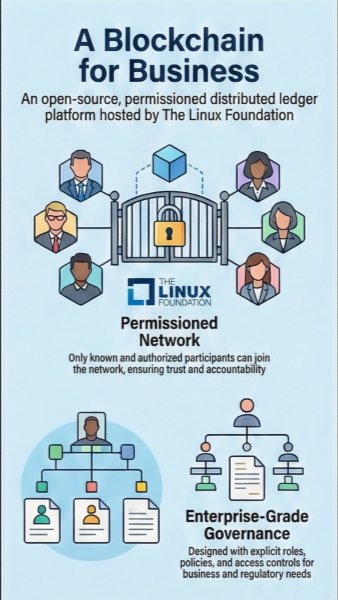
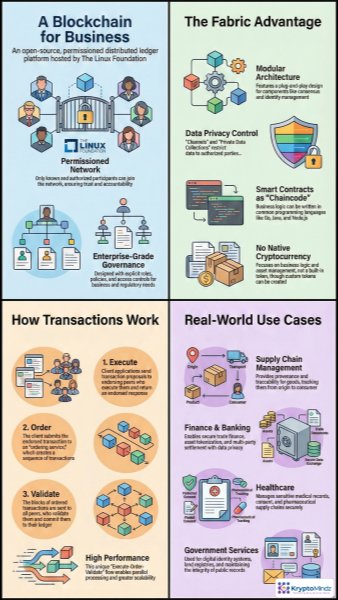
Hyperledger Fabric shows how blockchain can move beyond public cryptocurrency networks and solve practical business problems. In this overview, you’ll see how permissioned blockchain networks let companies collaborate with verified partners while keeping sensitive information protected. The video introduces Fabric’s approach to governance, privacy, smart contracts, and enterprise-grade transaction control. It also connects the technology to real-world use cases in supply chain traceability, financial services, healthcare data sharing, and government record management. By the end, you’ll understand why Hyperledger Fabric is a strong fit for organizations that need trust, auditability, and privacy across multiple stakeholders.
A permissioned blockchain network allows only verified and approved participants to join, making it ideal for businesses that need accountability and regulatory control. In Hyperledger Fabric, each organization can operate its own peers while identity is managed through a membership service provider that confirms who users and systems are. This structure helps prevent anonymous participation and supports clear access rights for reading data, submitting transactions, and approving updates. Governance rules define how new members are added, how smart contracts are approved, and how network policies evolve over time. For industries such as banking, logistics, and healthcare, this creates a trusted environment where organizations can work together without giving up operational control.
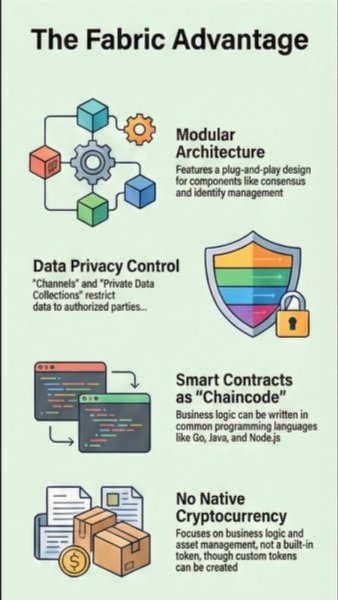
Hyperledger Fabric’s modular architecture gives enterprises the flexibility to configure blockchain components around their business and technical requirements. Instead of forcing every network to use the same setup, Fabric lets teams customize services such as consensus, ordering, identity management, and cryptography. This is especially useful for organizations that must integrate blockchain with existing enterprise systems, security policies, or identity providers. A retailer, for example, may optimize for high-volume supply chain events, while a financial institution may prioritize stricter privacy and compliance controls. This adaptable design helps companies build scalable blockchain applications without sacrificing security or long-term maintainability.
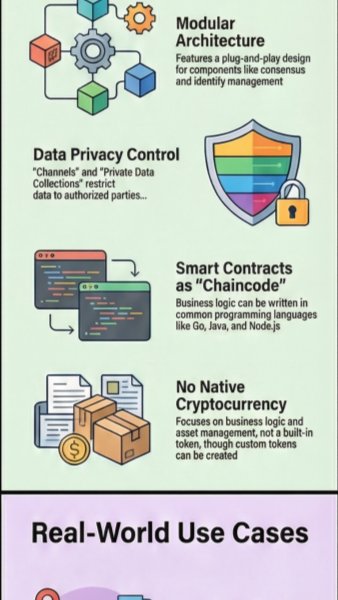
Privacy is one of Hyperledger Fabric’s strongest advantages for enterprise blockchain networks. Channels and private data collections allow selected participants to share confidential records, while other network members can still verify integrity through cryptographic hashes. Fabric smart contracts, known as chaincode, can be written in familiar programming languages such as Go, Java, and Node.js, making development more accessible for enterprise teams. Unlike many public blockchains, Fabric does not require a native cryptocurrency, which reduces complexity for businesses that simply need shared records, digital assets, or workflow automation. Organizations can also create custom tokens or asset models for use cases such as loyalty points, invoices, credentials, or regulated financial instruments.
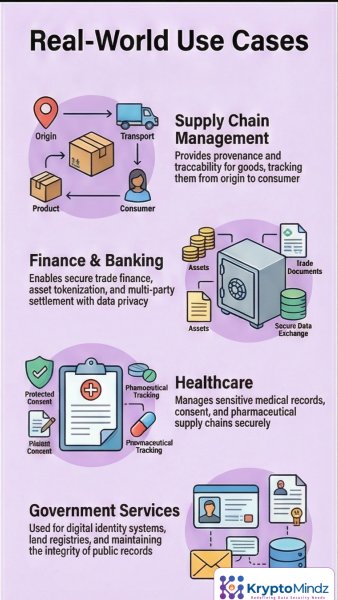
Hyperledger Fabric is widely used in supply chain management because it can create a shared, tamper-resistant record of goods as they move from origin to end customer. Companies can track product provenance, verify certifications, detect counterfeits, and respond faster during recalls or quality issues. In finance, Fabric supports secure multi-party workflows such as trade finance, asset tokenization, and settlement between banks, insurers, and corporate partners. Sensitive financial details can remain visible only to authorized parties, while the broader network still benefits from trusted transaction verification. This makes Fabric valuable for digitizing letters of credit, collateral records, payment obligations, and other processes that traditionally depend on slow manual reconciliation.
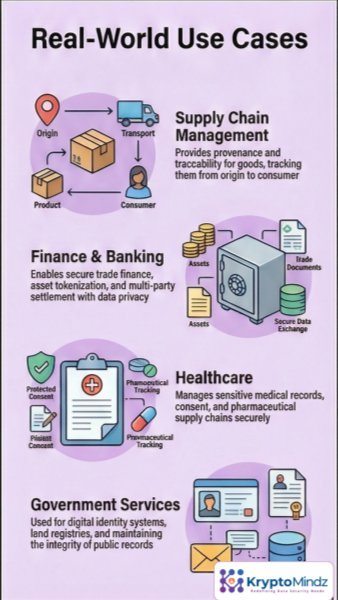
In healthcare, Hyperledger Fabric can help organizations share medical records, consent permissions, and pharmaceutical tracking data without exposing private patient information to unauthorized parties. Hospitals, labs, insurers, and regulators can coordinate around verified records while maintaining strict access controls. For pharmaceutical supply chains, Fabric can support drug traceability and help reduce the risk of counterfeit medicines entering circulation. Governments can use the same enterprise blockchain principles for digital identity, land registries, licensing, benefits distribution, and public record management. By creating immutable audit trails, Fabric helps improve transparency, reduce fraud, and make public services more efficient for citizens and agencies.
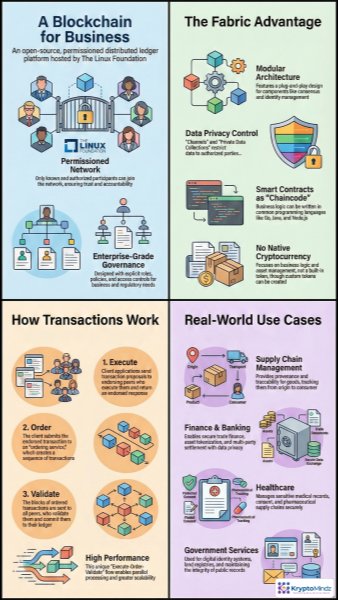
Hyperledger Fabric brings together permissioned membership, modular architecture, privacy controls, and flexible smart contracts to meet real enterprise blockchain requirements. Its design allows multiple organizations to collaborate on shared processes while keeping confidential information protected and access tightly controlled. Businesses can use Fabric to improve traceability, automate multi-party transactions, reduce reconciliation, and strengthen auditability across complex networks. From supply chains and financial services to healthcare systems and government registries, Fabric provides a practical foundation for secure digital transformation. For organizations evaluating blockchain for business, the key value lies in building trust between parties that need to work together but cannot rely on a single central authority.
Follow the hub for smart contract, DeFi, blockchain infrastructure and Web3 security resources.
Related Service Blockchain Trust & Web3 SecuritySecure smart contracts, token workflows, integrations and decentralized infrastructure before launch.
Implementation Use Case Secure AI DeFi Risk AgentExplore how monitored agents can support DeFi risk review, anomaly triage and governance operations.
Recommended Course Verifiable Trust After AI & QuantumLearn how blockchain, credentials and cryptographic trust models support resilient digital systems.
YouTube Playlist AI Agents + Blockchain CourseWatch the course on secure Web3 agents, wallets, DeFi workflows and smart contract integrations.
Book a Discovery Call Map This to Your RoadmapDiscuss how this topic applies to your product, compliance posture, architecture or delivery plan.
Editorial trust
Each KryptoMindz article is reviewed against current enterprise AI, blockchain, digital identity and compliance practices before publication or major updates.
Founder-led perspective from KryptoMindz Technologies, focused on secure AI adoption, Web3 risk, digital identity and enterprise trust architecture.
LinkedIn profileResearch, engineering and advisory work across AI Agents, Enterprise Blockchain, Digital Identity and Digital Trust Engineering.
YouTube channelDiscover more insights and resources on our platform.
Visit Kryptomindz