eIDAS 2.0 & Blockchain: From Code to Legal Trust
Discover how eIDAS 2.0 turns blockchains into legally trusted electronic ledgers, powering EBSI, EUDI wallets, and verifiable digital identities across the EU.
Discover how eIDAS 2.0 turns blockchains into legally trusted electronic ledgers, powering EBSI, EUDI wallets, and verifiable digital identities across the EU.
For years, blockchain records have been powerful technical proof, but not always easy to use as legal evidence. eIDAS 2.0 changes that by giving certain blockchain-based records a clearer legal status across the European Union. Imagine proving when a contract was issued, when a certificate was created, or when a supply chain event happened without relying on a private database. This shift helps businesses, public institutions, and citizens move from “the technology says so” to “the law recognizes it.” In practice, eIDAS 2.0 makes blockchain legal evidence more usable, more trusted, and easier to defend in cross-border situations.
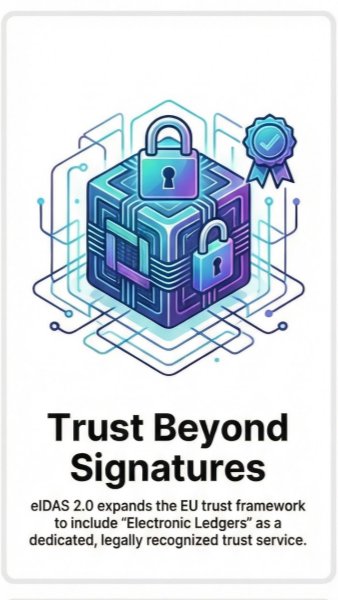
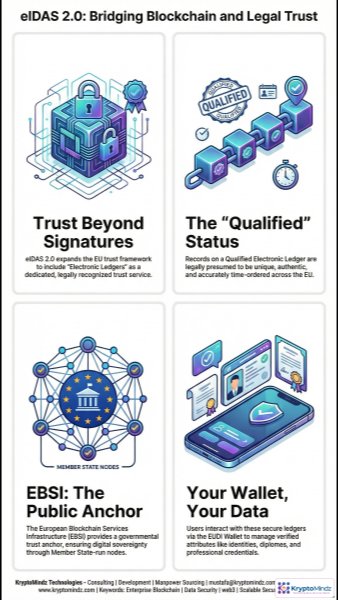
eIDAS 2.0 expands the idea of digital trust beyond electronic signatures by recognizing Electronic Ledgers as official trust services. This means a secure ledger can do more than store technical timestamps; it can support legally relevant proof of data integrity, origin, and sequence. For example, a university could register diploma issuance on an Electronic Ledger, while a logistics company could record customs or delivery milestones. Instead of asking every party to trust a single platform, the ledger provides a shared layer of verification. This creates a stronger foundation for digital compliance, auditability, and trust service innovation across Europe.
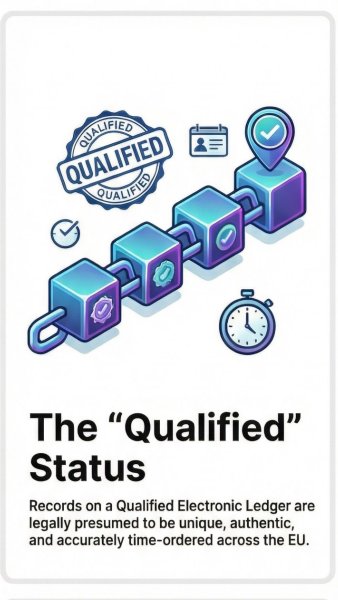
A Qualified Electronic Ledger goes a step further by offering legal presumptions that can matter during a dispute. When a record is entered into a qualified ledger, it benefits from assumptions around uniqueness, authenticity, and correct chronological order. That can be valuable when proving who registered a document first, whether a credential was valid at a given time, or how a chain of events unfolded. For businesses, this can reduce evidentiary uncertainty and make audit trails easier to rely on. In practical terms, a Qualified Electronic Ledger helps turn trusted blockchain records into stronger, dispute-ready digital evidence.
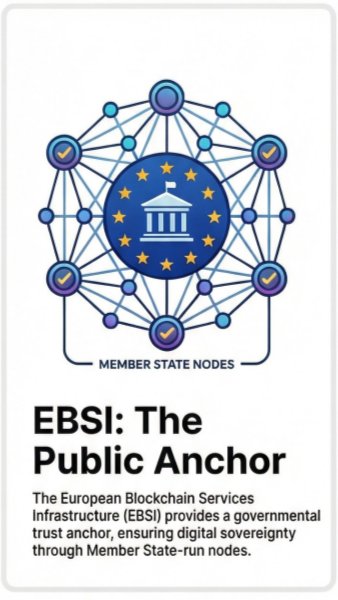
The European Blockchain Services Infrastructure, or EBSI, is designed as a public blockchain backbone for trusted digital services in Europe. Instead of depending on one private provider, EBSI is supported by nodes operated with public-sector participation across Member States. This makes it especially relevant for credentials, notarization, public records, and cross-border verification. A citizen could use an EBSI-backed proof to validate a diploma in another country, while an authority could verify a document without manually contacting the issuer. By combining blockchain verification with public governance, EBSI supports a more interoperable and trustworthy digital Europe.
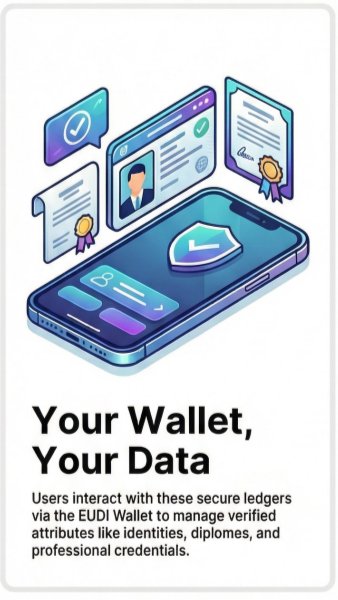
The EUDI Wallet brings the user into the center of Europe’s digital identity model. Instead of repeatedly uploading scans or sharing more personal data than necessary, people can present verified credentials directly from their wallet. These credentials might include national IDs, diplomas, driving licenses, professional permits, or business authorizations. The ledger-backed foundation helps verifiers confirm authenticity without taking control away from the user. For citizens and organizations, the EUDI Wallet supports faster onboarding, safer identity checks, and more privacy-friendly digital interactions.
Follow the hub for EUDI wallets, verifiable credentials, digital signatures and trust architecture.
Related Service Digital Identity & eIDAS StrategyDesign trusted identity, wallet and credential systems with compliance and interoperability in mind.
Implementation Use Case Government Citizen ServicesExplore how trusted digital services can streamline identity-driven workflows and citizen support.
Recommended Course The Future of Digital IdentityLearn how wallets, verifiable credentials and digital trust frameworks change onboarding and compliance.
YouTube Playlist eIDAS 2.0 EUDI Wallet KYC BootcampWatch the learning path for EUDI wallet onboarding, KYC architecture and trusted digital identity.
Book a Discovery Call Map This to Your RoadmapDiscuss how this topic applies to your product, compliance posture, architecture or delivery plan.
Editorial trust
Each KryptoMindz article is reviewed against current enterprise AI, blockchain, digital identity and compliance practices before publication or major updates.
Founder-led perspective from KryptoMindz Technologies, focused on secure AI adoption, Web3 risk, digital identity and enterprise trust architecture.
LinkedIn profileResearch, engineering and advisory work across AI Agents, Enterprise Blockchain, Digital Identity and Digital Trust Engineering.
YouTube channelDiscover more insights and resources on our platform.
Visit Kryptomindz